HackRF PortaPack Firmware Spoofs All The Things

The HackRF is an exceptionally capable software defined radio (SDR) transceiver, but naturally you need to connect it to a computer to actually do anything with it. So the PortaPack was developed to turn it into a stand-alone device with the addition of a touchscreen LCD, a few buttons, and a headphone jack. With all the hardware in place, it’s just a matter of installing a firmware capable enough to do some proper RF hacking on the go.

Enter MAYHEM, an evolved fork of the original PortaPack firmware that the developers claim is the most up-to-date and feature packed version available. Without ever plugging into a computer, this firmware allows you to receive, decode, and re-transmit a dizzying number of wireless protocols. From firing off the seating pagers at a local restaurant to creating a fleet of phantom aircraft with spoofed ADS-B transponders, MAYHEM certainly seems like it lives up to the name.

[A. Petazzoni] recently put together a detailed blog post about installing and using MAYHEM on the HackRF/PortaPack, complete with a number of real-world examples that show off just a handful of possible applications for the project. Jamming cell phones, sending fake pager messages, and cloning RF remotes is just scratching the surface of what’s possible.

It’s not hard to see why some have already expressed concern about the project, but in reality, none of these capabilities are actually new. This firmware simply brings them all together in one easy-to-use package, and while there might be an argument to be made about proliferation, we all know that the responsibility to behave ethically rests on the user and not the tools.

Real Spectrum Analysis Goes Virtual

One of the hard things about electronics is that you can’t really see the working parts without some sort of tool. If you work on car engines, fashion swords, or sculpt clay, you can see with your unaided eye what’s going on. Electronic components are just abstract pieces and the real action requires a meter or oscilloscope to understand. Maybe that’s what [José] was thinking of when he built a-radio. This “humble experiment” pipes a scan from a software-defined radio into VR goggles, which can be as simple as a smartphone and some cardboard glasses.

The resulting image shows you what the radio spectrum looks like. Granted, so will a spectrum analyzer, but perhaps the immersion will provide a different kind of insight into radio frequency analysis.

Continue reading “Real Spectrum Analysis Goes Virtual”

Coaxial Connectors, Starting With The PL259

For the casual breadboard experimenter with a microcontroller and a few peripherals, there’s little concern over interconnects as a set of jumper wires will suffice. But as any radio amateur will tell you though, at higher frequencies it’s a very different affair. [Ria Jairam N2RJ] has embarked upon a series of videos exploring co-axial cable and its various connectors, and her first offering features the humble UHF connector, sometimes known as the PL259. Though it’s one of the older choices and its design flaws mean that “UHF” is more of an aspiration for it than a reality, it remains a common connector at the lower end of the amateur radio frequency range.

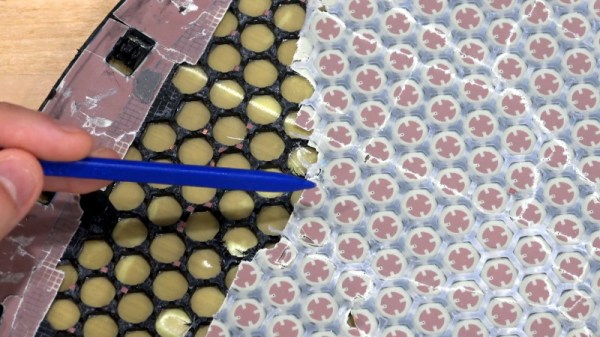
She starts with a brief history of co-axial cable, before introducing the UHF connector. We’re the introduced to its major flaw, in that it doesn’t present a constant impedance. The resulting mismatch presents a significant problem to a transmitter, especially at higher frequencies. We’re then taken through the various different models of UHF connector, including those with honeycomb dielectric to minimize the mismatch, and the fancy expensive plugs with strain relief. Finally she takes us through the proper fitting of a PL259 plug, something that there’s a bit more to than most of us might think. Altogether it’s an interesting and informative watch from an engaging and knowledgeable host, and we look forward to more.

Meanwhile, the field of RF connectors is something we’ve dipped a to into from time to time ourselves.

Continue reading “Coaxial Connectors, Starting With The PL259”

Portable Ham Antenna Uses SMD Capacitors

[K6ARK] likes to operate portable, so he puts together very lightweight antennas. One of his latest uses tiny toroids and SMD capacitors to form trap elements. You can see  the construction of it in the video below.

You usually think of toroid winding as something you do when building transmitters or receivers, especially small ones like these. We presume the antenna is best for QRP (low power) operation since the tiny core would saturate pretty quickly at higher power. Exactly how much power you should pass through an FT50-43 core depends on the exact application, but we’ve seen numbers around 5 watts.

Continue reading “Portable Ham Antenna Uses SMD Capacitors”

Aircraft Radio Bares All

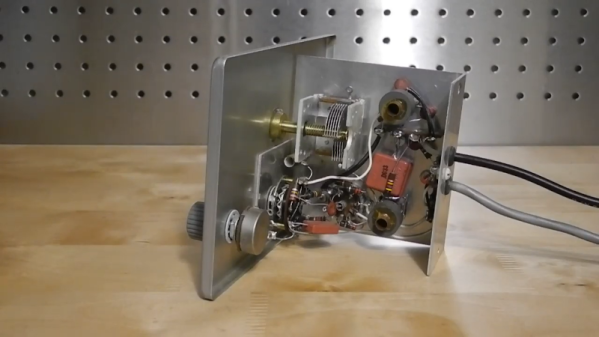
There is a certain charm to older electronics gear. Heavy metal chassis and obviously hand-wired harness can be a work of art even if they would be economically impractical for most modern gear. Watching [msylvain59’s] tear down of a Collins 51R VOR receiver is a good example of that. The construction looks so solid.

If you aren’t familiar with VOR, it stands for VHF omnidirectional range and allows airplanes to tune into a fixed ground-based beacon and determine its heading in relation to the beacon. In some cases, it can also calculate distance.

Continue reading “Aircraft Radio Bares All”

Product Review: The TinySA, A Shirt-Pocket Sized Spectrum Analyzer

I suppose most of us have had the experience of going to the mailbox and seeing that telltale package in the white plastic bag, the sign that something has just arrived from China. This happened to me the other day, and like many of you it was one of those times when I puzzled to myself: “I wonder what I bought this time?”

With so many weeks or months between the time of your impulsive click on the “Buy Now” button on AliExpress or eBay and the slow boat from China actually getting the package to your door, it’s easy enough to forget what exactly each package contains. And with the price of goods so low, the tendency to click and forget is all the easier. That’s not necessarily a good thing, but I like surprises as much as the next person, so I was happy to learn that I was now the owner of a tinySA spectrum analyzer. Time for a look at what this little thing can do.

Continue reading “Product Review: The TinySA, A Shirt-Pocket Sized Spectrum Analyzer”

Ethernet Goes To The Ether

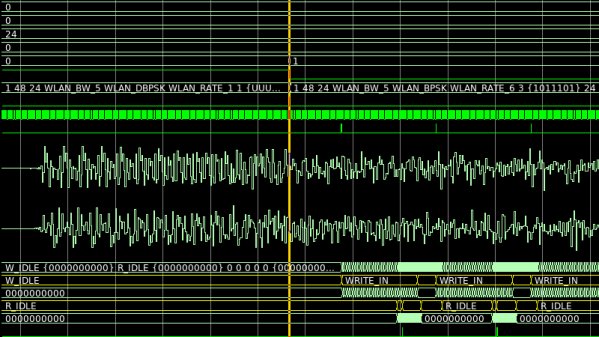
Since the ether is an old term for the fictitious space where radio waves propagate, we always thought it was strange that the term ethernet refers to wired communication. Sure, there are wireless devices, but that’s not really ethernet. [Jacek] had the same thought, but decided to do something about it.

What he did is use two different techniques to alter the electromagnetic emission from an ethernet adapter on a Raspberry Pi. The different conditions send Morse code that you can receive at 125 MHz with a suitable receiver.

Practical? Hardly, unless you are looking to exfiltrate data from an air-gapped machine, perhaps. But it does have a certain cool factor. The first method switches the adapter between 10 Mbps and 100 Mbps. The second technique uses a stream of data to accomplish the modulation. The switching method had a range of around 100 meters while the data-based method topped out at about 30 meters. The code is on GitHub if you want to replicate the experiment.

There is plenty of precedent for this sort of thing. In 1976 Dr. Dobb’s Journal published an article about playing music on an Altair 8800 by running code while an AM radio was nearby. We’ve seen VGA adapters forced to transmit data, too.

Continue reading “Ethernet Goes To The Ether”