Controlling A Terminal With Google Voice

sms

For how awesome Google Voice is, we’re surprised we haven’t seen this before. [Steve] is using Google Voice to run commands on just about any Linux box.

Google Voice doesn’t have an official API, and existing unofficial APIs weren’t up to snuff for [Steve]’s project. He ended up writing his own that checks his unread message inbox every minute and looks for new text messages beginning with the phrase, ‘Cmd’. If a series of checks pass – the text coming from a known phone number and a proper terminal command – the command runs and sends the a text back indicating success or failure.

While [Steve] probably won’t be playing nethack or Zork via SMS anytime soon, we can see this being very useful for a Raspi home automation task. Just send a text message and a properly configured Linux box can open your garage door, turn on the lights, or even start a webcam.

Homebrew GPS Gets ±1 Meter Resolution With A Raspberry Pi

GPS

We’ve been following the work of [Andrew Holme] and his homebrew GPS receiver for a while now. A few years ago, [Andrew] built a four-channel GPS receiver from scratch, but apparently that wasn’t enough for him. He expanded his build last year to track up to eight satellites, and this month added a Raspberry Pi for a 12-channel, battery-powered homebrew GPS receiver that has an accuracy of about 3 feet.

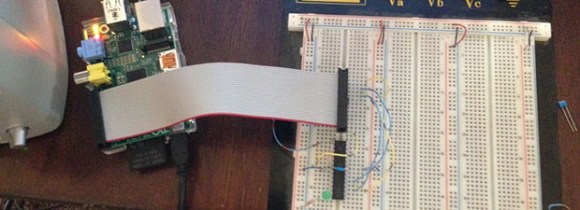
The Raspi is attached to an FPGA board that handles the local oscillator, real-time events, and tracks satellites automatically. The Pi handles the difficult but not time-critical math through an SPI interface. Because the Pi is attached to the FPGA through an SPI interface, it can also load up the FPGA with even more custom code, potentially turning this 12-channel receiver into a 16- or 18-channel one.

An LCD display attached to the FPGA board shows the current latitude, longitude, and other miscellaneous data like the number of satellites received. With a large Li-ion battery, the entire system can be powered for about 5 hours; an impressively portable GPS system that rivals the best commercial options out there.

Old LED Marquee Turned Embedded Video Player

driving-led-marquee-with-rpi

[Sprite_TM] is was sent an old LED Marquee by an anonymous fan of his hacking projects. The display isn’t full color, but it’s large — 224 by 48 pixels — and he figured he could render some okay images with the bi-color diodes. In the end, he replaced the controller and turned it into a video player.

The original system work well enough, but the 100 MHz 486 industrial style PC that drove the display seems a little comical these days. After giving it a spin and testing out how it drives the display [Sprite] hooked up an FTDI chip and managed to get it playing video from his computer. Above you can see part of the opening sequence of The Simpsons.

Now that he had learned its secrets he set out to give it an embedded controller. His first attempt was with a Carambola board which he’s worked with before. That proved to be a little slow for all the pixel data he was pushing so he upgraded to a Raspberry Pi and never looked back. You can see the demo video after the jump.

Continue reading “Old LED Marquee Turned Embedded Video Player”

Hackerspace Security System Brings RFID, Video Feedback, And Automatic Doors

rfid-hackerspace-door-lock

[Will] has been hard at work on a replacement system for his Hackerspace’s RFID door lock. The original is now several years old and he’s decided to upgrade to a much more powerful processor, adding some bells and whistles along the way.

The control box seen above is the exterior component of the system. It’s a telephone service box like you’d find on the back of most houses in the US. They had a few of these lying around and they are a perfect choice because… well… they’re meant to be locking enclosures that brave the elements. [Will] made the jump from an Arduino which has run the locks for the last three years to a Raspberry Pi board. This gives him a lot of extra power to work with and he took advantage of that by adding a vehicle backup LCD screen for visual feedback. You can see it giving the ‘Access Granted’ message he used during testing but the demo video after the break shows that they plan to do some image scripting to display a head shot of the RFID tag owner whenever a tag is read.

There are several other features included as well. The system Tweets whenever a tag is read, helping the members keep tabs on who is hanging out at the space right now. It also patches into a sliding door which one of the members automated using a garage door opener motor.

Continue reading “Hackerspace Security System Brings RFID, Video Feedback, And Automatic Doors”

SqueezeBerry: A Raspberri Pi Powered Squeezebox Appliance

squeezeberry

We like the look which [Emmanuel] achieved with his Raspberry Pi based Squeezebox client. It’s got that minimalist slant that makes it seem like a commercial product at first glance. But one more look at the speakers without grates, the character LCD, and the utilitarian buttons, knobs, and switches tips us off that it’s filled with the hardware we know and love.

Since Logitech announced that it was terminating the Squeezebox line we’ve seen several projects which take up the torch. We’ve seen the RPi used as a Squeezebox server and several embedded Linux systems used as clients. This follows in the footsteps of the latter. The RPi is running Raspbian with the squeezelite package handling the bits necessary to talk to his server. The controls on the front include a power switch, rotary encoder and button for navigating the menus, and a potentiometer to adjust the HD44780 LCD screen’s contrast. The speakers are a set of amplified PC speakers that were liberated from their cases and mounted inside of the wooden box that makes up the enclosure. The in-progress shots of that case look pretty rough, but some sanding and painting really pulled everything together. As you would expect, we’ve embedded the demo video after the jump.

Continue reading “SqueezeBerry: A Raspberri Pi Powered Squeezebox Appliance”

Network-controlled Fireworks Launcher

rpi-fireworks-launcher

[Thomas] and his friends wanted to ring in the new year by setting off some fireworks. To keep a safe distance and have a little fun they built this network controller launcher (translated).

the image on the left shows the build in its unused and pristine state. But by the end of the celebration it look a bit melted and burnt. Still, for the first revision of the system it ended up working pretty well.

We’ve seen several remote fireworks launchers that burn up resistors to light the fuses. But this system is much more reusable. The image on the right shows the heating elements which light the fuses. Younger readers might have no idea what they’re looking at, but every automobile used to come with at least one of these electric cigarette lighters. Just drive 12V through them and they get burning hot relatively quickly. That’s where the car battery on the base comes into play. It is connected to the lighters using some mechanical relays.

In the food container attached to the side of the launcher you’ll find a Raspberry Pi which provides the web connection for the system. [Thomas] wrote code which uses a webpage with some bomb icons as buttons. Check out the video after the break to see him demonstrate how fast one of these lighters will glow red after pressing a button on his smart phone.

Continue reading “Network-controlled Fireworks Launcher”

Building A Vehicle Parking Camera

rpi-backup-camera

We’re never really sure what to call these things. When we say “back up camera” it sounds distinctly like a redundancy system for when the primary camera fails to work. But it is used for when you move in reverse in an automobile. [Jeremy Blythe] built the distance sensing video system using a Raspberry Pi board as the brain.

The flexibility of Linux and the power of the RPi board ended up making it pretty easy to get everything working together. He’s using a Microsoft Lifecam Cinema HD camera, which connects to one of the USB ports on the board. Just above that you can see the infrared distance sensor which is connected to the RPi’s GPIO header using one of Adafruit’s Pi Cobbler breakout boards. This also facilitates the connection to the 176×220 color LCD screen.

In the video after the break you can see [Jeremy] testing out the system by moving his hand in front of the sensor. Python is used to grab the image from the camera, draw a circle on it, and overlay the distance in centimeters at the bottom. Once his hand is within 30cm the overlay turns red and the work STOP is displayed. Pretty neat!

Continue reading “Building A Vehicle Parking Camera”