Wireless Upgrade For A Heathkit HERO 1 Robot

F3DDY

For those of you that don’t know, the Heathkit HERO (Heathkit Educational Robot) was a ‘bot built in the early 1980s. [Rick] wasn’t satisfied with his model ETW-18’s programming interface, so decided to upgrade it to be able to run Python using a hacked wireless router. We’d agree that things have advanced since then, since this little guy was originally programmed in machine code using an onboard keypad.  As [Rick] points out, it’s “exactly as awful” as it sounds!

To begin restoring and upgrading his robot, a kit was obtained from [hero-1] to allow for a serial programming interface. Although an improvement, the desire was to be able to program this robot using Python, and to not have to have a cable running across the floor all the time. A router with a serial port was obtained from a thrift store, then hacked using [OpenWrt]. After fitting the components into the robot, [FR3DDY] was born, “A ~30 year old robot, accessible through wifi, capable of running Python.”

Be sure to check out his site, which has some videos we weren’t able to embed. He’s also included some Python code that he used to program it. If this has made you curious about the Python language, why not check out this recent post about learning it the hard way?

Cheetah Robot Can Run Down Even The Fastest Of Us

It’s a blur, but you really don’t want to seen this thing coming for you anyway. It’s the latest look at what the folks at Boston Dynamics have been working on under a DARPA contract. They call it the Cheetah robot as it’s the fastest four-legged bot ever developed. The clip after the break shows it breaking the world record over 100 meters… for a human. This isn’t really legitimate since the run is done on a treadmill and the robot is tethered. But it’s still impressive scary.

The Cheetah is a relative of BigDog, another Boston Dynamics robot which we’ve seen several times in the past. BigDog specializes in lifting heavy loads and traversing rough terrain. We don’t think it will be too long before both traits can be “bred” into one device. A lot of times when we feature these robots there are comments about how they invoke images from The Terminator movies. For us this is more along [Michael Bay’s] vision of robots from the Transformers series. It certainly not small enough or fast enough to be seen as an early version of the Rat Thing.

Continue reading “Cheetah Robot Can Run Down Even The Fastest Of Us”

Can A Robot Be A Safe And Cost-effective Alternative To Guide Dogs?

[Tom Ladyman] is making the case that a robot can take the place of a guide dog. According to his presentation, guide dogs cost about £45,000 (around $70k) to train and their working life is only about six years. On the other hand, he believes that this robot can be put into service for about £1,000 (around $1500). The target group for the robots is blind and visually impaired people. This makes since, because the robot lacks a dog’s ability to assist in other ways (locating and returning items to their companion, etc.). The main need here is independent travel.

He starts with the base of an electric wheelchair — a time-tested and economy-of-scale platform. The robot navigates based on images from four downward facing cameras mounted on the pole seen above. The X on the top of the pole allows for a much wider range of sight. The robot identifies its companion via a tag on their shoe, but it’s got another trick up its sleeve. The cameras feed to a set of four BeagleBoards which work together to process them into a 3D map at about 12 FPS, allowing for obstacle avoidance.

Check out the video after the break for a bit more information. The 3D guidance system is also explained in detail at the link above.

Continue reading “Can A Robot Be A Safe And Cost-effective Alternative To Guide Dogs?”

Tank Router Defends Your Pets?

The guys over at Section9 Hackerspace in Springfield, Missouri just finished building this treaded robot. Despite the juxtaposition of the cat, it really doesn’t defend anything. The project is a reconnaissance robot controlled over the network with video feedback.

The team started off with some lofty goals. They wanted to the robot to be able to climb stairs and to feature a detachable flying portion in order to get a better look at hard to reach places. Cost and complexity are cited as the reasons they ditched the idea of the flyer. The rest of the features came out much as planned. The motor controller for the treads is connected to an Arduino. This uses an Ethernet shield to connect to the WRT54G router which is also coming along for the ride. This seems a bit over-powered but it makes it easy to connect the webcam on the front (also via Ethernet).

On the software side they wrote an Android app. It controls the movement of the robot, as well as that of the camera. Of course you need to see where you’re going so they went the extra mile to include video from the webcam. Check out their show-and-tell video after the break.

Continue reading “Tank Router Defends Your Pets?”

Steam-powered Hexapod

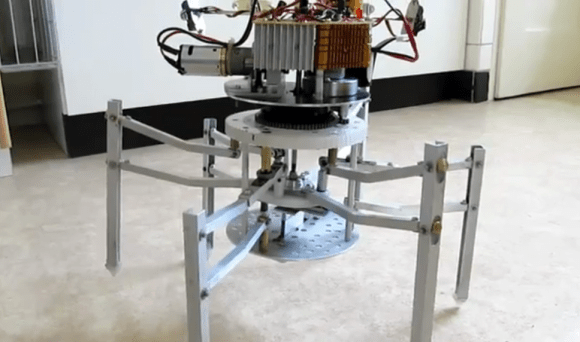
This all-mechanical hexapod (translated) was meticulously planned and beautifully constructed. It’s not craning its neck to see what’s ahead. That’s a smoke stack for the steam engine which propels the machine.

Mechanically the legs were the hardest part. That’s only because the steam engine was not built from scratch. It’s a Wilesco D14 which is powered by solid fuel tablets. It puts out high RPM but low power so the gear ratio was set at 286:1 to make the most of its output.

The legs themselves are made of brass rods. These are anchored on one side of a larger gear, with a pivot point that allows the leg to slide vertically. The result is best seen in the clip after the break. As the drive wheel rotates, the pivot point moves the body forward until the foot is lifted by the sliding motion of the rod. It ends up looking more elegant than some of the more dexterous hexapods, but it lacks the ability to turn.

Continue reading “Steam-powered Hexapod”

RC Plane Made Specifically For UAVs

We’ve seen our fair share of remote-controlled planes turned into UAVs and FPV platforms, but the Techpod is the first airplane we’ve seen specifically designed to be used as a camera-equipped robotic airplane.

The Techpod is the brainchild of [Wayne Garris]. He has been flying camera-equipped FPV airplanes for a while now, but recently realized the current offerings of remote control planes didn’t match his needs. [Wayne] decided to design his own plane specifically designed with a pan/tilt camera mount in the nose.

[Wayne]’s prototype was designed with some very fancy aeronautical design software packages and milled out of foam. From the videos after the break, we can see the Techpod flies beautifully, but needs the Kickstarter community to bring his model to the masses.

The specs for the Techpod put it up there with other high-performances FPV and UAV models; with its 102 inch (2590 mm) wingspan and a pair of batteries wired in parallel, the Techpod can stay aloft transmitting video for up to one hour.

Video of the plane in action after the break.

Continue reading “RC Plane Made Specifically For UAVs”

Can A Kickstarter Project Actually Build A Space Elevator?

It’s the stuff that Science Fiction is made of: an elevator that climbs its way into space rather than needing a rocket to get there. Can it be done? No. But this Kickstarter project aims to fund research that will eventually make a space elevator possible. They’re already way over their goal, and plan to use the extra funds to extend the reach of the experiments.

A complete success would be a tether that reaches into space, held taught by a weight which is pulled away from earth by centrifugal force. That’s not really on the radar yet (last we heard humans weren’t capable of producing a substance strong enough to keep the tether from snapping). What is in the works is a weather balloon supporting a ribbon which a robot can climb. The team isn’t new to this, having built and tested several models at University and then in a start-up company that closed its doors a few years ago. Now they’re hoping to get a 3-5 kilometer ribbon in the air and to build a new robot to climb it.

For now we’ll have to be satisfied with the 1000 ft. climb video after the break. But we hope to see an Earth-Moon freight system like the one shown in the diagram above before the end of our lifetimes.

Continue reading “Can A Kickstarter Project Actually Build A Space Elevator?”