An Awesome, Futuristic, All-in-one Robot Chassis

bot

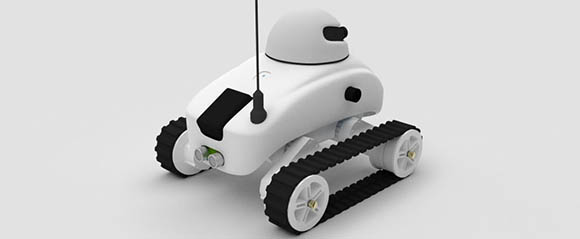
No matter how many advances in electronics we find, we’re constantly surprised at the lack of progress in robot chassis. Sure, it should be a simple task to make a capable robot that looks cool, but aside from the Veter project team, no one else seems to be advancing the state of robot mechanics.

We’ve seen robotic chassis and hardware from the Veter team before, and this new version brings a whole lot more to the table. While the camera. GPS, compass, and ultrasonic sensors are the same from the previous build, there’s a whole lot more software inspired by [Sebastian Thrun]’s autonomous car class to make this build a little more capable.

While the Veter team is using a Beagleboard for their on-board computer, it should be possible to change the hardware over to a more economical Raspberry Pi. Even then, it won’t be a cheap build, but we doubt you’ll find a better robotics platform for less.

Roomba Becomes Data Center Robot

robot

Running a data center takes a lot of work, and even making sure the ambient temperature for hundreds of boxes is in the proper range is an arduous task. When faced with the prospect of installing hundreds of temperature sensors in an EMC data center, [Vivek] had a better idea: put just a few sensors on a robot and drive around the racks. With the right software, it’s a breeze to automate the process and build a near real-time temperature monitoring solution for a huge data center.

The data center robot is based on a iRobot Create, basically a Roomba without a vacuum. Attached to the robot is a netbook, Arduino, and a PVC mast housing three temperature sensors and a USB webcam.

Using the floor of the data center for navigation, the robot canvasses the racks sending temperature data back to a server via WiFi. From there, the temperatures can be graphed to make sure the racks aren’t too hot or too cold.

You can check out a video of the robot in action after the break.

Continue reading “Roomba Becomes Data Center Robot”

3d Printed Hexapod Robot

3d-printed-hexapod

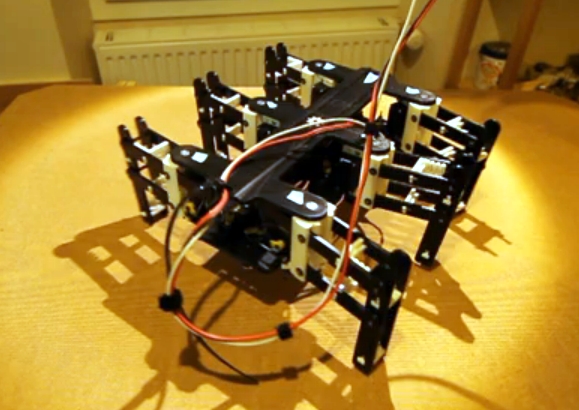
This hexapod was made almost entirely via 3d printing (translated). The parts that you need to supply include a few fasteners to make connections, twelve servo motors, and a method of driving them. As you can see in the video after the break, all those parts come together into a little robot that functions quite well. The only thing that we think is missing are some grippy feet to help prevent slipping.

[Hugo] calls the project Bleuette. It is completely open source, with the cad files and source code available on his Github repository. There is additional information in the wiki page of that repo. This gives us a good look at the electronic design. He’s controlling the legs with an Arduino, but it’s all dependent on his own shield which features a PIC 18F452 to take care of the signals used to drive all of the servo motors. The board also has some peripherals to monitor the current draw and regulate the incoming power.

Continue reading “3d Printed Hexapod Robot”

Automated Doors For Theatre Effect

Door Actuator

For a theatre production, [Jason] needed a way to automatically open and close doors as a special effect. His solution, hosted on Github, lets him remotely control the doors, and put them into a ‘freak out’ mode for one scene in the play.

Two Victor 884 motor controllers are attached to an Arduino that controls the system. A custom controller lets [Jason] actuate the doors remotely, and LEDs are used to display the state of the system.

On the mechanical side, two wind shield wiper motors are used. These are connected to custom arms that were printed using a Lulzbot AO-100. The arms allow for the door to be automatically actuated, but also allow for actors to open the door manually.

The result is a neat special effect, and the 3D models that are included in the repository could be useful for other people looking to build automated doors. In the video after the break, [Jason] walks us through the system’s design and demonstrates it in action.

Continue reading “Automated Doors For Theatre Effect”

Robot Has Rhythm; Carries Drum Sticks

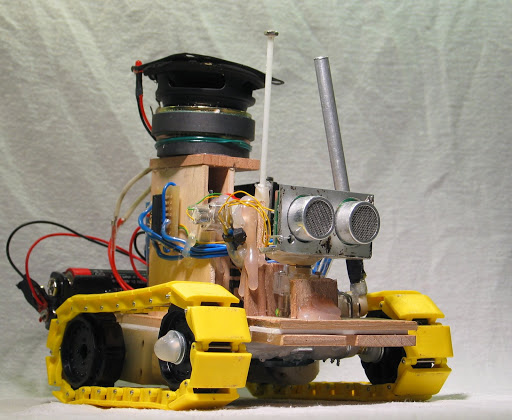
This little robot needs to go on the road with the Blue Man Group. The treaded rover carries its own drum sticks and uses random objects as its drum set.

We admit that this is not a fresh hack. It harkens from 2008 but this is the first time we can remember seeing the little guy. After viewing the video embedded after the jump we think you’ll agree the project deserves to be seen by as many aspiring hardware hackers as possible.

Perched atop the pile is a speaker, with a second hidden between the yellow treads. The lower unit lets the PICAX 28 microcontroller produce beeps and pops, while the upper unit provides a background track for the drumming. The two rods extending above the ultrasonic rangefinder are connected to a couple of motors and drum along with a third stick that looks like a tail. Even the servo that sweeps the rangefinder from side to side keeps the beat. The synchronized magic is all in the code, which you can get your hands on in step 11 of this longer build tutorial.

Continue reading “Robot Has Rhythm; Carries Drum Sticks”

Who Would Win In A Fight, Robot [Lemmy] Or Robot God?

[youtube=https://www.youtube.com/watch?v=3RBSkq-_St8&w=580]

So this is what happens when a fan of The Rock-afire Explosion grows up. Meet Compressorhead, a musical trio of hydraulic and pneumatic musical mastery.

Compressorhead is a lean band, consisting of only three members. Stickboy, the drummer, is a four-armed beast reminiscent of [General Grievous] that plays a 14-piece Pearl kit with a double bass. His listed influences include [Danny Carey] and the original MPC60.

Fingers is the guitarist and a wonder of mechanical linkages consisting of 78 hydraulically actuated fingers. Influences include [Yngwie Malmsteen], but with more fingers and less of an ego, we expect Fingers to be an even better guitarist than his idol.

Bringing in the low-end is Bones, the robotic tread-mounted bassist for Compressorhead. Like Fingers, he plays an unmodified instrument. He’s also the newest member of the band, completed in 2012.

If you’d like to check out Compressorhead in person, they seem to be touring Australia right now. If you’d like to schedule them, their rider lists a requirement of 65 Amp, 3 phase power, 3 liters each of hydraulic fluid and motor oil, and suspiciously no requirement for removing all the brown M&Ms from a package. Be sure to check out the videos of the band in action on their media site.

Thanks [BadWolf] for sending this one in.

Brute Forcing A GPS PIN

pin

[JJ] picked up a Garmin Nuvi 780 GPS from an auction recently. One of the more frustrating features [JJ] ran into is it’s PIN code; this GPS can’t be unlocked unless a four-digit code is entered, or it’s taken to a ‘safe location’. Not wanting to let his auction windfall go to waste, [JJ] rigged up an automated brute force cracking robot to unlock this GPS.

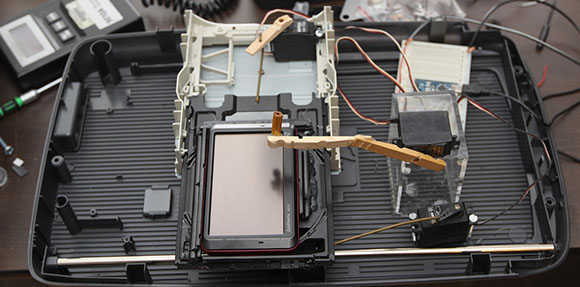
The robot is built around an old HP scanner and a DVD drive sled to move the GPS in the X and Y axes. A clever little device made out of an eraser tip and a servo taps out every code from 0000 to 9999 and waits a bit to see if the device unlocks. It takes around 8 seconds for [JJ]’s robot to enter a single code, so entering all 10,000 PINs will take about a day and a half.

Fortunately, the people who enter these codes don’t care too much about the security of their GPS devices. The code used to unlock [JJ]’s GPS was 0248. It only took a couple of hours for the robot to enter the right code; we’d call that time well spent.

You can check out the brute force robot in action after the break.

Continue reading “Brute Forcing A GPS PIN”