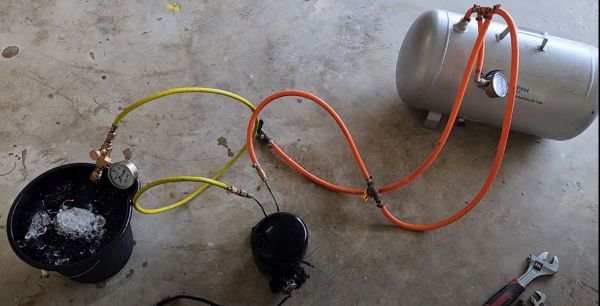
A DIY Pulse Tube Cryocooler In The Quest For Home-Made Liquid Nitrogen

What if you have a need for liquid nitrogen, but you do not wish to simply order it from a local supplier? In that case you can build your very own pulse tube cryocooler, as [Hyperspace Pirate] is in the process of doing over at YouTube. You can catch part 1 using a linear motor and part 2 using a reciprocating piston-based version also after the break. Although still very much a work-in-progress, the second version of the cryocooler managed to reduce the temperature to a chilly -75°C.

The pulse tube cryocooler is one of many types of systems used for creating a cooling effect. Commercially available refrigerators and freezers tend to use Rankine cycle coolers due to their low cost and effectiveness at (relatively) warmer temperatures. For cryogenic temperatures, Stirling engines are commonly used, although they find some use in refrigeration as well. All three share common elements, but they differ in their efficiency over a larger temperature range.

In this video series, the viewer is taken through the physics behind these coolers and the bottlenecks which prevent them from simply cooling down to zero Kelvin. Despite the deceptive simplicity of pulse tube cryocoolers — with just a single piston, a regenerator mesh, and some tubing — making them work well is an exercise in patience. We’re definitely looking forward to the future videos in this series as it develops.

Continue reading “A DIY Pulse Tube Cryocooler In The Quest For Home-Made Liquid Nitrogen”

Raspberry Pi biosensor with screen-printed electrodes

Raspberry Pi And PpLOGGER Make A Low-Cost Chemiluminescence Detector

[Laena] and her colleagues at the La Trobe Institute for Molecular Science in Melbourne, Australia used a Raspberry Pi to make a low-cost electrochemiluminescence (ECL) detector to measure inflammation markers, which could be used to detect cardiovascular disease or sepsis early enough to give doctors a better chance at saving a patient’s life.

ECL reactions emit light as a result of an electrically-activated chemical reaction, making them very useful for detecting biochemical markers in blood, saliva, or other biological samples.  ECL setups are fundamentally fairly straightforward. The device includes a voltage reference generator to initiate the chemical reaction and a photomultiplier tube (PMT) to measure the emitted light. The PMT outputs a current which is then converted to a voltage using a transimpedance amplifier (TIA). That signal is then sampled by the DAQCplate expansion board and the live output can be viewed in ppLOGGER in real-time.

Using the RPi allowed the team to do some necessary, but pretty simple signal processing, like converting the TIA voltage back to a photocurrent and integrating the current to obtain the ECL intensities. They mention the added signal processing potential of the RPi was a huge advantage of their setup over similar devices, however, simple integration can be done pretty easily on most any microcontroller. Naturally, they compared their device to a standard ECL setup and found that the results were fairly comparable between the two instruments. Their custom device showed a slightly lower limit of detection than the standard setup.

Their device costs roughly $1756 USD in non-bulk quantities with the PMT being the majority of the cost ($1500). Even at almost $2000, their device provides more than $8000 in savings compared to ECL instruments on the market. Though cost is much more than just the bill of materials, we like seeing the community making efforts to democratize science, and [Laena] and her colleagues did just that. I wonder if they can help us figure out the venus fly trap while they’re at it?

Picture of NanoStat in 3D-printed enclosure with LiPo battery and US quarter for scale.

An ESP32-Based Potentiostat

Ever wanted to make your own wireless chemical sensor? Researchers from the University of California, Irvine (UC Irvine) have got you covered with their ESP32-based potentiostat.

We’ve talked about potentiostats here on Hackaday before. Potentiostats are instruments that analyze the electrical properties of an electroactive chemical cell. Think oxidation and reduction reactions (redox) from your chemistry course, if you can remember that far back. Potentiostats can be used in several different modes/configurations, but the general idea is for these instruments to induce redox reactions within a given electroactive chemical cell and then measure the resulting current produced by the reaction. By measuring the current, researchers can determine the concentration of a known substance within a sample or even determine the identity of an unknown substance, to name a few potential applications.

These instruments have become mainstays in research labs around the world and have incredible utility in the consumer space. Glucometers, devices used to measure blood glucose levels, are an example of technologies that have made their way into everyday life due to the advances made in electrochemistry and potentiostat research over the last few decades. Given their incredible utility to scientific research and medical technologies, a great deal of effort has gone into democratizing potentiostats, making them more available to the general public for educational and hobbyist purposes. Of course, any medical applications must go through rigorous testing and approvals by each country’s appropriate governing bodies. So we’re talking more non-medical purposes here.

The first popular open-source, DIY potentiostat was the CheapStat, which we’ve covered here on Hackaday before. Since then, developing newer and more advanced open-source potentiostats has become a popular endeavor within the scientific community. The researchers from UC Irvine wanted to put their own special spin on the open-source potentiostat craze and they did so with their inclusion of the ESP32 as their main processor. This obviously opens up them up do a whole host (see what we did there) of wireless capabilities that others before them have not explored.

With the ESP32, they developed a nice web-based GUI that makes controlling and collecting data from the potentiostat very seamless and user-friendly. You can imagine the great possibilities here. Teacher-led classroom demonstrations where the instructor can easily access each student’s device over the cloud to help troubleshoot or explain results. Developing soil monitoring sensors that can be deployed all around a farm to remotely collect data on feed, soil composition, and plant health. The possibilities here sure are promising.

We hope you’ll dive into their paper as it’s well worth a read. Happy hacking, Hackaday.

You Can Make Ferrofluid On The Cheap With VHS Tapes

Ferrofluid is a wonderous substance. It’s a liquid goop that responds to magnetic fields in exciting and interesting ways. It’s actually possible to make it yourself, and it’s cheap, too! The key is to get yourself some old VHS tapes.

The only fitting end for a copy of Speed II. 

The trick is to separate the ferric oxide from the plastic tape inside the VHS cassette. Step one is naturally to smash open a cassette, and pull out the plastic tape from inside. The tape can then be dunked in acetone to dissolve the plastic, leaving behind the ferric oxide that once stored your cherished copy of Heat. A magnet is an easy way to collect the ferric oxide, which should then be left to dry. The powdery substance can then be blended in a ratio of 1 mL of ferric oxide to 0.333 mL of cooking oil. Poor mixing can be improved by adding a droplet of water mixed with dish detergent. You should end up with a brownish sludge that acts as a rudimentary ferrofluid.

It’s a neat bit of home science. As with most such activities, it bears noting the safety risks. Don’t leave your acetone uncovered to form a nasty flammable vapor, and keep yourself keenly aware of any fire or ignition risks. Overall though, it’s a fairly straightforward process. While the resulting material isn’t necessarily lab grade, you could potentially use it to build your own ferrofluid display!

The Gallium Nitride Revolution

[Asianometry] has been learning about gallium nitride semiconductors and shares what he knows in an informative video you can see below. This semiconductor material has a much higher bandgap voltage than the more common silicon. This makes it useful for applications that need higher efficiency and less heating.

The original use of the material was for LEDs, but we are seeing increasing use of the material in high-power applications like chargers. Phone chargers are especially common using this technology. This isn’t surprising when your think about how many phone chargers are needed worldwide every day.

Other places that need power-efficient devices are data centers, electric vehicles, and battery-operated equipment. It isn’t clear, though, that we can make enough of the material to meet global demand if it becomes extremely popular. This is especially true because the machinery and processes used to create silicon devices don’t work with gallium nitride. Silicon carbide is a competitor, and it could be easier to create, even though it isn’t as efficient as gallium nitride.

We’ve looked at gallium nitride before, and we are sure we are going to be seeing it again. Silicon carbide may one day operate on the surface of Venus. You can even use it to make homemade LEDs.

Continue reading “The Gallium Nitride Revolution”

The Physics Behind The Collapse Of A Huge Aquarium

At the end of last week Aquadom, the world’s largest cylindrical aquarium, unexpectedly shattered and caused an emergency as it flooded both the Berlin hotel that housed it and the surrounding streets. From an engineering perspective it’s a fascinating story, because its construction was such that this shouldn’t have happened. We have an analysis of what might have gone wrong from [Luis Batalha] (Nitter), and from it we can learn a little about the properties of the plastic used.

The aquarium was made of an acrylic polymer which has an interesting property — at a certain temperature it transitions between a glass-like state and a rubber-like one. Even at room temperature the acrylic is well below the transition temperature, but as the temperature drops the acrylic becomes exponentially more brittle. When the outside temperature dropped to well below zero the temperature also dropped in the foyer, and the high water pressure became enough to shatter the acrylic.

Sadly few of the fish from the aquarium survived, but fortunately nobody was killed in the incident. News coverage shows how the force of the water destroyed the doors and brought wreckage into the street, and we’re guessing that it will be a while before any other hotel considers such a project as an attraction. Meanwhile we’ve gained a little bit of knowledge about the properties of acrylic, which might come in handy some day.

Header: Chrissie Sternschuppe, CC BY-SA 2.0.

Laser Fusion Ignition: Putting Nuclear Fusion Breakthroughs Into Perspective

This month the media was abuzz with the announcement that the US National Ignition Facility (NIF) had accomplished a significant breakthrough in the quest to achieve commercial nuclear fusion. Specifically, the announcement was that a net fusion energy gain (Q) had been measured of about 1.5: for an input of 2.05 MJ, 3.15 MJ was produced.

What was remarkable about this event compared to last year’s 1.3 MJ production is that it demonstrates an optimized firing routine for the NIF’s lasers, and that changes to how the Hohlraum – containing the deuterium-tritium (D-T) fuel – is targeted result in more effective compression. Within this Hohlraum, X-rays are produced that serve to compress the fuel. With enough pressure, the Coulomb barrier that generally keeps nuclei from getting near each other can be overcome, and that’s fusion.

Based on the preliminary results, it would appear that a few percent of the D-T fuel did undergo fusion. So then the next question: does this really mean that we’re any closer to having commercial fusion reactors churning out plentiful of power?

Continue reading “Laser Fusion Ignition: Putting Nuclear Fusion Breakthroughs Into Perspective”