Nuclear Reactors Get Small

Steve Martin was ahead of his time when he told us “Let’s get small!” While you usually think of a nuclear reactor as a big affair, there’s a new trend towards making small microreactors to produce power where needed instead of large centralized generation facilities. The U.S. Department of Energy has a video about the topic, you can watch below.

You probably learned in science class how a basic nuclear fission reactor works. Nuclear fuel produces heat from fission while a moderator like water prevents it from melting down both by cooling the reactor and slowing down neutrons. Control rods further slow down the reaction or — if you pull them out — speed it up. Heat creates steam (either directly or indirectly) and the steam turns a conventional electric generator that is no more high tech than it ever has been.

Continue reading “Nuclear Reactors Get Small”

Something’s Up In Switzerland: Explaining The B Meson News From The Large Hadron Collider

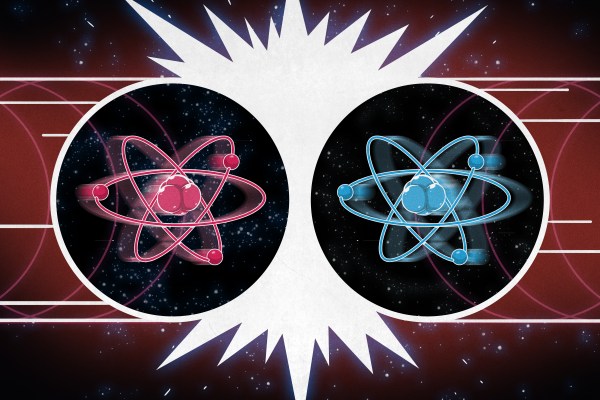
Particle physics is a field of extremes. Scales always have 10really big number associated. Some results from the Large Hadron Collider Beauty (LHCb) experiment have recently been reported that are statistically significant, and they may have profound implications for the Standard Model, but it might also just be a numbers anomaly, and we won’t get to find out for a while. Let’s dive into the basics of quantum particles, in case your elementary school education is a little rusty.

It all starts when one particle loves another particle very much and they are attracted to each other, but then things move too fast, and all of a sudden they’re going in circles in opposite directions, and then they break up catastrophically…

Continue reading “Something’s Up In Switzerland: Explaining The B Meson News From The Large Hadron Collider”

The Mysterious Wobble Of Muons

You might think that particle physicists would be sad when an experiment comes up with different results than their theory would predict, but nothing brightens up a field like unexplained phenomena.  Indeed, particle physicists have been feverishly looking for deviations from the Standard Model. This year, there have been tantalizing signs that a long unresolved discrepancy between theory and experiment will be confirmed by new experimental results.

In particular, the quest to measure the magnetic moment of muons started more than 60 years ago, and this has been measured ever more precisely since. From an experiment in 1959 at CERN in Switzerland, to the turn of the century at Brookhaven, to this year’s result at Fermilab, the magnetic moment of the muon seems to be at odds with theoretical predictions.

Although a statistical fluke is basically excluded, this value also relies on complex theoretical calculations that are not all in agreement. Instead of heralding a new era of physics, it might just be another headline too good to be true. But some physicists are mumbling “new particle” in hushed tones. Let’s see what all the fuss is about.

Continue reading “The Mysterious Wobble Of Muons”

The Laser Power Record Has Been Broken

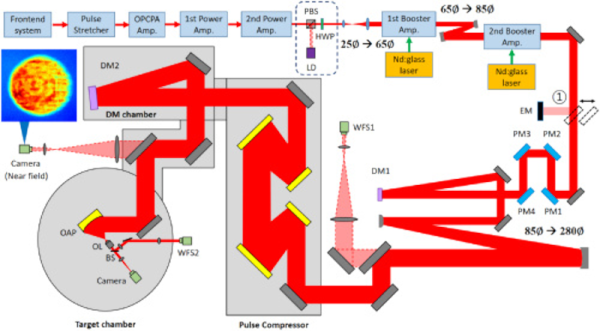
Lasers do all sorts of interesting things and — as with so many things — more is better. Korean scientists announced recently they’ve created the most powerful laser beam. 1023 watts per square centimeter, to be exact. It turns out that 1022 Watts/cm2 may not be commonplace, but has been done many times already at several facilities, including the CoReLS petawatt (PW) laser used by the researchers.

Just as improving a radio transmitter often involves antenna work instead of actual power increases, this laser setup uses an improved focus mechanism to get more energy in a 1.1 micron spot. As you might expect, doing this requires some pretty sophisticated optics.

Continue reading “The Laser Power Record Has Been Broken”

The Fine Structure Constant In A Blink

Electronics is really an applied branch of physics, so it isn’t surprising that if you are serious about your electronics, you probably know a little physics, too. If you’ve ever heard the term “fine structure constant” and weren’t entirely sure what it means, [Parth G] wants to explain it to you in about a minute. His video explanation appears below.

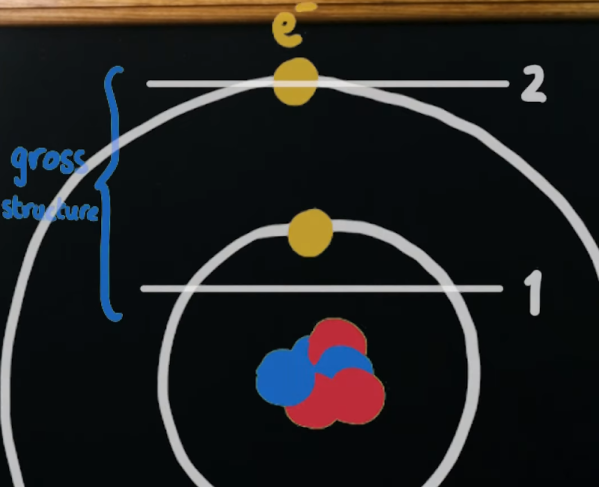
You may know that the constant, often represented by α, is approximately 1/137, but what does that mean? The answer relates to the orbit of electrons. You might remember from school that electrons orbit in shells around the nucleus.  That is, an atom might have some electrons in the innermost shell, and more electrons in an outer shell.

Continue reading “The Fine Structure Constant In A Blink”

Ask Hackaday: If Aliens Came By, Would We Even Notice?

A few years ago we talked about the chance that the first known extrasolar visitor — Oumuamua — might be a derelict solar sail. That notion has been picking up steam in the popular press lately, and it made us think again about the chances that the supposed rock was really a solar sail discarded or maybe even a probe flying with a solar sail. At the same time, Mars is as close as it ever gets so there is a gaggle of our probes searching the red planet, some of them looking for signs of past life.

All this makes us think: if we did find life or even artifacts of intelligent life, would we realize it? Sure, we can usually figure out what’s alive here on Earth. But to paraphrase Justice Potter Stewart, “We know it when we see it.” Defining life turns out to be surprisingly tricky, recognizing alien technology would be even harder.

Continue reading “Ask Hackaday: If Aliens Came By, Would We Even Notice?”

Learn Engineering Concepts With Some Cool Animations

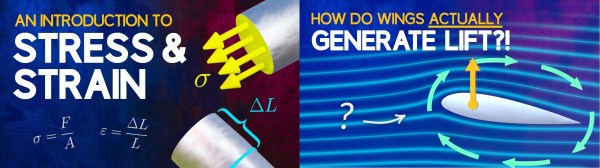
All feats of engineering build on a proper understanding of the basic engineering concepts. Learning these concepts from a book or class tends to be a rather uninspiring exercise, unfortunately. To make this task a lot more enjoyable, [The Efficient Engineer] has produced a series of high-quality, easy-to-watch videos on the concepts.

The videos focus mainly on mechanical and structural engineering and contain excellent animations and just enough math to give you a basic understanding. There are 22 videos so far and cover a wide variety of topics, including FEA analysis, stress and strain, aerodynamics, and Young’s modulus. Each video starts with the basics, then digs down into the topic, all the while visualizing the subject being discussed. For example, for FEA he starts with the applications, then covers discretization (meshing) and how to solve the calculations.

For more excellent educational videos, check out [Real Engineering] and [Practical Engineering]. Continue reading “Learn Engineering Concepts With Some Cool Animations”