Hunting Neutrinos In The Antarctic

Neutrinos are some of the strangest particles we have encountered so far. About 100 billion of them are going through every square centimeter on Earth per second but their interaction rate is so low that they can easily zip through the entire planet. This is how they earned the popular name ‘ghost particle’. Neutrinos are part of many unsolved questions in physics. We still do not know their mass and they might even be there own anti-particles while their siblings could make up the dark matter in our Universe. In addition, they are valuable messengers from the most extreme astrophysical phenomena like supernovae, and supermassive black holes.

The neutrinos on earth have different origins: there are solar neutrinos produced in the fusion processes of our sun, atmospheric neutrinos produced by cosmic rays hitting our atmosphere, manmade reactor neutrinos created in the radioactive decays of nuclear reactors, geoneutrinos which stem from similar processes naturally occurring inside the earth, and astrophysical neutrinos produced outside of our solar system during supernovae and other extreme processes most of which are still unknown. Continue reading “Hunting Neutrinos In The Antarctic”

Metasurface Design Methods Can Make LED Light Act More Like Lasers

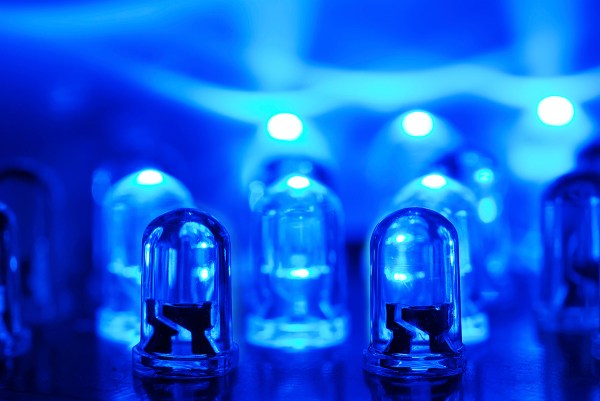
Light-emitting diodes (LEDs) are not exactly new technology, but their use over time has evolved from rather dim replacements of incandescent signal lights in control panels to today’s home lighting. Although LEDs have the reputation of being power-efficient, there is still a lot of efficiency to be gained.

UC Santa Barbara researchers [Jonathan Schuller] and his team found that a large number of the photons that are generated never make it out of the LED. This means that the power that was used to generate these photons was essentially wasted. Ideally one would be able to have every single photon successfully make it out of the LED to contribute to the task of illuminating things.

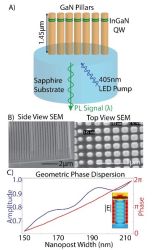
In their paper titled ‘Unidirectional luminescence from InGaN/GaN quantum-well metasurfaces‘  (pre-publication Arxiv version) they describe the problem of photon emission in LEDs. Photons are normally radiated in all directions, causing a ‘spray’ of photons that can be guided somewhat by the LED’s packaging and other parameters. The challenge was thus to start at the beginning, having the LED emit as many photons in one direction as possible.

Their solution was the use of a metasurface-based design, consisting out of gallium nitride (GaN) nanorods on a sapphire substrate. These were embedded with indium gallium nitride (InGaN) quantum wells which emit the actual photons. According to one of the researchers, the idea is based on subwavelength antenna arrays already used with coherent light sources like lasers.

With experiments showing the simulated improvements, it seems that this research may lead to even brighter, more efficient LEDs before long if these findings translate to mass production.

(Thanks, Qes)

High Speed The Way We Want It

The one thing we have learned over the current pandemic is that we need the internet, and the faster the better. Though cost is surely a hurdle, the amount of bandwidth available has its bottlenecks rooted from the underlying technology. Enter new technology from an Australian Research team who have claimed to have field tested internet speeds as fast at 44.2 terabits per second.

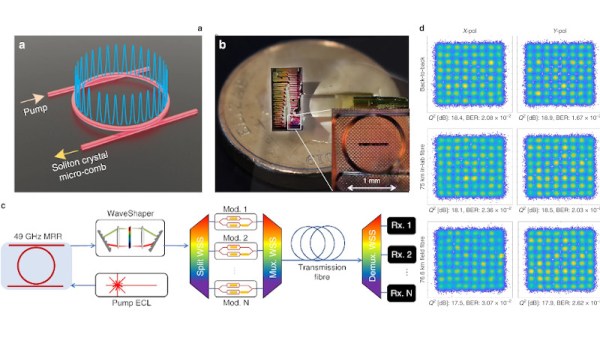
The breakthrough in bandwidth is attributed to a new optical chip that employs optical frequency combs or micro-comb, and has been published by [Corcoran et al] of Monash University. The team exploits the ability of certain crystals to create resonant optical fields called solitons and these form highly efficient optical transmission system. For the uninitiated, optical frequency combs are an optical spectrum of equidistant lines whose values if fixed, can be used to measure unknown frequencies. The original discovery earned Roy J. Glauber, John L. Hall and Theodor W. Hänsch the Nobel Prize in Physics in 2005, and though it is a relatively new field it has seen a lot of activity in the research community.

The experimental setup has a resonator with a free spectral range spacing of 48.9GHz, and from the generated optical fields or lines, 80 were selected. Using a side-band modulator the bands were doubled and eventually with 64 QAM modulation facilitated a symbol rate of 23 Gigabaud. Now at this point, the paper says that this experiment is still an under-utilization of the available resources. The extra connectivity speed may be helpful in gaming and streaming but we will be needing faster drives to get our emails attachments downloaded faster. If you are inspired and want to play with lasers and optical communications, check out the DIY Laser Optical Link.

Thanks [Anil Pattni] for the tip.

Engineers Develop A Brain On A Chip

Our abilities to multitask, to quickly learn complex maneuvers, and to instantly recognize objects even as infants are just some of the ways that human brains make use of our billions of synapses. Biologically, our brain requires fluid-filled cavities, nerve fibers, and numerous other cells and connections in order to function. This isn’t the case with a new kind of brain recently announced by a team of MIT engineers in Nature Nanotechnology. Compared to the size of a typical human brain, this new “brain-on-a-chip” is able to fit on a piece of confetti.

When you take a look at the chip, it is more similar to tiny metal carving than to any neurological organ. The technology used to design the chip is based on memristors – silicon-based components that mimic the transmissions of synapses. A concatenation of “memory” and “resistor”, they exist as passive circuit elements that retain a relationship between the time integrals of current and voltage across an element. As resistance varies, tiny read charges are able to access a history of applied voltage. This can be accomplished by hysteresis and other non-linear properties of passive circuitry.

These properties can be best observed at nanoscale levels, where they aren’t dwarfed by other electronic and field effects. A tiny positive and negative electrode are separated by a “switching medium”, or space between the two electrodes. Voltage applied to one end causes ions to flow through the medium, forming a conduction channel to the other end. These ions make up the electrical signal transmitted through the circuit.

In order to fabricate these memristors, the researchers used alloys of silver for the positive electrode, and copper alongside silicon for the negative electrode. They sandwiched the two electrodes along an amorphous medium and patterned this on a silicon chip tens of thousands of times to create an array of memristors. To train the memristors, they ran the chips through visual tasks to store images and reproduce them until cleaner versions were produced. These new devices join a new category of research into neuromorphic computing – electronics that function similar to the way the brain’s neural architecture operates.

The opportunity for electronics that are capable of making instantaneous decisions without consulting other devices or the Internet spell the possibility of portable artificial intelligence systems. Though we already have software systems capable of simulating synaptic behavior, developing neuromorphic computing devices could vastly increase the capability of devices to do tasks once thought to belong solely to the human brain.


New Microscope Directly Images Protein Atoms

There’s an old joke that you can’t trust atoms — they make up everything. But until fairly recently, there was no real way to see individual atoms. You could infer things about them using X-ray crystallography or measure their pull on tiny probes using atomic force microscopes, but not take a direct image. Until now. Two laboratories recently used cryo-electron microscopy to directly image atoms in a protein molecule with a resolution of about 1.2 x 10⁻⁷ millimeters or 1.2 ångströms. The previous record was 1.54 ångströms.

Recent improvements in electron beam technology helped, as did a device that ensures electrons that strike the sample travel at nearly the same speeds. The latter technique resulted in images so clear, researchers could identify individual hydrogen atoms in the apoferritin molecule and the water surrounding it.

Continue reading “New Microscope Directly Images Protein Atoms”

How Science Adapted To The Aftermath Of Cold War Nuke Tests

Current global events have demonstrated that we do not live in the most stable of times. Still, most of us 90’s kids are probably glad that we did not have to endure the political shakiness of the Cold War era when people were living in constant fear of nuclear Armageddon. Nuclear weapons tests were common during this period as the United States and the Soviet Union invested heavily to increase the quality and quantity of their warheads in the race for nuclear supremacy.

Even though the political situation stabilized after the fall of the Soviet Union, the consequences of the vast amount of nuclear tests conducted back then are still noticeable today. Besides the devastating effects on human health and the environment, this period also leaves some implications for science which are not always negative.

Continue reading “How Science Adapted To The Aftermath Of Cold War Nuke Tests”

Swap Your Microwave For A High Voltage Stereo

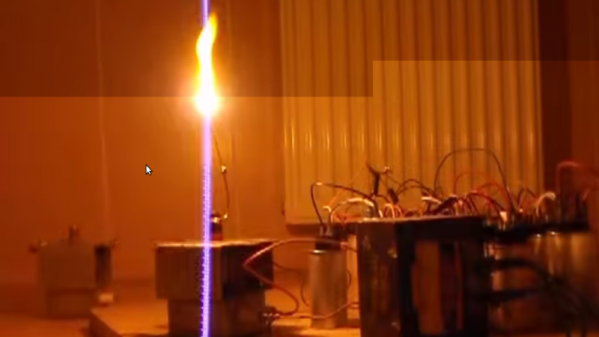
When building a new project, common wisdom suggests to avoid “reinventing the wheel”, or doing something simple from scratch that’s easily available already. However, if you can build a high-voltage wheel, so to speak, it might be fun just to see what happens. [Dan] decided to reinvent not the wheel, but the speaker, and instead of any conventional build he decided to make one with parts from a microwave and over 6,000 volts.

The circuit he constructed works essentially like a Tesla coil with a modulated audio signal as an input. The build uses the high voltage transformer from the microwave too, which steps the 240 V input up to around 6 kV. To modulate that kind of voltage, [Dan] sends the audio signal through a GU81M vacuum tube with the support of a fleet of high voltage capacitors. The antenna connected to the magnetron does tend to catch on fire somewhere in the middle of each song, so it’s not the safest device around even if the high voltage can be handled properly, but it does work better than expected as a speaker.

If you want a high-voltage speaker that (probably) won’t burn your house down, though, it might be best to stick to a typical Tesla coil. No promises though, since working with high voltages typically doesn’t come with safety guarantees.

Continue reading “Swap Your Microwave For A High Voltage Stereo”