COVID-19 And The State Of The Climate

The novel coronavirus sweeping the globe has led governments to institute widespread quarantines to stem the spread. Many industries have slowed production or shutdown entirely, and economic activity has slowed to a crawl. This has naturally led to a sudden reduction in greenhouse gas emissions. But how great will the effect be, and will it buy us any real time?

On The Ground

Nitrogen dioxide levels in China have dropped sharply with the reduction in industrial activity due to COVID-19. Image source: NASA

In the wake of COVID-19, good news stories have sprung up as people look for a silver lining. Unfortunately, these stories aren’t always true. There aren’t dolphins in the waters of Venice, though the water has cleared due to reduced boat activity. And drunken elephants did not begin roaming the mountains of China.

Despite this, there have been notable reductions in emissions in several areas due to government-mandated lockdowns. Northern Italy is seeing a much lower concentration of nitrogen dioxide, likely due to reduced industrial and vehicular activity. Carbon monoxide levels have similarly dropped in New York, while China has seen its carbon emissions temporarily drop by a full 25%.

On the surface of it, these are all promising numbers. Many are cautiously optimistic that this could be a major development to help stave off the worst of climate change for a little longer. Nonetheless, it’s early days yet, and what happens after the crisis passes is just as important as what’s happening now.

Continue reading “COVID-19 And The State Of The Climate”

On 5G And The Fear Of Radiation

The world around us is a scary place, with a lot of visible and invisible dangers. Some of those invisible dangers are pretty obvious, such as that of an electrical shock from exposed wiring. Some are less obvious, for example the dangers of UV radiation to one’s skin and eyes commonly known, but also heavily underestimated by many until it’s too late. In the US alone, skin cancer ends up affecting about one in every five people.

Perhaps ironically, while the danger from something like UV radiation is often underestimated, other types of electromagnetic radiation are heavily overestimated. All too often, the distinction between what is and isn’t considered to be harmful appears to be made purely on basis of whether it is ‘natural’ radiation or not. The Sun is ‘natural’, ergo UV radiation cannot be harmful, but the EM radiation from a microwave or 5G wireless transceiver is human-made, and therefore harmful. This is, of course, backwards.

Rather than dismissing such irrational fears of radiation, let’s have a look at both the science behind radiation and the way humans classify ‘danger’, such as in the case of 5G cell towers. Continue reading “On 5G And The Fear Of Radiation”

Making Aerogel, It’s Not For The Faint-Hearted

Aerogel — that mixture of air and silica — is one of those materials that seems like a miracle. It is almost not there since the material is 99% air. [NileRed] wanted to make his own and he documented his work in a recent video you can see below.

If you decide to replicate his result, be careful with the tetramethyl orthosilicate. Here’s what he says about it:

And the best part is, that when it’s in your eyes, it gets under the surface, and the particles are way too small to remove. For this reason, you could go permanently blind.

It can also mess up your lungs, so you probably need a vent hood to really work with this. It isn’t cheap, either. The other things you need are easier to handle: methanol, distilled water, and ammonia.

Continue reading “Making Aerogel, It’s Not For The Faint-Hearted”

ESP8266 And Sensors Make For A Brainy NERF Ball

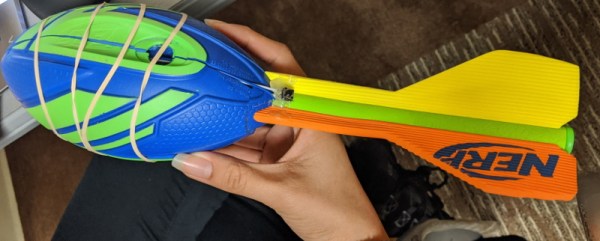
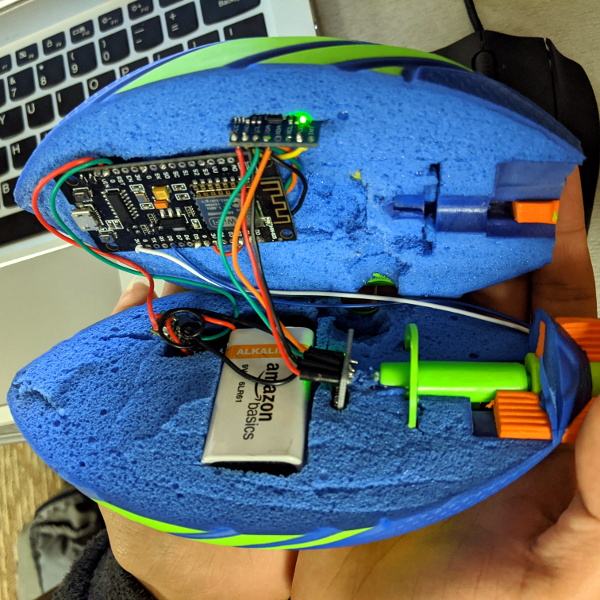
For his final project in UCLA’s Physics 4AL program, [Timothy Kanarsky] used a NodeMCU to smarten up a carefully dissected NERF football. With the addition to dual MPU6050 digital accelerometers and some math, the ball can calculate things like the distance traveled and angular velocity. With a 9 V alkaline battery and a voltage regulator board along for the ride it seems like a lot of weight to toss around; but of course nobody on the Hackaday payroll has thrown a ball in quite some time, so we’re probably not the best judge of such things.

Even if you’re not particularly interested in refining your throw, there’s a lot of fascinating science going on in this project; complete with fancy-looking equations to make you remember just how poorly you did back in math class.

As [Timothy] explains in the write-up, the math used to find velocity and distance traveled with just two accelerometers is not unlike the sort of dead-reckoning used in intercontinental ballistic missiles (ICBMs). Since we’ve already seen model rockets with their own silos, seems all the pieces are falling into place.

The NodeMCU polls the accelerometers every 5 milliseconds, and displays the data on web page complete with scrolling graphs of acceleration and angular velocity. When the button on the rear of the ball is pressed, the data is instead saved to basic Comma Separated Values (CSV) file that’s served up to clients with a minimal FTP server. We might not know much about sportsball, but we definitely like the idea of a file server we can throw at people.

Interestingly, this isn’t the first time we’ve seen an instrumented football. Back in 2011 it took some pretty elaborate hardware to pull this sort of thing off, and it’s fascinating to see how far the state-of-the-art has progressed.

Teaching Science With An Empty Soda Bottle

Creating the next generation of scientists and engineers starts by getting kids interested in STEM at an early age, but that’s not always so easy to do. There’s no shortage of games and movies out there to entertain today’s youth, and just throwing a text book at them simply isn’t going to cut it anymore. Modern education needs to be engrossing and hands-on if it’s going to make an impact.

Which is exactly what the Institute of Science and Technology Austria hopes to accomplish with the popSCOPE program. Co-founded by [Dr. Florian Pauler] and [Dr. Robert Beattie], the project uses off-the-shelf hardware, 3D printed parts, and open source software to create an engaging scientific instrument that students can build and use themselves. The idea is to make the experience more personal for the students so they’re not just idle participants sitting in a classroom.

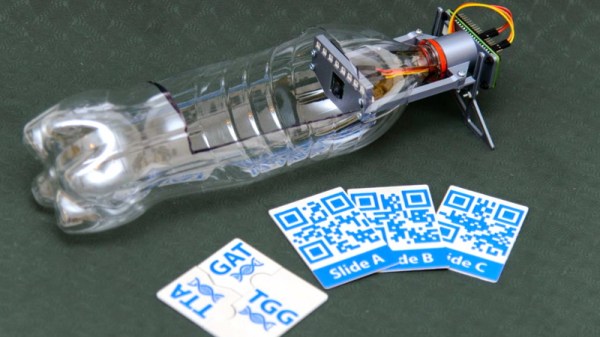
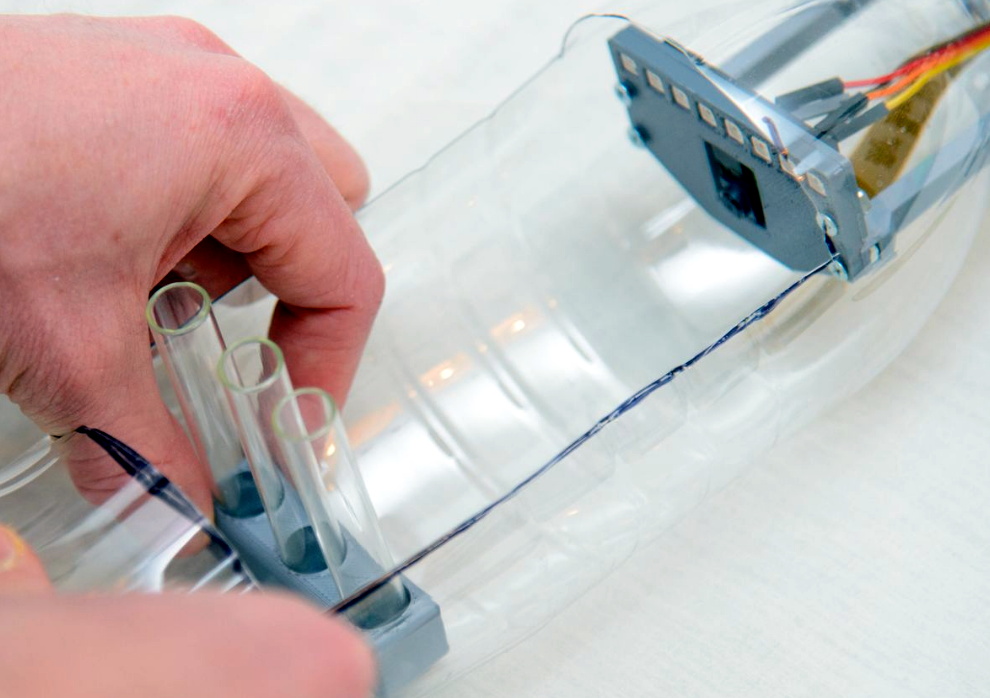
The hardware in use here is quite simple, essentially just a Raspberry Pi Zero W, a camera module, a Pimoroni Blinkt LED module, and a few jumper wires. It all gets bolted to a 3D printed frame, which features a female threaded opening that accepts a standard plastic soda (or pop, depending on your corner of the globe) bottle. You just cut a big opening in the side of the bottle, screw it in, and you’ve saved yourself a whole lot of time by not printing an enclosure.

So what does the gadget do? That obviously comes down to the software it’s running, but out of the box it’s able to do time-lapse photography which can be interesting for biological experiments such as watching seeds sprout. There’s also a set of 3D printable “slides” featuring QR codes, which the popSCOPE software can read to show images and video of real microscope slides. This might seem like cheating, but for younger players it’s a safe and easy way to get them involved.

For older students, or anyone interested in homebrew scientific equipment, the Poseidon project offers a considerably more capable (and complex) digital microscope made with 3D printed parts and the Raspberry Pi.

Star Trackers: Telling Up From Down In Any Space

Keeping track of position is crucial in a lot of situations. On Earth, it’s usually relatively straight-forward, with systems having been developed over the centuries that would allow one to get at least a rough fix on one’s position on this planet. But for a satellite out in space, however, it’s harder. How do they keep their communications dishes pointed towards Earth?

The stars are an obvious orientation point. The Attitude and Articulation Control Subsystem (AACS) on the Voyager 1 and 2 space probes has the non-enviable task of keeping the spacecraft’s communication dish aligned precisely with a communications dish back on Earth, which from deep space is an incomprehensibly tiny target.

Back on Earth, the star tracker concept has become quite popular among photographers who try to image the night skies. Even in your living room,  VR systems also rely on knowing the position of the user’s body and any peripherals in space. In this article we’ll take a look at the history and current applications of this type of position tracking. Continue reading “Star Trackers: Telling Up From Down In Any Space”

Two Perspectives On James Clerk Maxwell And His Equations

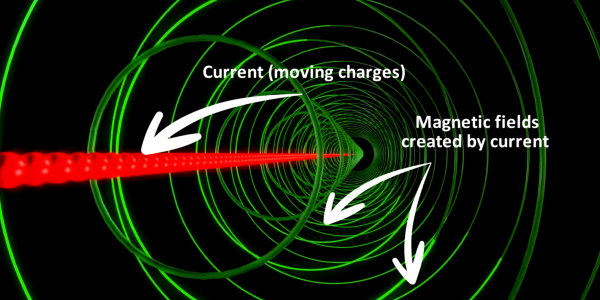
We are unabashed fans of [The History Guy’s] YouTube channel, although his history videos aren’t always about technology, and even when they are, they don’t always dig into the depths that we’d like to see. That’s understandable since the channel is a general interest channel. However, for this piece on James Clerk Maxwell, he brought in [Arvin Ash] to handle the science side. While [The History Guy] talked about Maxwell’s life and contributions, [Arvin] has a complementary video covering the math behind the equations. You can see both videos below.

Of course, if you’ve done electronics for long, you probably know at least something about Maxwell’s equations. They unified electricity and magnetism and Einstein credited them with spurring one of his most famous theories.

Continue reading “Two Perspectives On James Clerk Maxwell And His Equations”