Renewable energy sources are becoming increasingly popular. However, such energy can be wasted if an excess is available when it’s not yet needed. A particularly relevant example is solar power; solar panels provide most of their output during the day, while often a household’s greatest energy use is at night.
One way to get around this problem is by storing excess energy so that it can be used later. The most common way this is done is with large batteries, however, it’s not the only game in town. Phase change materials are proving to be a useful tool to store excess energy and recover it later – storing energy not as electricity, but as heat. Let’s take a look at how the technology works, and some of its most useful applications. Continue reading “Using Phase Change Materials For Energy Storage”→
The jumping off point for this experiment is the calorie count on the back of food packaging. [Ben] touches on “bomb calorimetry” — the process of burning foodstuff in an oxygen-rich environment and measuring the heat given off to establish how much energy was present in the sample. But our bodies are flameless… can we really extract similar amounts of energy as these highly controlled combustion chambers? His solution is to measure his body’s intake by eating nothing but Soylent for a week, then subjects his body’s waste to the bomb calorimetry treatment to calculate how much energy was not absorbed during digestion. (He burned his poop for science, and made fun of some YouTubers at the same time.)
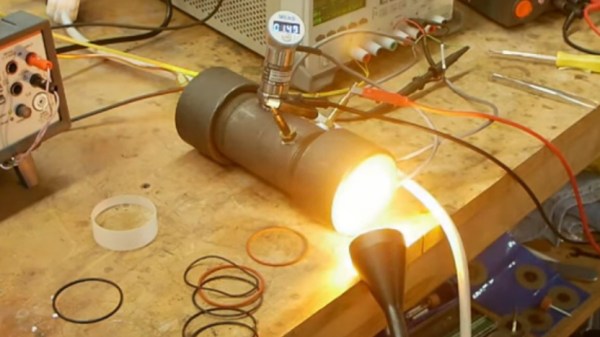
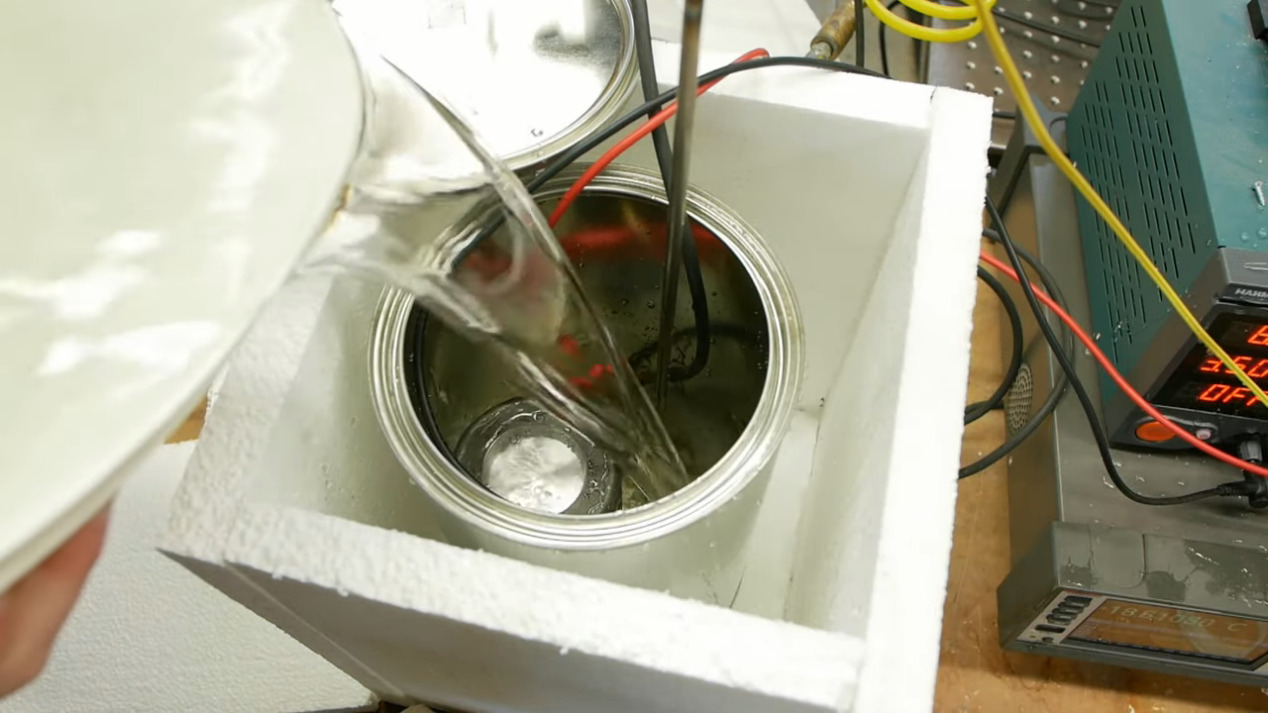
The test apparatus is a cool build — a chunk of pipe with an acrylic/glass laminated window that has a bicycle tire value for pressurization, a pressure gauge, and electrodes to spark the combustion using nichrome wire and cotton string. It’s shown above, burning a Goldfish® cracker but it’s not actually measuring the energy output as this is just a test run. The actual measurements call for the combustion chamber to be submerged in an insulated water bath so that the temperature change can be measured.
Now to the dirty bits. [Ben] collected fecal matter and freeze-dried it to ready it for the calorimeter. His preparation for the experiment included eating nothing but Soylent (a powdered foodstuff) to achieve an input baseline. The problem is that he measures the fecal matter to have about 75% of the calories per gram compared to the Soylent. Thinking on it, that’s not surprising as we know that dung must have a high caloric level — it burns and has been used throughout history as a source of warmth among other things. But the numbers don’t lead to an obvious conclusion and [Ben] doesn’t have the answer on why the measurements came out this way. In the YouTube comments [Bitluni] asks the question that was on our minds: how do you correlate the volume of the input and output? Is comparing 1g of Soylent to 1g of fecal matter a correct equivalency? Let us know what you think the comments below.
Jerry Seinfeld launched his career with Bee Movie, an insect-themed animated feature that took the world by storm in 2007. It posed the quandary – that supposedly, according to all known laws of aviation, bees should not be able to fly. Despite this, the bee flies anyway, because bees don’t care what humans think is impossible.
The quote isn’t easily attributed to anyone in particular, but is a cautionary tale about making the wrong assumptions in an engineering context. Yes, if you model a bee using the same maths as an airliner, of course you’ll find that it shouldn’t be able to fly. Its tiny wings can’t possibly generate enough lift to get its body off the ground. But that’s because the assumption is an erroneous one – because bees don’t fly in the same way planes do. Bees flap their wings. But that’s just the beginning. The truth is altogether more complex and interesting! Continue reading “Flapping Wings And The Science Of How Bees Can Fly”→
On February 18th, the Perseverance rover safely touched down on the Martian surface. In the coming days and weeks, the wide array of instruments and scientific payloads tucked aboard the robotic explorer will spring to life; allowing us to learn more about the Red Planet. With a little luck, it may even bring us closer to determining if Mars once harbored life as we know it.
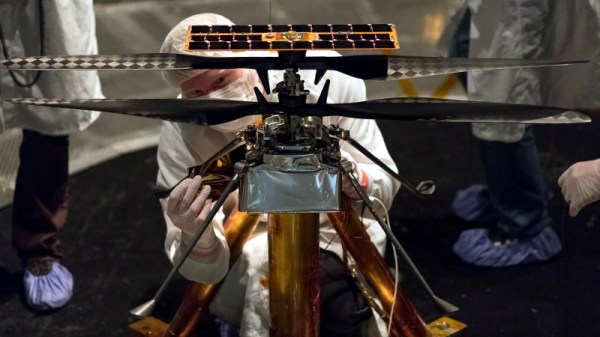
Among all of the pieces of equipment aboard the rover, one of the most intriguing must certainly be Ingenuity. This small helicopter will become the first true aircraft to take off and fly on another planet, and in a recent interview with IEEE Spectrum, operations lead [Tim Canham] shared some fascinating details about the vehicle and some of the unorthodox decisions that went into its design.
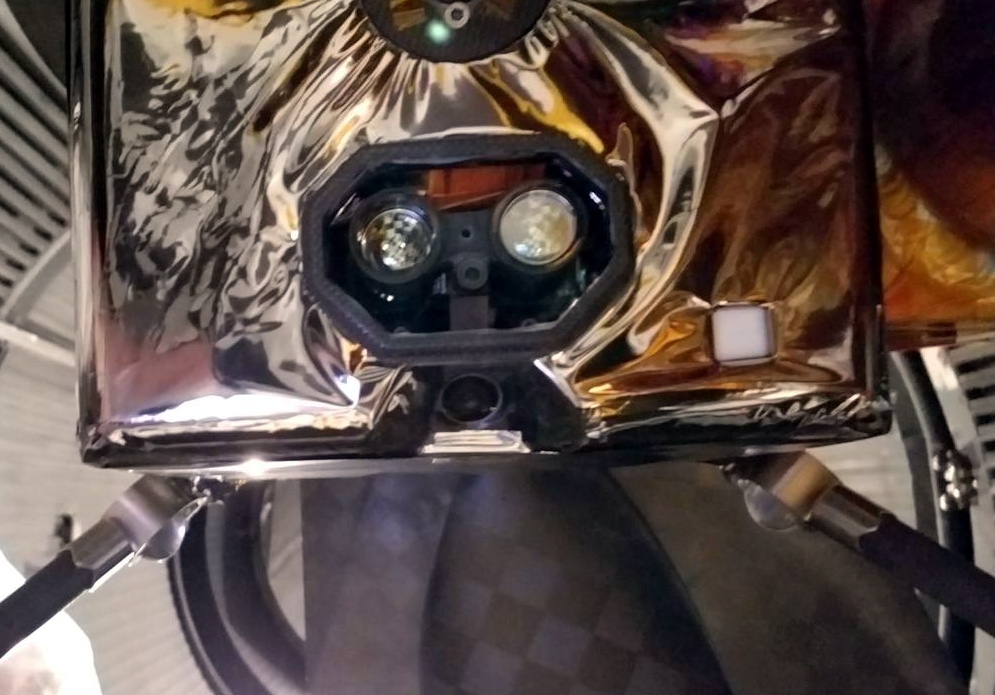
Ingenuity’s downward facing sensors.
[Tim] explains that, as a technology demonstrator, the team was allowed to take far more risks in developing Ingenuity than they would have been able to otherwise. Rather than sticking with legacy hardware and software, they were free to explore newer and less proven technology.
That included off-the-shelf consumer components, such as a laser altimeter purchased from SparkFun. It also means that the computational power packed into Ingenuity far exceeds that of Perseverance itself, though how well the helicopter’s smartphone-class Snapdragon 801 processor will handle the harsh Martian environment is yet to be seen.
On the software side, we also learn that Ingenuity is making extensive use of open source code. Not only is the onboard computer running Linux, but the vehicle is being controlled by an Apache 2.0 licensed framework developed by NASA’s Jet Propulsion Laboratory for CubeSats and other small spacecraft. The project is available on GitHub for anyone who wants it, and according to the changelog, the fixes and improvements required for the “Mars Helicopter Project” were merged in a few releases ago.
The fact that code currently ticking away on the surface of Mars can be downloaded and implemented into your own DIY project is a revelation that’s not lost on [Tim]. “It’s kind of an open-source victory because we’re flying an open-source operating system and an open-source flight software framework and flying commercial parts that you can buy off the shelf if you wanted to do this yourself someday.”
Of course, it took a whole lot more than some Python libraries and a handful of sensors from SparkFun to design and build the first space-going helicopter. But the fact that even a small slice of the technology inside of a project like Ingenuity is now available to the average hacker and maker is a huge step towards democratizing scientific research here on Earth.
We live in the information age where access to the internet is considered a fundamental human right. Exercising this right does largely rely on the technological advances made in optical communication. Using light to send information has a long history: from ancient Greece, through Claude Chappe’s semaphore towers and Alexander Graham Bell’s photophone, to fiber optic networks and future satellite internet constellations currently developed by tech giants.
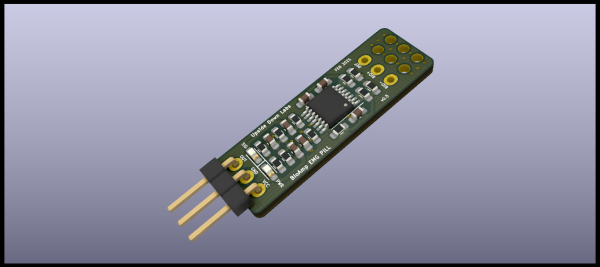
Ever felt like what your MCU of choice misses is a way to read the electrical signals from your muscles? In that case [Deepak Khatri] over at Upside Down Labs has got your back with the BioAmp EMG Pill. Described as an affordable, open source electromyography (EMG) module, based around a TL074 quad low-noise JFET-input opamp. At just over 32×10 millimeters, it’s pretty compact as well.
The onboard opamp ensures that the weak electrical signals captured from the muscles when they move are amplified sufficiently that the ADC of any microcontroller or similar can capture the signal for further processing. Some knowledge of how to set up an EMG is required to use the module, of course, and the TL074 opamp prefers an input voltage between 7-30 V. Even so, it has all the basics onboard, and the KiCad project is freely available via the above linked GitHub project.
In addition, [Deepak] also tweeted about working on an affordable, open source active prosthetics controller (and human augmentation device), which has us very much interested in what other projects may come out of Upside Down Labs before long. After, all we’re no strangers to hacking with biosignals.
Modern life has its conveniences. Often, those conveniences lead to easier hacks. A great example of that is the rise of satellite television and the impact it has had on amateur radio telescopes. There was a time when building a dish and a suitable low noise amplifier was a big deal. Now they are commodity parts you can get anywhere.
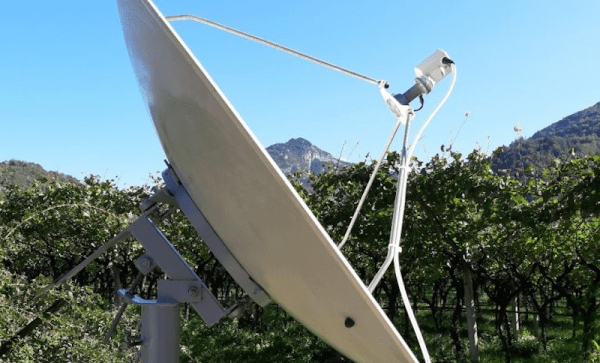
The antenna in use is a 1.2-meter prime focus dish. Some TV dishes use an offset feed, but that makes it harder to aim for use in a radio telescope. In addition to off-the-shelf antenna and RF components, an AirSpy software-defined radio picks up the frequency-shifted output from the antenna. There is more about the software side of the build in a follow-up post. We liked that this was a pretty meaty example of using GNU Radio.