Life Found On Ryugu Asteroid Sample, But It Looks Very Familiar

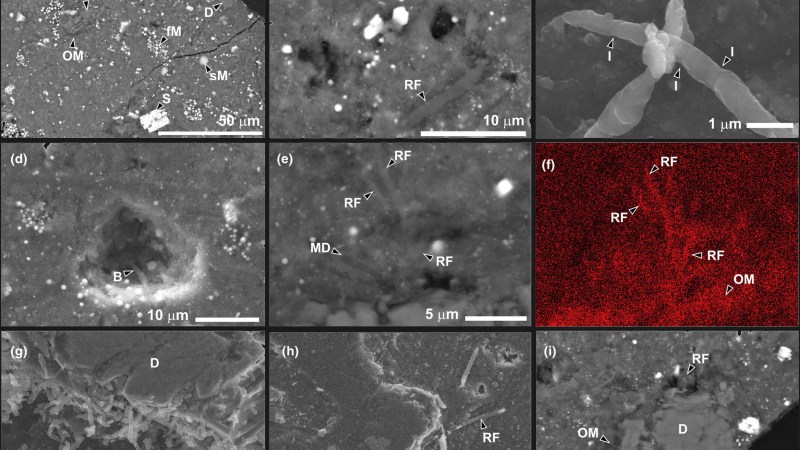
Samples taken from the space-returned piece of asteroid Ryugu were collected and prepared under strict anti-contamination controls. Inside the cleanest of clean rooms, a tiny particle was collected from the returned sample with sterilized tools in a nitrogen atmosphere and stored in airtight containers before being embedded in an epoxy block for scanning electron microscopy.

It’s hard to imagine what more one could do, but despite all the precautions taken, the samples were rapidly colonized by terrestrial microorganisms. Only the upper few microns of the sample surface, but it happened. That’s what the images above show.
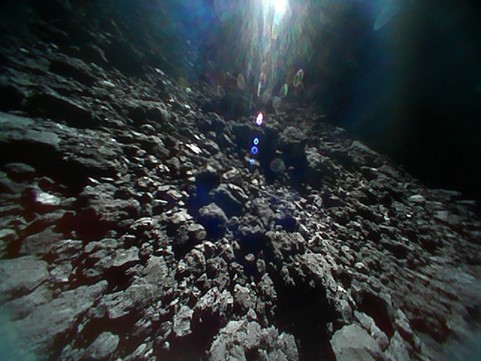
The surface of Ryugu from Rover 1B’s camera. Source: JAXA

Obtaining a sample from asteroid Ryugu was a triumph. Could this organic matter have come from the asteroid itself? In a word, no. Researchers have concluded the microorganisms are almost certainly terrestrial bacteria that contaminated the sample during collection, despite the precautions taken.

You can read the study to get all the details, but it seems that microorganisms — our world’s greatest colonizers — can circumvent contamination controls. No surprise, in a way. Every corner of our world is absolutely awash in microbial life. Opening samples on Earth comes with challenges.

As for off-Earth, robots may be doing the exploration but despite NASA assembling landers in clean room environments we may have already inadvertently exported terrestrial microbes to the Moon, and Mars. The search for life to which we are not related is one of science and humanity’s greatest quests, but it seems life found on a space-returned samples will end up looking awfully familiar until we step up our game.

Humans Can Learn Echolocation Too

Most of us associate echolocation with bats. These amazing creatures are able to chirp at frequencies beyond the limit of our hearing, and they use the reflected sound to map the world around them. It’s the perfect technology for navigating pitch-dark cave systems, so it’s understandable why evolution drove down this innovative path.

Humans, on the other hand, have far more limited hearing, and we’re not great chirpers, either. And yet, it turns out we can learn this remarkable skill, too. In fact, research suggests it’s far more achievable than you might think—for the sighted and vision impaired alike!

Continue reading “Humans Can Learn Echolocation Too”

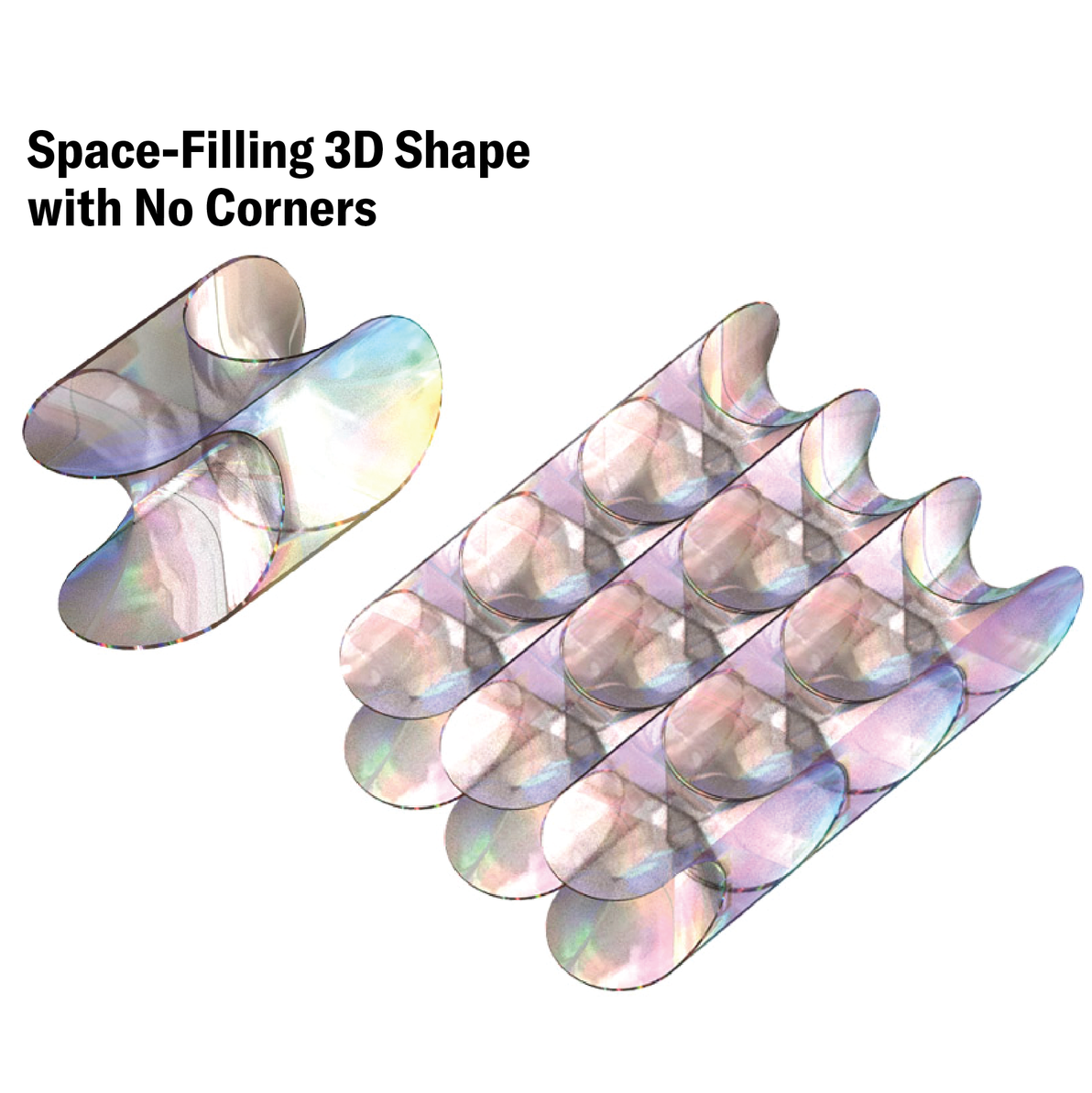
3D Space Can Be Tiled With Corner-free Shapes

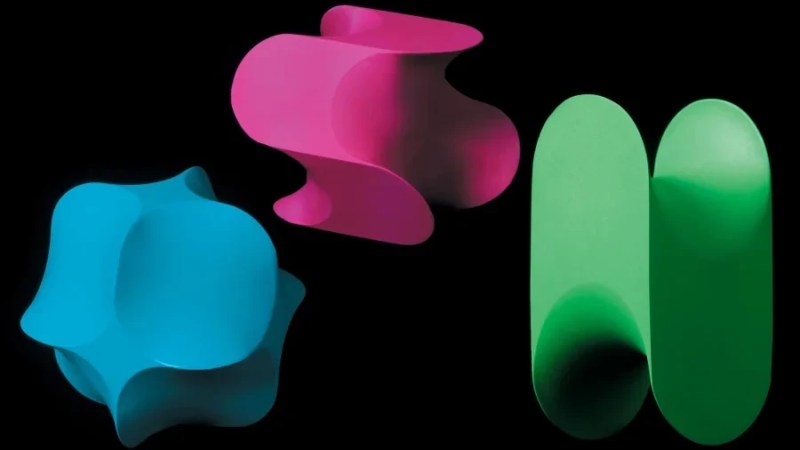
Tiling a space with a repeated pattern that has no gaps or overlaps (a structure known as a tessellation) is what led mathematician [Gábor Domokos] to ponder a question: how few corners can a shape have and still fully tile a space? In a 2D the answer is two, and a 3D space can be tiled in shapes that have no corners at all, called soft cells.

These shapes can be made in a few different ways, and some are shown here. While they may have sharp edges there are no corners, or points where two or more line segments meet. Shapes capable of tiling a 2D space need a minimum of two corners, but in 3D the rules are different.

A great example of a natural soft cell is found in the chambers of a nautilus shell, but this turned out to be far from obvious. A cross-section of a nautilus shell shows a cell structure with obvious corners, but it turns out that’s just an artifact of looking at a 2D slice. When viewed in full 3D — which the team could do thanks to a micro CT scan available online — there are no visible corners in the structure. Once they knew what to look for, it was clear that soft cells are present in a variety of natural forms in our world.

[Domokos] not only seeks a better mathematical understanding of these shapes that seem common in our natural world but also wonders how they might relate to aperiodicity, or the ability of a shape to tile a space without making a repeating pattern. Penrose Tiles are probably the most common example.

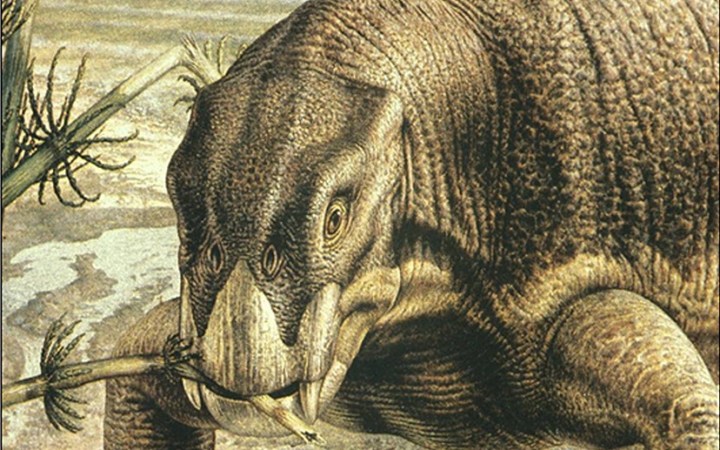
An artist's depiction of a lystrosaurus munching on a prehistoric plant. It looks kind of like a hippo with a beak. The main body of the animal is grey-ish green and it's beak is ivory with two tusks jutting out from its top jaw.

Mammalian Ancestors Shed Light On The Great Dying

As we move through the Sixth Extinction, it can be beneficial to examine what caused massive die-offs in the past. Lystrosaurus specimens from South Africa have been found that may help clarify what happened 250 million years ago. [via IFLScience]

The Permian-Triassic Extinction Event, or the Great Dying, takes the cake for the worst extinction we know about so far on our pale blue dot. The primary cause is thought to be intense volcanic activity which formed the Siberian Traps and sent global CO2 levels soaring. In Karoo Basin of South Africa, 170 tetrapod fossils were found that lend credence to the theory. Several of the Lystrosaurus skeletons were preserved in a spread eagle position that “are interpreted as drought-stricken carcasses that collapsed and died of starvation in and alongside dried-up water sources.”

As Pangea dried from increased global temperatures, drought struck many different terrestrial ecosystems and changed them from what they were before. The scientists say this “likely had a profound and lasting influence on the evolution of tetrapods.” As we come up on the Thanksgiving holiday here in the United States, perhaps you should give thanks for the prehistoric volcanism that led to your birth?

If you want to explore more about how CO2 can lead to life forms having a bad day, have a look at paleoclimatology and what it tells us about today. In more recent history, have a look at how we can detect volcanic eruptions from all around the world and how you can learn more about the Earth by dangling an antenna from a helicopter.


Creating And Control Of Magnetic Skyrmions In Ferromagnetic Film Demonstrated

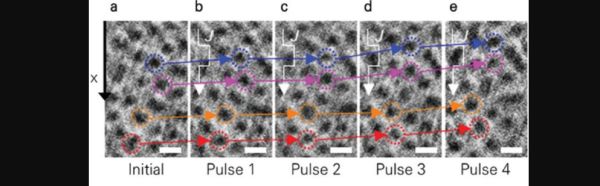
Visualization of magnetic skyrmions. (Credit: KRISS)

Magnetic skyrmions are stable quasi-particles that can be generated in (some) ferromagnetic materials with conceivable solutions in electronics, assuming they can be created and moved at will. The creation and moving of such skyrmions has now been demonstrated by [Yubin Ji] et al. with a research article in Advanced Materials. This first ever achievement by these researchers of the Korea Research Institute of Standards and Science (KRISS) was more power efficient than previously demonstrated manipulation of magnetic skyrmions in thicker (3D) materials.

Magnetic skyrmions are sometimes described as ‘magnetic vortices’, forming statically stable solitons. For magnetic skyrmions their stability comes from the topological stability, as changing the atomic spin of the atoms inside the skyrmion would require overcoming a significant energy barrier.

In the case of the KRISS researchers, electrical pulses together with a  magnetic field were used to create magnetic skyrmions in the ferromagnetic  (Fe3GaTe2, or FGaT) film, after which a brief (50 µs) electric current pulse was applied. This demonstrated that the magnetic skyrmions can be moved this way, with the solitons moving parallel to the electron flow injection, making them quite steerable.

While practical applications of magnetic skyrmions are likely to be many years off, it is this kind of fundamental research that will enable future magnetic storage and spintronics-related devices.

Featured image: Direct imaging of the magnetic skyrmions. The scale bars represent 300 nm. (Credit:Yubin Ji et al., Adv. Mat. 2024)

Rendering of a JetZero blended wing body aircraft with US Air Force markings. (Credit: US Air Force)

Blended Wing Body Passenger Airplanes And The End Of Winged Tubes

The SR-71 with its blended wing body design. (Photo by Tech. Sgt. Michael Haggerty, US Air Force, 1988)

Ask someone to picture an airplane and they’re likely to think of what is essentially a tube with wings and a stabilizing tail tacked onto one end of said tube. Yet it is also no secret that the lift produced by such a tube is rather poor, even if they’re straightforward for loading cargo (static and self-loading) into them and for deciding where to put in windows. Over the decades a number of alternative airplane designs have been developed, with some of them also ending up being produced. Here most people are probably quite familiar with the US Air Force’s B-2 Spirit bomber and its characteristic flying wing design, while blended wing body (BWB) maintains a somewhat distinctive fuselage, as with for example the B-1 Lancer.

Outside of military airplanes BWBs are a pretty rare sight. Within the world of passenger airplanes the tube-with-wings pattern that the first ever passenger airplanes adopted has persisted with the newest designs, making it often tricky to distinguish one airplane from another. This could soon change, however, with a strong interest within the industry for passenger-oriented BWBs. The reason for this are the significant boosts in efficiency, quieter performance and more internal (useful) volume, which makes airline operators very happy, but which may also benefit passengers.

With that said, how close are we truly to the first BWB passenger airplane delivery to an airline?

Continue reading “Blended Wing Body Passenger Airplanes And The End Of Winged Tubes”

Measuring The Mighty Roar Of SpaceX’s Starship Rocket

SpaceX’s Starship is the most powerful launch system ever built, dwarfing even the mighty Saturn V both in terms of mass and total thrust. The scale of the vehicle is such that concerns have been raised about the impact each launch of the megarocket may have on the local environment. Which is why a team from Brigham Young University measured the sound produced during Starship’s fifth test flight and compared it to other launch vehicles.

Published in JASA Express Letters, the paper explains the team’s methodology for measuring the sound of a Starship launch at distances ranging from 10 to 35 kilometers (6 to 22 miles). Interestingly, measurements were also made of the Super Heavy booster as it returned to the launch pad and was ultimately caught — which included several sonic booms as well as the sound of the engines during the landing maneuver.

Continue reading “Measuring The Mighty Roar Of SpaceX’s Starship Rocket”