Making Better Rubies At Home

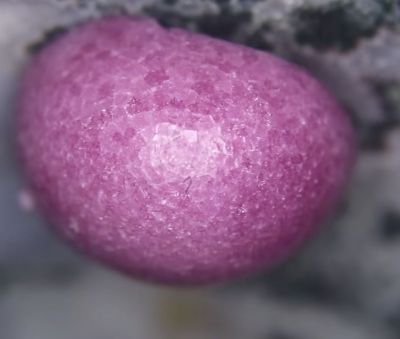
Not the prettiest ruby, for sure. (Credit: Gems of Science, YouTube)

Sapphires and rubies aren’t just pretty, they also got a range of practical uses. This makes it even more useful to be able to make them at home for obviously completely innocent experiments. Cue [Gems of Science] and his attempts to make good-looking rubies, without resorting to the brute-force laser blasting approach that [Styropyro] previously used to create murky-looking gems.

That basic method used involves blasting aluminium oxide with a laser, which results in a container full of what are technically gems, but – as the image on the right makes clear – not exactly the prettiest or easiest to shine up. Much of the problem here is that these are hollow geodes composed of countless tiny crystals instead of solid singular crystals.

Although there are commercial ways to fairly easily create large crystals from a small seed crystal, none of these lend themselves to a DIY hobbyist with just a garage to muck about in. This leaves one alternative: the flux method. Rather than melting the material that will be grown onto the seed crystal, this flux crystal growth method uses a solvent (flux) and temperatures that a home kiln can achieve.
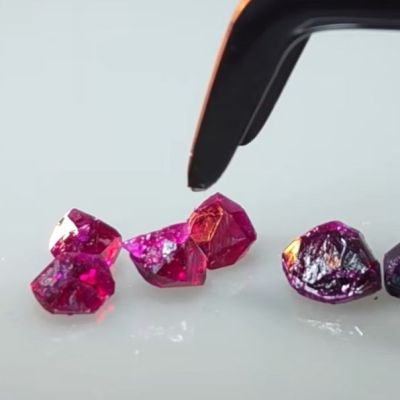
These rubies may be small, but are very shiny. (Credit: Gems of Science, YouTube)

Of note here is also that it’s the addition of Cr3+ ions into the base Al2O3 matrix that makes a ruby into a ruby, by giving it its red glow. In order to grow crystals this way you need to pick not only a suitable solvent, but also use a crucible that doesn’t want to become part of said crystal. Unfortunately a platinum crucible runs into the thousands of USD, but a graphite crucible should do if you keep oxygen away from it.

For the flux molybdenum oxide was used, mixed with chromium oxide and aluminium oxide to provide the ingredients for crystal growth. Unfortunately added charcoal interfered with the molybdenum, ruining that batch. This led to trying out more crucible types to find a recipe that worked, thereby finding out that an ‘alumina’ crucible also contained silica, which poisons the reaction, resulting in only tiny ruby crystals.

Ultimately pure alumina crucibles seemed to work great, until they began to shatter en masse, resulting in pained wallet noises and the purchases of some pre-loved platinum crucibles. This worked really well, but now the flux was evaporating too quickly to enable large crystal growth, thus requiring additives to stabilize it. Along with temperature cycling to induce the growth of larger crystals, this finally generated some solid results. After a first batch of smaller rubies, next up larger ones of up to 10 mm were grown.

While cutting one of these large rubies to set into a ring it was clear that it was still rather flawed, with pockets of flux captured into the crystal, but with the basic method now more or less dialed in it should be possible to address these small flaws as well.

Continue reading “Making Better Rubies At Home” →

Superconducting Temperature Record Set At Ambient Pressure

An interesting type of superconductors available to us today are the ones that achieve this property at room temperature, with only the small snag that they require crushing pressures that would render biological lifeforms into a very thin layer of molecules. What these however suggest is that something in these materials changes at these high pressures, and if we could retain that state upon releasing said pressure, we might be able to have our superconducting cake and eat it too.

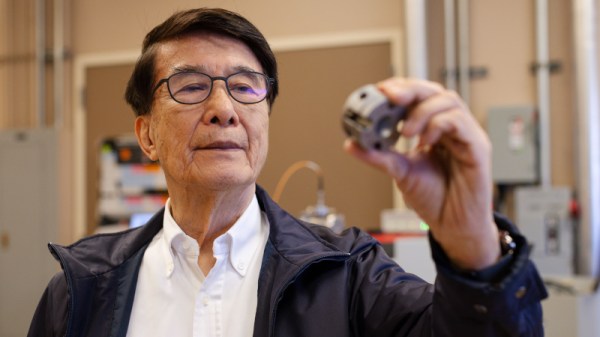
This is effectively what researchers recently achieved, with a research article in PNAS Physics by [Liangzi Deng] et al. covering the pressure-quench protocol (PQP) that they used for this feat. There is also an associated easy-to-read press release by Argonne National Laboratory (ANL) as well as one by the University of Houston.

Target material was a cuprate, specifically HgBa2Ca2Cu3O8+δ, also known as the HBCCO series or Hg1223 for short. Hg1223 has been the subject of much research and experimentation since the 1990s, with it demonstrating a transition temperature (Tc) of 133 K (-140°C). With this quenching method – which sees the high pressures on the cooled sample suddenly released – this bumped the Tc up to 151 K, or -122°C.

While still a far cry from room temperature superconductors, managing to lock in these superconducting properties at an 18 K higher temperature using a straightforward procedure does raise the prospect of massively reducing the cooling needs for superconductors.

Art of 3D printer in the middle of printing a Hackaday Jolly Wrencher logo

3D Printering: Why Is My PLA So Brittle?

Over the years poly(lactic acid) (PLA) – also known as polylactide – has become a popular thermoplastic for a variety of reasons. One of these reasons is that it’s easily produced from a renewable resource, i.e. lactic acid, with the resulting polymer even being compostable if you assume that your compost pile hits a steady 65°C or more, well above the polymer’s glass transition temperature (Tg).

That said, PLA by itself is a pretty crummy material, being exceedingly brittle and inferior to common alternatives like PET(G) in many metrics. Over the decades much research has gone into figuring out this material, its amorphous and crystalline states, as well as how to use plasticizers, copolymers, mechanical manipulation and PLLA/PDLA blends to produce more useful variants of PLA.

Today’s spools of thermoplastic filament that gets marketed as ‘PLA’ are the result of such engineering, though with plenty of remaining issues, as anyone who has struggled through a spool of brittle PLA filament can attest to. Although you can find plenty of tips online about how you should ‘just’ toss said spool into an filament dryer, oven or similar to bake it – with accusing fingers pointed at moisture intrusion, hydrolysis and kin – it helps to understand the fundamentals of how PLA works, and how it degrades.

Continue reading “3D Printering: Why Is My PLA So Brittle?” →

Using Acoustic Resonators As Thrusters For Small Robots

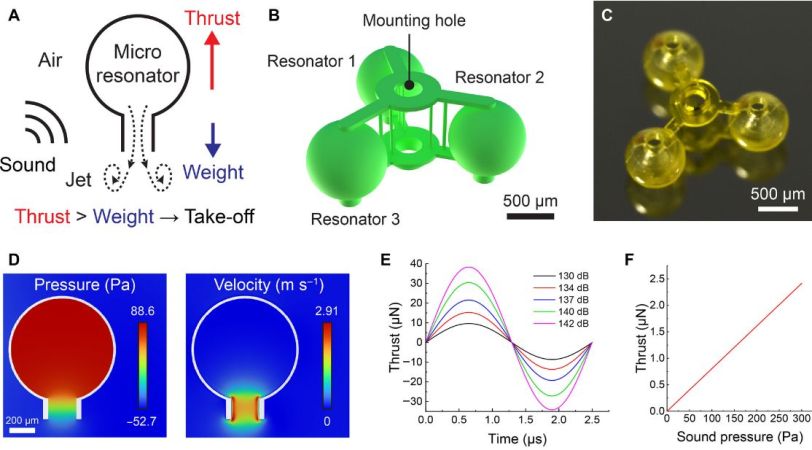
There are quite a few rather unconventional methods of propulsion, but perhaps one of the more curious approaches involved Helmholtz resonance, as demonstrated by [Junsun Hwang] et al. with a paper in Science Advances and associated summary article by EPFL’s School of Engineering.

Although probably better known from something like musical instruments, Helmholtz resonance can be used for more than creating or deadening noise. If stimulated with an external acoustic source that matches the chamber’s resonance frequency the result is a jet of air at the neck of the chamber. This acoustic actuation can thus be used for a number of applications.

In the paper a number of such applications are demonstrated, including a boat with three of these chambers for propulsion and steering, as well as a microflier (see above image) that when placed above an ultrasonic phased area will hover due to the production of this jet of air.

This microflier concept was then adapted with angled resonator chambers so that they could drive a propeller. Naturally, the produced thrust is only a fraction of a Newton so it’s essential to make these structures as light as possible, in the order of micrograms. These microfliers were created using high-resolution 3D printing, with a few iterations attempted to determine the optimal configuration.

In the case of the boat the ultrasonic transducers were directly placed on the bottom of the resonance chamber, but in the case of the microfliers the weight limitations necessitate these transducers to be external. Even if not the most practical kind of flying robot, as a demonstrator of this application of Helmholtz resonance for acoustic propulsion it’s pretty cool.

Using Starlink’s Satellites To Study Earth’s Upper Atmosphere

Aside from global access to cat videos, the presence of thousands of Starlink broadband internet access satellites in LEO has a very pleasant side effect for atmospheric researchers. Starlink publicly publishes near-real-time ephemeris data on its individual satellites. From this data you can deduce many details about the atmosphere at that altitude, including its density at specific altitudes at specific times, information which otherwise would be very hard to gather. Recently, this allowed [Mamoru Yamamoto] to determine the density of the thermosphere using tomography.

In a similar 2025 paper by [Zhuoliang Ou] et al. as published in Remote Sensing, this same data source was used to investigate details of the thermosphere. With Starlink publishing this data since 2021, this provides an invaluable dataset for studying this outermost part of the atmosphere.

Continue reading “Using Starlink’s Satellites To Study Earth’s Upper Atmosphere” →

Removing Microplastics From Soil With Tumbling Magnetic Flakes

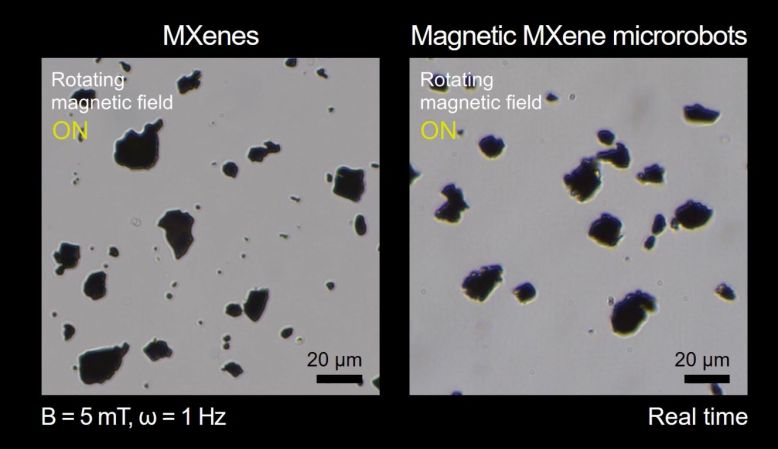
While in aquatic environments microplastics can be filtered out relatively easily, in soil it’s much harder to get to these microscopic particles. While you can certainly strip mine an entire area to process its soil, a less invasive method would involve something like the magnetic flakes proposed and demonstrated by [Jeonghyo Kim] et al. in a recent article in npg asia materials.

The Ti3C2Tx flakes, referred to as MXene microparticles, were designed to attract target microplastics. These were then combined with ferromagnetic nickel nanoparticles to make structures that can be propelled through soil using an external magnetic field.

During tests under laboratory conditions the researchers managed to remove about 81% of polystyrene and 72% of PET particles this way from soil, with a correspondingly higher percentage in water. After having the flakes rummage about for a while through the target material, they are removed with a strong magnetic field, which should recover most of them.

Naturally, the question with any such system is how it’ll perform once exposed to real world conditions and its myriad of soil types and conditions.

Have Scientists Stuck The Landing On The Glueball Discovery?

Exciting discoveries in particle physics are one of those things that it can be easy to get blase about. Some people get caught up in the obvious excitement, while others yawn: “Oh, you found the Higgs Boson, just like Higgs predicted. Call me when you have something new.” Well, if you’re in category B, prepare to yawn while the rest of us break out champagne, because it looks like we’ve finally found the glueball. 

The glueball has got to be one of the oddest particles to fall out of the Standard Model. It’s not a fundamental particle, but its makeup contains no quarks– those itty bits that make up protons and neutrons– nor any leptons like electrons or muons. No, the glueball is a hadron made entirely of bosons: specifically, gluons, the force-carrying particles of the strong nuclear force. It’s also been called gluonium or a gluon-ball, but glueball is more fun.

Try and imagine a proton without any quarks. Remember that inside the proton there are three quarks, held together with force-carrying gluon particles. If you have zero quarks, but enough of those gluons tangled up in the right ways, and you get a tangible, if short lived particle. That’s the glueball, a neutral particle that will decay almost immediatly in to Pions. It works because gluons have ‘colour charge’– the strong nuclear force’s answer to electric charge.

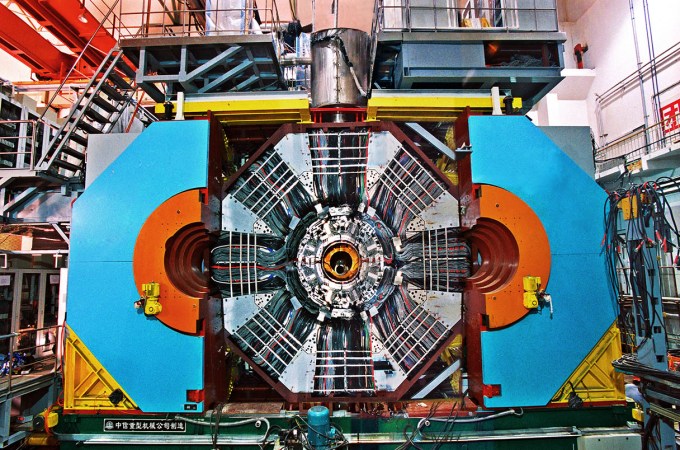
It’s also one of those things that will probably never be seen in nature: odds are, even in the hottest collisions, you’re going to get a quark or two mixed up with your gluon soup. That’s okay; the gluonic state is what we’ve been looking for. As long as the particle is mostly gluons, and behaves as the Standard Model predicts it should, physicists are inclined to call it good enough. The latest candidate to hit “good enough” is X(2370), which fell out of a collision in the Beijing Electron–Positron Collider II (BEPC II), as detected by the Beijing Spectrometer III (BES III). The paper hit ArXiv at the end of July. It’s taken the collaboration this long to make sure of what they were looking at, as they sorted through the terabytes of data an instrument like this generates.

Is this likely to affect you in any way? No. It confirms what we already thought we knew about the universe, and the particle itself is too short-lived to ever exist outside of some very extreme– mostly man-made– environments. On the other hand, it’s an excuse to celebrate scientific discovery, and we’ll take any of those we can, just like when the Muon Magnetic Moment measured in at the expected value, or neutrinos transmuted elements in exactly the way the models said they would. Besides, if we’re really lucky this result will turn out not to be a glueball, but something new and interesting. Then even the most jaded nerds will have reason to celebrate.

Header image: The Bejing III Spectrometer, BESII.