Fuel Cell Turns PET And Carbon Dioxide Into Useful Chemicals

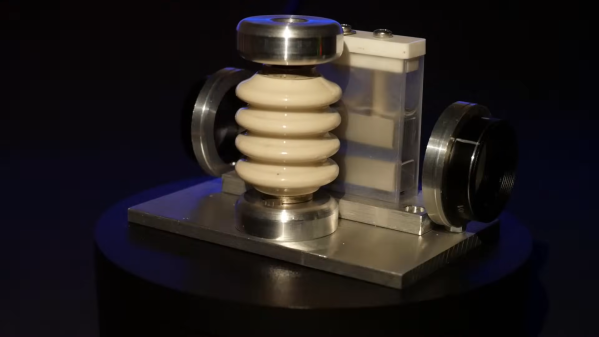
The University of Cambridge has a novel fuel cell design that can grab CO2 from the atmosphere or industrial processes and, combined with waste PET plastic, provides syngas and glycolic acid, a product used in some cosmetics. You can read about the device in a recent paper.

The strange juxtaposition of CO2 and PET is no accident. The processes work together with solar energy. There is no external voltage required, but the cell operates as a photocell to produce electricity from the solar energy. Removing both CO2 and waste plastic from the environment is a good thing.

Syngas is hydrogen and carbon monoxide and finds use in producing methanol and ammonia. It also will work as a fuel that can replace gasoline when gasoline isn’t available. It has a few other uses, like reducing iron ore to sponge iron and even converting methanol to gasoline.

The technology has a ways to go to operate at scale, and we doubt this will ever be a consumer item since you are unlikely to need syngas or glycolic acid in your home or vehicle. But it still is a promising technique to reduce both greenhouse gas and plastic waste in one swoop.

We’ve looked at other ways to grab carbon dioxide and make it useful. If you want to make your own syngas, there are other ways to do it.

Cottonization: Making Hemp And Flax Fibers Into The Better Cotton

These days it’s hard to imagine that fabrics were ever made out of anything other than cotton or synthetic fibers, yet it wasn’t too long ago that hemp and flax-based fabrics — linen — were the rule rather than the exception. Cotton production has for centuries had the major disadvantages of requiring a lot of water and pesticides, and harvesting the cotton was very labor-intensive, making cotton rather expensive. In order to make separating the cotton fibers from the seed easier, improved versions of the cotton gin (‘cotton engine’) were developed, with the 19th century’s industrial revolution enabling a fully automated version.

What makes cotton attractive is the ease of processing these fibers, which are part of the seed pod. These fibers are 25 mm – 60 mm long, 12 μm – 45 μm fine fibers that can be pulled off the seeds and spun into yarn or whatever else is needed for the final product, much like wool. Hemp and flax fibers, in contrast, are extracted from the plant stem in the form of bast fibers. Rather than being pure cellulose, these fibers are mostly a mixture of cellulose, lignin, hemicellulose and pectin, which provide the plant with rigidity, but also makes these fibers coarse and stiff.

The main purpose of cottonization is to remove as much of these non-cellulosic components as possible, leaving mostly pure cellulose fibers that not only match the handleability of cotton fibers, but are also generally more durable. Yet cottonization used to be a long and tedious process, which made bast fiber-based textiles expensive. Fortunately, the steam explosion cottonization method that we’ll be looking at here may be one of the methods by which the market will be blown open for these green and durable fibers.

Continue reading “Cottonization: Making Hemp And Flax Fibers Into The Better Cotton”

Cosmic Ray Navigation

GPS is a handy modern gadget — until you go inside, underground, or underwater. Japanese researchers want to build a GPS-like system with a twist. It uses cosmic ray muons, which can easily penetrate buildings to create high-precision navigation systems. You can read about it in their recent paper. The technology goes by MUWNS or wireless muometric navigation system — quite a mouthful.

With GPS, satellites with well-known positions beam a signal that allows location determination. However, those signals are relatively weak radio waves. In this new technique, the reference points are also placed in well-understood positions, but instead of sending a signal, they detect cosmic rays and relay information about what it detects to receivers.

The receivers also pick up cosmic rays, and by determining the differences in detection, very precise navigation is possible. Like GPS, you need a well-synchronized clock and a way for the reference receivers to communicate with the receiver.

Muons penetrate deeper than other particles because of their greater mass. Cosmic rays form secondary muons in the atmosphere. About 10,000 muons reach every square meter of our planet at any minute. In reality, the cosmic ray impacts atoms in the atmosphere and creates pions which decay rapidly into muons. The muon lifetime is short, but time dilation means that a short life traveling at 99% of the speed of light seems much longer on Earth and this allows them to reach deep underground before they expire.

Detecting muons might not be as hard as you think. Even a Raspberry Pi can do it.

Creating Lithography-Free Photonic Reprogrammable Circuits

The field of photonics has seen significant advances during the past decades, to the point where it is now an integral part of high-speed, international communications. For general processing photonics is currently less common, but is the subject of significant research. Unlike most photonic circuits which are formed using patterns etched into semiconductor mask using lithography, purely light-based circuits are a tantalizing possibility. This is the focus of a recent paper (press release, ResearchGate) in Nature Photonics by [Tianwei Wu] and colleagues at the University of Pennsylvania.

What is somewhat puzzling is that despite the lofty claims of this being ‘the first time’ that such an FPGA-like device has been created for photonics, this is far from the case, as evidenced by e.g. a 2017 paper by [Kaichen Dong] and colleagues (full  article PDF) in Advanced Materials. Here the researchers used a slab of vanadium dioxide (VO2) with a laser to heat sections to above 68 °C where the material transitions from an insulating to a metallic phase and remains that way until the temperature is lowered again. The μm-sized features that can be created in this manner allow for a wide range of photonic devices to be created.

A rewritable metacanvas. a) Schematic of laser writing different photonic operator patterns on a metacanvas. b) Temperature-dependentresistance of a VO2 film. c) Optical images from writing and erasing process on the metacanvas. . d) Diagram showing the mathematical matrix (F) is compiled onto a metacanvas in the form of a photonic operator for manipulation of light waveform (I ). e) Schematic of a metacanvas programmed as a beam steerer with a steering angle ϕ. (Credit: Dong et al., 2018)
A rewritable metacanvas. a) Schematic of laser writing different photonic operator patterns on a metacanvas. b) Temperature-dependent resistance of a VO2 film. c) Optical images from writing and erasing process on the metacanvas. . d) Diagram showing the mathematical matrix (F) is compiled onto a metacanvas in the form of a photonic operator for manipulation of light waveform. e) Schematic of a metacanvas programmed as a beam steerer with a steering angle ϕ. (Credit: Dong et al., 2018)

What does appear to be different with the photonic system presented by [Wu] et al. is that it uses a more traditional 2D approach, with a slab of InGaAsP on which the laser pattern is projected. Whether it is more versatile than other approaches remains to be seen, with the use of fully photonic processors in our computers still a long while off, never mind photonics-accelerated machine learning applications.

An image of two dogs and a bison wearing harnesses with the energy harvesting system. Text next to the animals says Dog 1 (Exp. 1), Dog 2 (Exp. 2), Dog 2 (Exp. 3), and Wisent (Exp. 4)

Kinefox Tracks Wildlife For A Lifetime

Radio trackers have become an important part of studying the movements of wildlife, but keeping one running for the life of an animal has been challenging. Researchers have now developed a way to let wildlife recharge trackers via their movements.

With trackers limited to less than 5% of an animal’s total mass to prevent limitations to the their movement, it can be especially difficult to fit trackers with an appropriately-sized battery pack to last a lifetime. Some trackers have been fitted with solar cells, but besides issues with robustness, many animals are nocturnal or live in dimly-lit spaces making this solution less than ideal. Previous experiments with kinetically-charged trackers were quite bulky.

The Kinefox wildlife tracking system uses an 18 g, Kinetron MSG32 kinetic energy harvesting mechanism to power the GPS and accelerometer. Similar to the mechanical systems found in automatic winding watches, this energy harvester uses a pendulum glued to a ferromagnetic ring which generates power as it moves around a copper coil. Power is stored in a Li-ion capacitor rated for 20,000 charge/discharge cycles to ensure better longevity than would be afforded by a Li-ion battery. Data is transmitted via Sigfox to a cloud-based database for easy access.

If you want to build one to track your own pets, the files and BOM are available on GitHub. We’ve featured other animal trackers before for cats and dogs which are probably also applicable to bison.

New Wearable Detects Imminent Vocal Fatigue

“The show must go on,” so they say. These days, whether you’re an opera singer, a teacher, or just someone with a lot of video meetings, you rely on your voice to work. But what if your voice is under threat? Work it too hard, or for too long, and you might find that it suddenly lets you down.

Researchers from Northwestern University have developed a new technology to protect against this happenstance. It’s the first wearable device that monitors vocal usage and calls for time out before damage occurs. The research has been published in the Proceedings of the National Academy of Sciences.

Continue reading “New Wearable Detects Imminent Vocal Fatigue”

The FPGA board in question which was programmed to run the algorithm. (Source: iranintl)

Iran’s Military Quantum Claim: It’s Only 99.4% Ridiculous

When Iran recently announced a quantum processing algorithm (Google translation) that would help its military to detect water surface disturbances, the instant response from Western media was one of ridicule, based on the displayed hardware. The hardware in question was the Digilent ZedBoard Zynq-7000 hybrid SoC/FPGA development board, which can be yours for less than $600.

Seems absurd, and the claim about any realistic military use absolutely is. But buried deep, deep down, there may be a tiny kernel of truth: because quantum computers are inherently parallel, FPGAs can make a good fit for small-scale quantum simulations.

Does this mean that the Iranian Navy would be better off simulating quantum circuits on an FPGA board than on a GPU or even a used laptop? Probably not. Will this hardware serve the proposed military application in the forseeable future? Absolutely not! Was this a misleading and ridiculous photo op? Yup. 100%.

But is emulating qubits in FPGA fabric a real thing? Turns out it is! Let’s have a look.

Continue reading “Iran’s Military Quantum Claim: It’s Only 99.4% Ridiculous”