Clay Makes For DIY Power Source, Just Add Water

[Robert Murray-Smith] starts out showing us some clay formations that house bees. He couldn’t take any of that clay home, but that’s no problem — clay is plentiful, and apparently, you can make a battery with it. Well, perhaps not really a battery. Adding water to zeolite — a clay often used as a filter material — generates heat, and where there’s heat, there can be electricity.

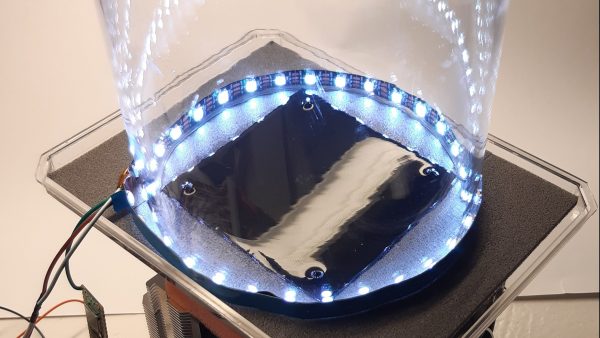
[Robert] uses a salvaged Peltier device, as you find in small electric refrigerators. These solid-state heat pumps usually convert electricity into a temperature differential, but in this case, it is used as a thermocouple, generating electricity from a temperature difference.

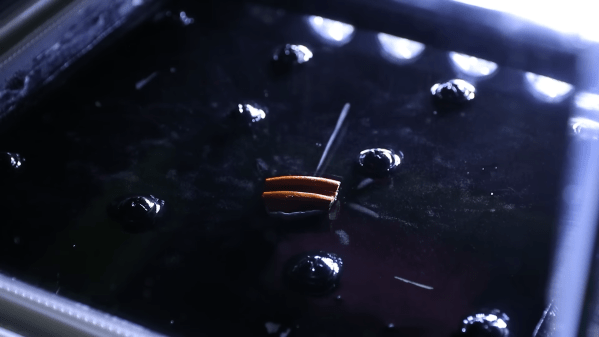
The clay used is a very fine aluminosilicate crystal known as zeolite 13X. Once it comes into contact with plain ordinary water, it immediately starts to boil. It’s a neat experiment, and with the Peltier underneath the metal container holding the clay, enough power is produced to spin a small motor. Of course this won’t power anything large, but on the other hand, plenty of things these days don’t take much power. This technique would work with any exothermic reaction of course, but there’s something compelling about the shelf-stability of water and clay.

Beats a potato, we suppose. Batteries don’t have to be difficult to make. It is only hard to make really good ones.

Continue reading “Clay Makes For DIY Power Source, Just Add Water”

Diagram of the Sun. (Credit: Kelvinsong)

Parker Solar Probe’s Confirmation Of Interchange Reconnection Being The Source Of Fast Solar Wind

Although experimental verification is at the heart of the scientific method, there is quite a difficulty range when it comes to setting up such an experiment. Testing what underlies the formation of the fast solar winds that are ejected from coronal holes in the Sun’s corona is one of these tricky experimental setups. Yet it would seem that we now have our answer, with a newly published paper in Nature by S. D. Bale and colleagues detailing what we learned courtesy of the Parker Solar Probe (PSP), which has been on its way to the Sun since it was launched in August of 2018 from Earth.

Artist rendition of the Parker Solar Probe. (Credit: NASA)

The Sun’s solar wind is the name for a stream of charged particles which are ejected from the Sun’s corona, with generally two types being distinguished: slow and fast solar winds. The former type appears to originate from the Sun’s equatorial belt and gently saunters away from the Sun at a mere 300 – 500 km/s with a balmy temperature of 100 MK.

The fast solar wind originates from coronal holes, which are temporary regions of cooler, less dense plasma within the corona. These coronal holes are notable for being regions where the Sun’s magnetic field extends into interplanetary space as an open field, along which the charged particles of the corona can escape the Sun’s gravitational field.

These properties of coronal holes allow the resulting stream to travel at speeds around 750 km/s and a blistering 800 MK. What was unclear up till this point was exactly what powers the acceleration of the plasma. It was postulated that the source could be wave heating, as well as interchange reconnection, but with the PSP now close enough to perform the relevant measurements, the evidence points to the latter.

Essentially, interchange reconnection is the reestablishing of a coronal hole’s field lines after interaction with convection cells on the Sun’s photosphere. These convection cells draw the magnetic field into a kind of funnel after which the field lines reestablish themselves, which results in the ejection of hotter plasma than with the slow solar wind. Courtesy of the PSP’s measurements, measured fast solar winds could be matched with coronal holes, along with the magnetic fields. This gives us the clearest picture yet of how this phenomenon works, and how we might be able to predict it.

(Heading image: Diagram of the Sun. (Credit: Kelvinsong) )

Characterizing Singular Atoms Using X-Ray Spectroscopy And Scanning Tunneling Microscopy

Scanning Tunneling Microscopes (STMs) are amazing tools which can manipulate singular atoms, but they cannot characterize these atoms as they act only on the outer electron shell. Meanwhile X-ray spectroscopy is a great tool for characterizing materials, but has so far been unable to scale down to singular atoms. This is where a recent study (paywalled, see summary article) by Tolulope M. Ajayi and colleagues demonstrates how both STM and X-rays can be combined in order to characterize singular atoms.

Structure of a part of the supramolecular complex used to measure the x-ray absorption spectrum of a single iron atom. The iron atom (red) is held within several ring-shaped structures. (Credit: Ajayi et al., 2023)

This research builds on previous research on synchrotron X-ray STM (SX-STM) which has been used for nanoscale imaging since 2009, but not down to the scale of a singular atom yet. Key to this achievement was to synthesize supramolecular complexes that could act as ‘tweezers’ to hold the atom under investigation in place and away from atoms of the same species. This not only allowed the atom to be identified using SX-STM, it also demonstrated that more subtle chemical properties of the atom can be analyzed in this manner, such as the way it interacts with other atoms.

The information gleaned this way matches up with what we know about the two atoms used in the study: iron and the rare earth terbium, with the latter’s lack of hybridization of its f orbitals (ℓ = 3) observable. For less well-studied atoms this method could provide a very efficient way to get a detailed overview of its properties. What is more, in future studies the researchers hope to use polarized X-rays to also obtain information about an atom’s spin state, opening interesting possibilities in areas such as spintronics and memory technologies.

Heading image: As the tip was scanned across ten positions in a sample containing two terbium atoms, it picked a signal only from the positions (2 and 9) where terbium was located (left: STM image; right: sketch of the corresponding molecular structure). (Credit: Ajayi et al, 2023)

Processing of PP/MWCNT nanocomposites and coating them with plasmonic NPs. (Credit: Sara Fateixa et al., 2023)

Affordably Detecting Water Pollutants Using 3D Printed Lattices And Plasmonic Nanoparticles

Although detecting pollution in surface waters has become significantly easier over the years, testing for specific pollutants still requires the taking of samples that are then sent to a laboratory for analysis. For something like detecting pesticide run-off, this can be a cumbersome and expensive procedure. But a 3D printed sensor demonstrated by [Sara Fateixa] and international colleagues offers hope that such tests can soon be performed in the field. The most expensive part of this setup is the portable Raman spectrometer that is used to detect the adsorbed molecules on the printed test strips.

The printed structure itself forms a plasmonic structure with gold or silver as the plasmonic metals deposited on the polypropylene (PP) and multi-walled carbon nanotube (MWCNT, 4% by weight) material. The mixture of PP and MWCNTs is to use both the bio-compatible properties of the former, while using the latter to make the PP significantly easier to print with and enhancing its mechanical properties.

Hamamatsu Raman Spectroscopy SERS Detection Module C13560.

For the experiment, researchers used a few prepared sensors to detect herbicides, including paraquat. This herbicide is cheap, widely used, and banned in various countries. After dissolving it in low concentrations in both tap water and sea water, a 3D printed sensor with Ag coating was was exposed to each sample before being left to dry at room temperature. Afterwards a Hamamatsu C13560 portable Raman spectrometer was used to analyze the sensors using surface-enhanced Raman scattering (SERS). The combination of plasmonic structures and Raman scattering means a significantly enhanced sensitivity, on the order of singular molecules, and is what makes SERS such a useful analytical technique.

In the resulting scan results, the herbicides showed up clearly, and further long-duration testing of newly printed sensors showed them to be very stable, even after 150 days of being stored. This makes it a promising new way to affordably and quickly perform tests for pollution, requiring only minimal local infrastructure to produce and analyze the sensors.

Heading: Processing of PP/MWCNT nanocomposites and coating them with plasmonic NPs. (Credit: Sara Fateixa et al., 2023)

Tree Planting Festivals, Air Cannons, Self-Burying Seeds, And The Complexities Of Reforestation

At first glance the problem of how to plant trees would seem to be a straightforward one: take a seed, jam it into the soil and let nature take its course. Or alternatively do much the same with a sapling that already got a start in a nice, comfortable greenhouse before leaving it to its own devices. To the average person this is generally the point where it’s considered a ‘done deal’, but one only has to take a look at the average survival rate of saplings out in the wild to perish that thought.

Each environment offers its own set of challenges when it comes to reforestation, which can perhaps be considered ironic as many of these trees are being planted where forests used to be, albeit centuries ago in many cases. There are the easy spots, such as flat fields, with rich soil, ample rain and mild weather, to the challenging terrain of Iceland, or mountainous terrain. Here the logistics are challenging and where once rich forests flourished, the very landscape seems adamant to reject this botanic intrusion.

Further complicating matters here are the myriad of reasons why we’re looking at planting so many new trees that it has even become an internet thing, as with the 2019 ‘Team Trees’ 20 million new trees challenge. So how did we get here, why exactly are we doing all of this, and how much of these attempts do bear fruit?

Continue reading “Tree Planting Festivals, Air Cannons, Self-Burying Seeds, And The Complexities Of Reforestation”

Royal Navy Tests Quantum Navigation

GPS has changed the way we get around the globe. But if you command a warship, you must think about what you would do if an adversary destroyed or compromised your GPS system. The Royal Navy and Imperial College London think a quantum navigation system might be the answer.
Of course, Heisenberg says you can’t know your speed and position simultaneously. But at the real-world level, you can apparently get close enough. The quantum sensors in question are essentially accelerometers. Unlike conventional accelerometers, though, these devices use ultracold atoms to make very precise measurements using a laser optical ruler, which means they do not drift as rapidly as, say, the accelerometer in your phone. Navigating with accelerometers is well understood, but the issue is how often you have to correct your computed position with an actual reference due to drift and other error accumulation. You can see a Sky News report on the trial below. Continue reading “Royal Navy Tests Quantum Navigation”

The Integral Molten Salt Reactor And The Benefits Of Having A Liquid Fission Reactor

Although to most the term ‘fission reactor’ brings to mind something close to the commonly operated light-water reactors (LWRs) which operate using plain water (H2O) as coolant and with sluggish, thermal neutrons, there are a dizzying number of other designs possible. Some of these have been in use for decades, like Canada’s heavy water (D2O) reactors (CANDU), while others are only now beginning to take their first step towards commercialization.

These include helium-cooled, high-temperature reactors like China’s HTR-PM, but also a relatively uncommon type developed by Terrestrial Energy, called the Integral Molten Salt Reactor (IMSR). This Canadian company recently passed phase 2 of the Canadian Nuclear Safety Commission’s (CNSC) pre-licensing vendor review. What makes the IMSR so interesting is that as the name suggests, it uses molten salts: both for coolant and the low-enriched uranium fuel, while also breeding fuel from fertile isotopes that would leave an LWR as part of its spent fuel.

So why would you want your fuel to be fluid rather than a solid pellet like in most reactors today?

Continue reading “The Integral Molten Salt Reactor And The Benefits Of Having A Liquid Fission Reactor”