Do you have a 5 V device you want to run 24/7, no matter whether you have electricity? Not to worry – Linear Technology has made a perfect IC for you, the LTC4040; with the perfect assortment of features, except perhaps for the hefty price tag.
[Lukilukeskywalker] has shared a PCB for us to review – a LTC4040-based stamp you can drop onto your PCB whenever you want a LTC4040 design. It’s a really nice module to see designed – things like LiFePO4 support make this IC a perfect solution for many hacker usecases. For instance, are you designing a custom Pi HAT? Drop this module to give your HAT the UPS capability for barely any PCB effort. if your Pi or any other single-board computer needs just a little bit of custom sauce, this module spices it up alright!
This week Jonathan Bennett and Katherine Druckman chat with Steve Seguin about VDO.Ninja and Social Stream Ninja, tools for doing live WebRTC video calls, recording audio and video, wrangling comments on a bunch of platforms, and more!
There was a time when a coffee vending machine was a relatively straightforward affair, with a basic microcontroller doing not much more than the mechanical sequencer it replaced. A modern machine by contrast has 21st century computing power, with touch screens, a full-fat operating system, and a touch screen interface. At Hackaday Supercon 2023, [Kuba Tyszko] shared his adventures in the world of coffee, after reverse engineering a couple of high-end dispensing machines. Sadly he doesn’t reveal the manufacturer, but we’re sure readers will be able to fill in the gaps.
Under the hood is a PC running a Linux distro from a CF card. Surprisingly the distros in question were Slax and Lubuntu, and could quite easily be investigated. The coffee machine software was a Java app, which seems to us strangely appropriate, and it communicated to the coffee machine hardware via a serial port. It’s a tale of relatively straightforward PC reverse engineering, during which he found that the machine isn’t a coffee spy as its only communication with its mothership is an XML status report.
In a way what seems almost surprising is how relatively straightforward and ordinary this machine is. We’re used to quirky embedded platforms with everything far more locked down than this. Meanwhile if hacking vending machines is your thing, you can find a few previous stories on the topic.
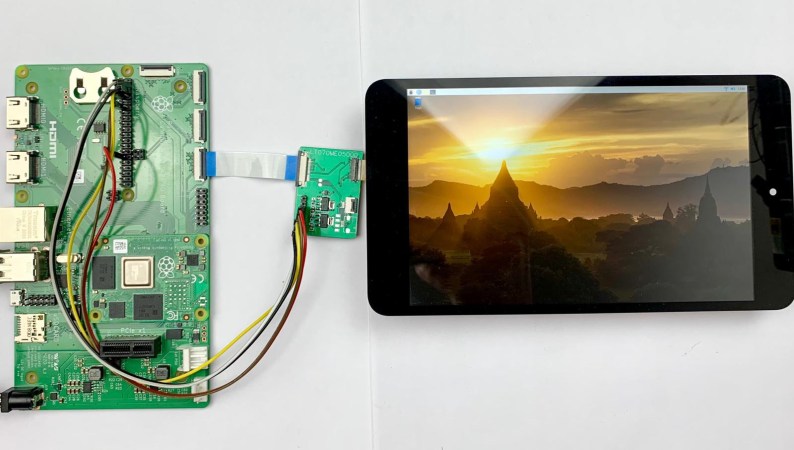
We would not be surprised if DSI screens made up the majority of screens on our planet at this moment in time. If you own a smartphone, there’s a 99.9% chance its screen is DSI. Tablets are likely to use DSI too, unless it’s eDP instead, and a smartwatch of yours definitely will. In a way, DSI displays are inescapable.
This is for a good reason. The DSI interface is a mainstay in SoCs and mobile CPUs worth their salt, it allows for higher speeds and thus higher resolutions than SPI ever could achieve, comparably few pins, an ability to send commands to the display’s controller unlike LVDS or eDP, and staying low power while doing all of it.
There’s money and power in hacking on DSI – an ability to equip your devices with screens that can’t be reused otherwise, building cooler and cooler stuff, tapping into sources of cheap phone displays. What’s more, it’s a comparably underexplored field, too. Let’s waste no time, then!
Decently Similar Internals
DSI is an interface defined by the MIPI Alliance, a group whose standards are not entirely open. Still, nothing is truly new under the sun, and DSI shares a lot of concepts with interfaces we’re used to. For a start, if you remember DisplayPort internals, there are similarities. When it comes to data lanes, DSI can have one, two or four lanes of a high-speed data stream; smaller displays can subsist with a single-lane, while very high resolution displays will want all four. This is where the similarities end. There’s no AUX to talk to the display controller, though – instead, the data lanes switch between two modes.
A few years back I wrote an “Ask Hackaday” article inviting speculation on the future of the physical plant of landline telephone companies. It started innocently enough; an open telco cabinet spotted during my morning walk gave me a glimpse into the complexity of the network buried beneath my feet and strung along poles around town. That in turn begged the question of what to do with all that wire, now that wireless communications have made landline phones so déclassé.
At the time, I had a sneaking suspicion that I knew what the answer would be, but I spent a good bit of virtual ink trying to convince myself that there was still some constructive purpose for the network. After all, hundreds of thousands of technicians and engineers spent lifetimes building, maintaining, and improving these networks; surely there must be a way to repurpose all that infrastructure in a way that pays at least a bit of homage to them. The idea of just ripping out all that wire and scrapping it seemed unpalatable.
With the decreasing need for copper voice and data networks and the increasing demand for infrastructure to power everything from AI data centers to decarbonized transportation, the economic forces arrayed against these carefully constructed networks seem irresistible. But what do the numbers actually look like? Are these artificial copper mines as rich as they appear? Or is the idea of pulling all that copper out of the ground and off the poles and retasking it just a pipe dream?
Last time, we went over switching regulator basics – why they’re wonderful, how do you find a switching regulator chip for your purpose, and how to easily pick an inductor for one. Your datasheet should also tell you about layout requirements. However, it might not, or you might want to deviate from them – let’s go more in-depth on what those requirements are about.
Appreciate The Feedback
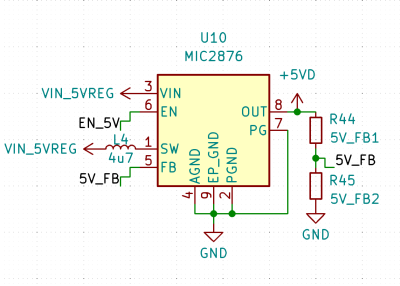
The two resistors on the right decide what your output voltage will be, and their output is noise-sensitive
There’s a few different switching regulator topologies. Depending on your regulator’s topology and how many components your chip contains, you might need some external components – maybe a Schottky diode, maybe a FET, or maybe even a FET pair. It’s often that the FET is built-in, and same goes for diodes, but with higher-current regulator (2 A to 3 A and above), it’s not uncommon to require an external one. For sizing up those, you’ll want to refer to the datasheet or existing boards.
Another thing is input and output capacitors – don’t skimp on those, because some regulators are seriously sensitive to the amount of capacitance they’re operating with. Furthermore, if you fail to consider things like capacitance dropping with voltage, you might make your regulator very unhappy – not that a linear regulator would be happy either, to be clear. We’ve covered an explainer on this recently – do check it out!
One thing you will likely need, is a feedback resistor divider – unless your switching regulator is pre-set for a certain voltage or is digitally controlled, you need to somehow point it to the right voltage, in an analog way. Quite a few switching regulators are set for a certain voltage output, but most of them aren’t, and they will want you to add a resistor divider to know what to output. There’s usually a formula for resistor divider calculation, so, pick a common resistor value, put it in as one of the resistors into the formula, get the other resistor value out of that formula, and see what’s the closest value you can actually buy. Don’t go below about 10 kΩ so that you don’t have unnecessary idle power consumption, but also don’t go too far above 100 kΩ to ensure good stability of the circuit. Continue reading “Switching Regulator Layout For Dummies”→
We’ve been harping a lot lately about the effort by carmakers to kill off AM radio, ostensibly because making EVs that don’t emit enough electromagnetic interference to swamp broadcast signals is a practical impossibility. In the US, push-back from lawmakers — no doubt spurred by radio industry lobbyists — has put the brakes on the move a bit, on the understandable grounds that an entire emergency communication system largely centered around AM radio has been in place for the last seven decades or so. Not so in Japan, though, as thirteen of the nation’s 47 broadcasters have voluntarily shut down their AM transmitters in what’s billed as an “impact study” by the Ministry of Internal Affairs and Communications. The request for the study actually came from the broadcasters, with one being quoted in a hearing on the matter as “hop[ing] that AM broadcasting will be promptly discontinued.” So the writing is apparently on the wall for AM radio in Japan.