Anyone who has spent any amount of time in or near people who are really interested in energy policies will have heard proclamations such as that ‘baseload is dead’ and the sorting of energy sources by parameters like their levelized cost of energy (LCoE) and merit order. Another thing that one may have noticed here is that this is also an area where debates and arguments can get pretty heated.
The confusing thing is that depending on where you look, you will find wildly different claims. This raises many questions, not only about where the actual truth lies, but also about the fundamentals. Within a statement such as that ‘baseload is dead’ there lie a lot of unanswered questions, such as what baseload actually is, and why it has to die.
Upon exploring these topics we quickly drown in terms like ‘load-following’ and ‘dispatchable power’, all of which are part of a healthy grid, but which to the average person sound as logical and easy to follow as a discussion on stock trading, with a similar level of mysticism. Let’s fix that.
If you’ve been even casually following NASA’s return to the Moon, you’re likely aware of the recent Wet Dress Rehearsal (WDR) for the Artemis II mission. You probably also heard that things didn’t go quite to plan: although the test was ultimately completed and the towering Space Launch System (SLS) rocket was fully loaded with propellant, a persistent liquid hydrogen leak and a few other incidental issues lead the space agency to delay further testing for at least a month while engineers make adjustments to the vehicle.
This constitutes a minor disappointment for fans of spaceflight, but when you’re strapping four astronauts onto more than five million pounds of propellants, there’s no such thing as being too cautious. In fact, there’s a school of thought that says if a WDR doesn’t shake loose some gremlins, you probably weren’t trying hard enough. Simulations and estimates only get you so far, the real thing is always more complex, and there’s bound to be something you didn’t account for ahead of time.
Let’s face it; remembering a bunch of passwords is the pits, and it’s just getting worse as time goes on. These days, you really ought to have a securely-generated key-smash password for everything. And at that point you need a password manager, but you still have to remember the password for that.
Well, Motorola is sympathetic to this problem, or at least they were in 2013 when they came up with the password pill. Motorola Mobility, who were owned by Google at the time, debuted it at the All Things Digital D11 tech conference in California. This was a future that hasn’t come to pass, for better or worse, but it was a fun thought experiment in near-futurism.
Today, we take office software suites for granted. But in the 1970s, you were lucky to have a typewriter and access to a photocopier. But in the early 1980s, IBM rolled out PROFS — the Professional Office System — to try to revolutionize the office. It was an offshoot of an earlier internal system. The system would hardly qualify as an office suite today, but for the time it was very advanced.
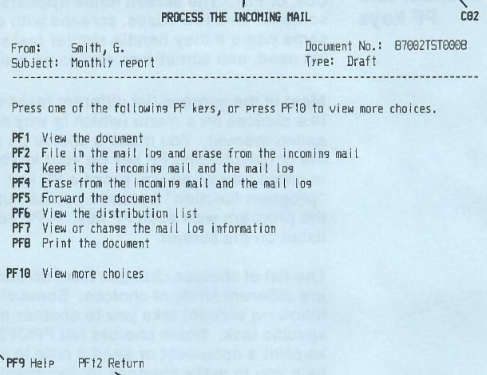
The key component was an editor you could use to input notes and e-mail messages. PROFS also kept your calendar and could provide databases like phonebooks. There were several key features of PROFS that would make it hard to recognize as productivity software today. For one thing, IBM terminals were screen-oriented. The central computer would load a form into your terminal, which you could fill out. Then you’d press send to transmit it back to the mainframe. That makes text editing, for example, a very different proposition since you work on a screen of data at any one time. In addition, while you could coordinate calendars and send e-mail, you could only do that with certain people.
A PROFS message from your inbox
In general, PROFS connected everyone using your mainframe or, perhaps, a group of mainframes. In some cases, there might be gateways to other systems, but it wasn’t universal. However, it did have most of the major functions you’d expect from an e-mail system that was text-only, as you can see in the screenshot from a 1986 manual. PF keys, by the way, are what we would now call function keys.
The calendar was good, too. You could grant different users different access to your calendar. It was possible to just let people see when you were busy or mark events as confidential or personal.
You could actually operate PROFS using a command-line interface, and the PF keys were simply shorthand. That was a good thing, too. If you wanted to erase a file named Hackaday, for example, you had to type: ERASE Hackaday AUT$PROF.
Styles
PROFS messages were short and were essentially ephemeral chat messages. Of course, because of the block-mode terminals, you could only get messages after you sent something to the mainframe, or you were idle in a menu. A note was different. Notes were what we could call e-mail. They went into your inbox, and you could file them in “logs”, which were similar to folders.
When it comes to knowledge there are things you know as facts because you have experienced them yourself or had them verified by a reputable source, and there are things that you know because they are common knowledge but unverified. The former are facts, such as that a 100mm cube of water contains a litre of the stuff, while the latter are received opinions, such as the belief among Americans that British people have poor dental care. The first is a verifiable fact, while the second is subjective.
In our line there are similar received opinions, and one of them is that you shouldn’t print with old 3D printing filament because it will ruin the quality of your print. This is one I can now verify for myself, because I was recently given a part roll of blue PLA from a hackerspace, that’s over a decade old. It’s not been stored in a special environment, instead it’s survived a run of dodgy hackerspace premises with all the heat and humidity that’s normal in a slightly damp country. How will it print?
It Ain’t Stringy
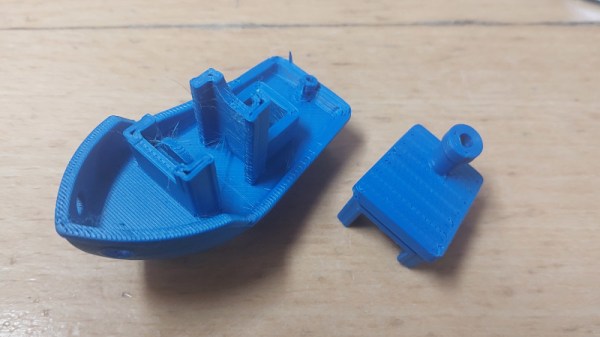
In the first instance, looking at the filament, it looks like any other filament. No fading of the colour, no cracking, if I didn’t know its age it could have been opened within the last few weeks. It loads into the printer, a Prusa Mini, fine, it’s not brittle, and I’m ready to print a Benchy.
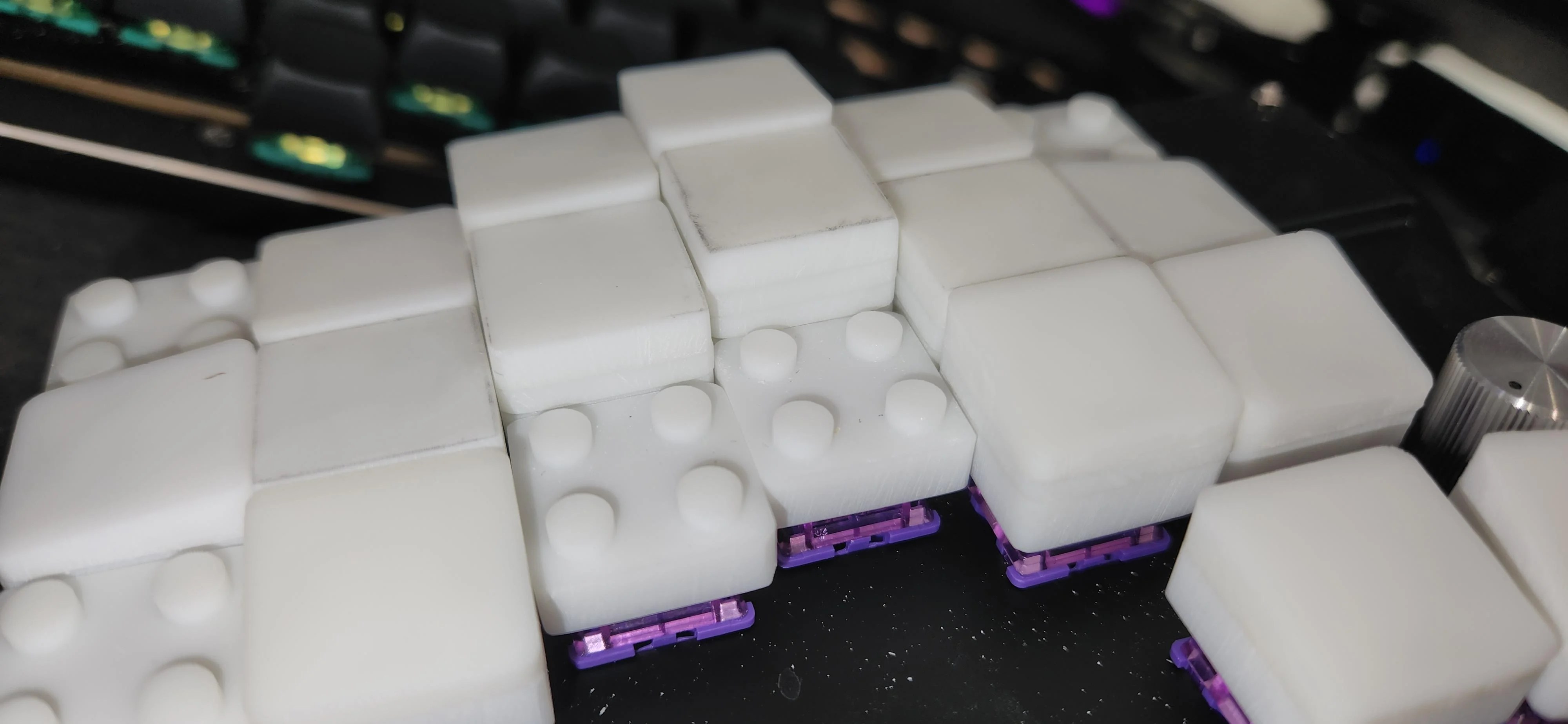
Now, we can’t call these LEGO key caps for obvious reasons, but also because they don’t actually work with standard LEGO. But that’s just fine and dandy, because they’re height-adjustable key caps that use the building block principle.
Image by [paper5963] via redditNow you could just as easily build wells as the dome shape pictured here, and I’d really like to see that one of these days.
In the caption of the gallery, [paper5963] mentions foam. As far as I’ve studied the pictures, it seems to be all 3D-printed material. If they were foam, they would likely be porous and would attract and hold all kinds of nastiness. Right?
[paper5963] says that there are various parts that add on to these, not just flat tops. There are slopes and curves, too. They are also designing these for narrow pitch, and say they are planning to release the files. Exciting!
The BBC recently published an exposé revealing that some Chinese subscription sites charge for access to their network of hundreds of hidden cameras in hotel rooms. Of course, this is presumably without the consent of the hotel management and probably isn’t specifically a problem in China. After all, cameras can now be very tiny, so it is extremely easy to rent a hotel room or a vacation rental and bug it. This is illegal, China has laws against spy cameras, and hotels are required to check for them, the BBC notes. However, there is a problem: At least one camera found didn’t show up on conventional camera detectors. So we wanted to ask you, Hackaday: How do you detect hidden cameras?
How it Works
Commercial detectors typically use one of two techniques. It is easy to scan for RF signals, and if the camera is emitting WiFi or another frequency you expect cameras to use, that works. But it also misses plenty. A camera might be hardwired, for example. Or store data on an SD card for later. If you have a camera that transmits on a strange frequency, you won’t find it. Or you could hide the camera near something else that transmits. So if your scanner shows a lot of RF around a WiFi router, you won’t be able to figure out that it is actually the router and a small camera.