Google Calls It Quits With VR, But Cardboard Lives On

Google giving up on one of their projects and leaving its established userbase twisting in the wind hardly counts as news anymore. In fact, it’s become something of a meme. The search giant is notorious for tossing out ideas just to see what sticks, and while that’s occasionally earned them some huge successes, it’s also lead to plenty of heartache for anyone unlucky enough to still be using one of the stragglers when the axe falls.

So when the search giant acknowledged in early March that they would no longer be selling their Cardboard virtual reality viewer, it wasn’t exactly a shock. The exceptionally low-cost VR googles, literally made from folded cardboard, were a massive hit when they were unveiled back in 2014. But despite Google’s best efforts to introduce premium Cardboard-compatible hardware with their Daydream View headset two years later, it failed to evolve into a profitable business.

Google Cardboard

Of course if you knew where to look, the writing had been on the wall for some time. While the Daydream hardware got a second revision in 2017, and Google even introduced a certification program to ensure phones would work properly with the $100 USD headset, the device was discontinued in 2019. On the software side, Android 7 “Nougat” got baked-in VR support in 2016, but it was quietly removed by the time Android 11 was released in the fall of 2020.

With Cardboard no longer available for purchase, Google has simply made official what was already abundantly clear: they are no longer interested in phone-based virtual reality. Under normal circumstances, anyone still using the service would be forced to give it up. Just ask those who were still active on Google+ or Allo before the plug was pulled.

But this time, things are a little different. Between Google’s decision to spin it off into an open source project and the legions of third party viewers on the market, Cardboard isn’t going down without a fight. The path ahead might be different from what Google originally envisioned, but the story certainly isn’t over.

Continue reading “Google Calls It Quits With VR, But Cardboard Lives On”

A Few Of My Favorite Things: Pens

Pens! They just might be the cheapest, most important piece of technology ever overlooked by a large group of people on a daily basis. Pens are everywhere from your desk to your car to your junk drawer, though they tend to blink out of existence when you need one. Where would we be without them? Probably still drawing on cave walls with dandelions and beets.

Photo of a Pilot Metropolitan by Aaron Burden on Unsplash

Why do I think pens are so great? Well, they’re a relatively cheap tool depending on the pen you get, but whatever you spend, you’re getting a lot for your money. Pens are possibility, pure and simple, and they’re even conveniently packaged in a portable device.

Aesthetically speaking, I like pens because of how different they can be both inside and out. Some of them make thick lines, some make thin lines, and in the case of flexible nibs, some alternate between thick and thin lines depending on pressure. I use pens for a number of reasons, most notably for writing. Everything you read here that bears my name began life as pen marks on paper.

Pens are revolutionary because they can be used to make ideas permanent and/or illustrate any concept. It’s up to you to use the pen wisely. You can use other, better tools later, but pens are always a great first tool. If you’re not encumbered by an uncomfortable grip, ink that skips, or a scratchy, draggy contact point, your ideas will flow more freely. When you find the right pen for you, you aren’t hindered by your tool — you’re elevated by it. Continue reading “A Few Of My Favorite Things: Pens”

Wet Country Wireless; How The British Weather Killed A Billion Pound Tech Company

A dingy and cold early February in a small British town during a pandemic lockdown is not the nicest time and place to take your exercise, but for me it has revived a forgotten memory and an interesting tale of a technology that promised a lot but delivered little. Walking through an early-1990s housing development that sprawled across the side of a hill, I noticed a couple of houses with odd antennas. Alongside the usual UHF Yagis for TV reception were small encapsulated microwave arrays about the size of a biscuit tin. Any unusual antenna piques my interest but in this case, though they are certainly unusual, I knew immediately what they were. What’s more, a much younger me really wanted one, and only didn’t sign up because their service wasn’t available where I lived.

All The Promise…

The TV advert looked promising in 1998.

Ionica was a product of Cambridge University’s enterprise incubator, formed at the start of the 1990s with the aim of being the first to provide an effective alternative to the monopolistic British Telecom in the local loop. Which is to say that in the UK at the time the only way to get a home telephone line was to go through BT because they owned all the telephone wires, and it was Ionica’s plan to change all that by supplying home telephone services via microwave links.

Their offering would be cheaper than BT’s at the socket because no cable infrastructure would be required, and they would aim to beat the monopoly on call costs too. For a few years in the mid 1990s they were the darling of the UK tech investment world, with a cutting edge prestige office building just outside Cambridge, and TV adverts to garner interest in their product. The service launched in a few British towns and cities, and then almost overnight they found themselves in financial trouble and were gone. After their demise at the end of 1998 the service was continued for a short while, but by the end of the decade it was all over. Just what exactly happened?

Continue reading “Wet Country Wireless; How The British Weather Killed A Billion Pound Tech Company”

Putting Your Time In

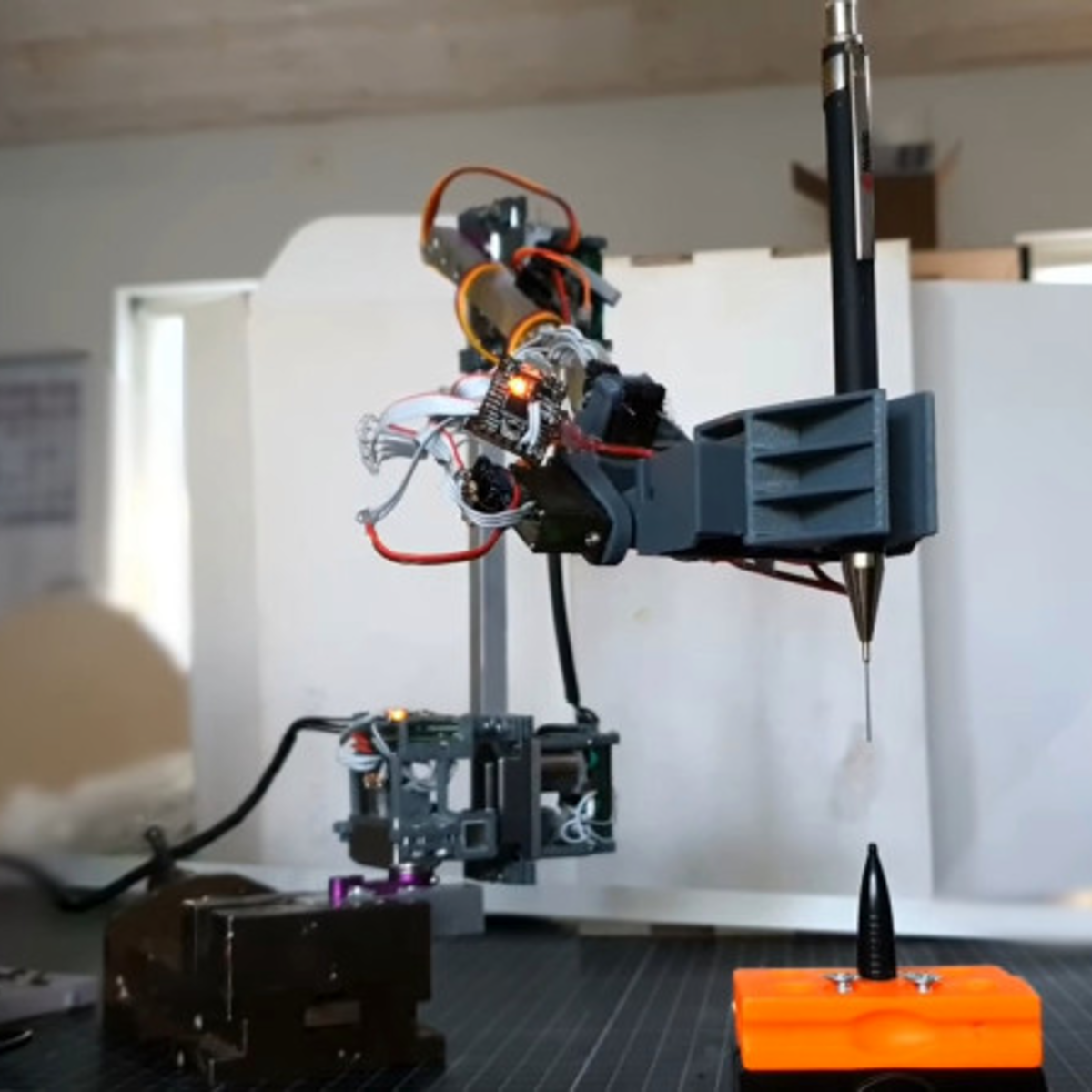
I was absolutely struck by a hack this week — [Adam Bäckström]’s amazing robot arm built with modified hobby servos. Basically, he’s taken apart and re-built some affordable off-the-shelf servo motors, and like the 6-Million-Dollar Man, he’s rebuilt them better, stronger, faster. OK, and smoother. We have the technology.

The results are undeniably fantastic, and enable the experienced hacker to get champagne robot motion control on a grape-juice budget by employing some heavy control theory, and redundant sensors to overcome geartrain backlash, which is the devil of cheap servos. But this didn’t come out of nowhere. In his writeup, [Adam] starts off with “You could say this project started when I ordered six endless servos in middle school, more than 15 years ago.” And it shows.

Go check out this video of his first version of the modified servos, from a six-axis arm he built in 2009(!). He’s built in analog position sensors in the motors, which lets him control the speed and makes it work better than any other hobby servo arm you’ve ever seen, but there’s still visible backlash in the gears. A mere twelve years later, he’s got magnetic encoders on the output and a fast inner loop compensates for the backlash. The result is that the current arm moves faster and smoother, while retaining accuracy.

Twelve years. I assume that [Adam] has had some other projects on his plate as well, but that’s a long term project by any account. I’m stoked to see his work, not the least because it should help a lot of others who are ready to step up their desktop servo-arm projects. But the real take-home lesson here is that if you’ve got a tough problem that you’re hacking on, you don’t have to get it done this weekend. You don’t have to get it done next weekend either. Keep hammering on it as long as you need, but keep on hammering. When you get it done, the results will be all the better for the long, slow, brewing time. What’s the longest project that you’ve ever worked on?

Bare-Metal STM32: Please Mind The Interrupt Event

Interruptions aren’t just a staple of our daily lives. They’re also crucial for making computer systems work as well as they do, as they allow for a system to immediately respond to an event. While on desktop computers these interrupts are less prominent than back when we still had to manually set the IRQ for a new piece of hardware using toggle switches on an ISA card, IRQs along with DMA (direct memory access) transfers are still what makes a system appear zippy to a user if used properly.

On microcontroller systems like the STM32, interrupts are even more important, as this is what allows an MCU to respond in hard real-time to an (external) event. Especially in something like an industrial process or in a modern car, there are many events that simply cannot be processed whenever the processor gets around to polling a register. Beyond this, interrupts along with interrupt handlers provide for a convenient way to respond to both external and internal events.

In this article we will take a look at what it takes to set up interrupt handlers on GPIO inputs, using a practical example involving a rotary incremental encoder.

Continue reading “Bare-Metal STM32: Please Mind The Interrupt Event”

Hackaday Podcast 111: 3D Graphics Are Ultrasonic, Lobotomizing Alexa, 3D-Printing Leaky Rockets, And Gaming The Font System

Hackaday editors Mike Szczys and Elliot Williams curate a week of great hacks. Physical displays created in 3D space are a holy grail, and you can make one with 200 ultrasonic transducers, four FPGAs, and a lot math. Smart speakers have one heck of a microphone array in them, it’s yours for the hacking if you just roll your own firmware. Hobby servos can be awful, but this week we saw they can be made really great by cracking open the DC motor to add a simple DIY position sensor. And lasers are making their way into car headlights; we illuminate the situation in this episode.

Take a look at the links below if you want to follow along, and as always, tell us what you think about this episode in the comments!

Direct download (~60 MB)

Places to follow Hackaday podcasts:

Continue reading “Hackaday Podcast 111: 3D Graphics Are Ultrasonic, Lobotomizing Alexa, 3D-Printing Leaky Rockets, And Gaming The Font System”

This Week In Security: XcodeSpy, Insecure SMS, And Partial Redactions

There seems to be a new trend in malware, targeting developers and their development and build processes. The appeal is obvious: rather than working to build and market a malicious application, an attacker just needs to infect a development machine. The hapless infected developers can now do the hard work to spread the malicious payload.

The newest example is XcodeSpy, discovered by a researcher who chose to remain anonymous. It works by using the Xcode IDE’s Run Script function to, well, run a script that completely backdoors your computer. The instance was found in a repackaged open source project, TabBarInteraction, but they’re just innocent victims. It was simple enough for someone to insert a script in the build process, and distribute the new, doped package. It’s probably not the only one out there, so watch out for Run Scripts with obfuscated payloads.

Continue reading “This Week In Security: XcodeSpy, Insecure SMS, And Partial Redactions”