Superconference Speakers Revealed

You’ll find the best hardware talks at the Hackaday Superconference. This year, we received over 140 proposals for a few dozen speaking slots. Although we’re still working through the proposals, today we can announce a few of the accepted and confirmed speakers so far. Below you’ll find about a third of the total slate of speakers.

Get Your Ticket to the Hackaday Superconference — they’re almost gone!

Continue reading “Superconference Speakers Revealed”

The Components Are INSIDE The Circuit Board

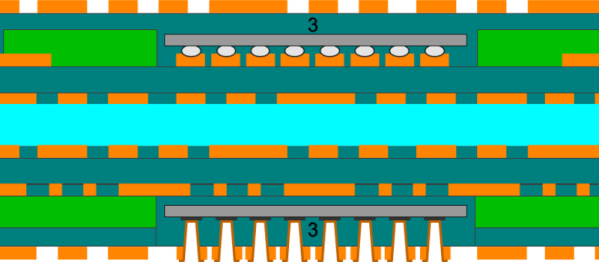
Through-hole assembly means bending leads on components and putting the leads through holes in the circuit board, then soldering them in place, and trimming the wires. That took up too much space and assembly time and labor, so the next step was surface mount, in which components are placed on top of the circuit board and then solder paste melts and solders the parts together. This made assembly much faster and cheaper and smaller.

Now we have embedded components, where in order to save even more, the components are embedded inside the circuit board itself. While this is not yet a technology that is available (or probably even desirable) for the Hackaday community, reading about it made my “holy cow!” hairs tingle, so here’s more on a new technology that has recently reached an availability level that more and more companies are finding acceptable, and a bit on some usable design techniques for saving space and components.

Continue reading “The Components Are INSIDE The Circuit Board”

These Twenty Assistive Technologies Projects Won $1000 In The Hackaday Prize

Today, we’re excited to announce the winners of the Assistive Technologies portion of The Hackaday Prize. In this round, we’re looking for projects that will help ensure a better quality of life for the disabled. Whether this is something that enhances learning, working, or daily living. These are the projects that turn ‘disability’ into ‘this ability’.

Hackaday is currently hosting the greatest hardware competition on Earth. We’re giving away hundreds of thousands of dollars to hardware creators to build the next great thing. Last week, we wrapped up the fourth of five challenges. It was all about showing a design to Build Something That Matters. Hundreds entered and began their quest to build a device to change the world.

There’s still one entry challenge remaining in The Hackaday Prize. Anything Goes is on right now and open to every idea imaginable. If you’re building a computer made of sand, awesome. Quadcopter hammock? Neat. This is the portion of the Hackaday Prize that’s open to the best ideas out there. It’s up to you to explain how your creation makes the world a little bit better place.

The winners of the Assistive Technologies challenge are, in no particular order:

Assistive Technologies Hackaday Prize Finalists:

Continue reading “These Twenty Assistive Technologies Projects Won $1000 In The Hackaday Prize”

Hack Space Debris At Your Peril

Who has dibs on space debris? If getting to it were a solved problem, it sure would be fun to use dead orbital hardware as something of a hacker’s junk bin. Turns out there is some precedent for this, and regulations already in place in the international community.

To get you into the right frame of mind: it’s once again 2100 AD and hackers are living in mile-long space habitats in the Earth-Moon system. But from where do those hackers get their raw material, their hardware? The system abounds with space debris, defunct satellites from a century of technological progress. According to Earth maritime law, if space is to be treated like international waters then the right of salvage would permit them to take parts from any derelict. But is space like international waters? Or would hacking space debris result in doing hard time in the ice mines of Ceres?

Continue reading “Hack Space Debris At Your Peril”

Scribble Your Way To Quick Printed Circuit Boards

There are a variety of techniques employed by electronic constructors seeking the convenience of a printed circuit board without the inconvenience of making a printed circuit board. Dead bug style construction in which the components float on a spiders-web of soldered leads above a ground plane is one, Manhattan style construction in which pads made from small cut squares of bare copper-clad PCB are glued on top of a groundplane is another.

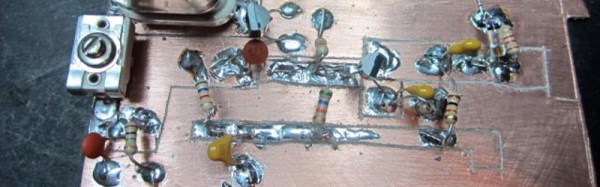
[Freestate QRP] has another take on this type of electronics, with what he calls “Scribble style” construction. He cuts away copper from bare board to create pads and rudimentary tracks, and for him the magic ingredient comes from his choice of an engineer’s scribe to do the job. This is where the “scribble” comes from, creating a pad is as simple as drawing it with the scribe.

Of course, this technique is not entirely new, constructors have been doing this type of work for years with Dremel tools, hand engraving tools, and similar. If you’ve ever tried to do it with a knife or scalpel you will know that it’s hardly an easy task with those hand tools so the prospect of another one doing a better job is rather interesting. He’s ready and able to demonstrate it in action, showing us a couple of RF circuits using the technique.

Have you tried this technique, or one like it? How did you get on, tell us in the comments. Meanwhile, you might like to read our own [Dan Maloney]’s look at dead bug and Manhattan construction.


Bodging On More Flash Memory

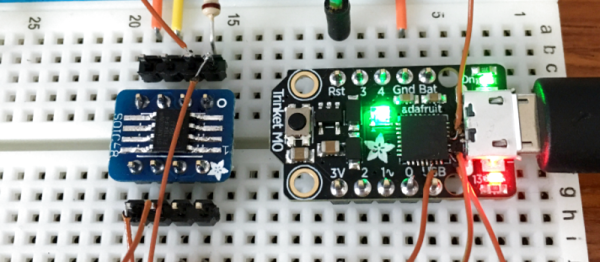
[Curmudegeoclast] found himself running out of flash memory on a Trinket M0 board, so he decided to epoxy and fly-wire a whopping 2 MB of extra flash on top of the original CPU.

We’ll just get our “kids these days” rant out of the way up front: the stock SAMD21 ARM chip has 256 kB (!) of flash to begin with, and is on a breakout board with only five GPIO pins, for a 51 kB / pin ratio! And now he’s adding 2 MB more? That’s madness. The stated reason for [Curmudegeoclast]’s exercise is MicroPython, which takes up a big chunk of flash just for the base language. We suspect that there’s also a fair amount of “wouldn’t it be neat?” in the mix as well. Whatever.

The hack is a classic. It starts off with sketchy wires soldered to pins and breadboarded up with a SOIC expander board. Following that proof of concept, some degree of structural integrity is brought to the proceedings by gluing the flash chip, dead-bug, on top of the microcontroller. We love the (0805?) SPI pullup resistor that was also point-to-point soldered into place. We would not be able to resist the temptation to entomb the whole thing in hot glue for “long-term” stability, but there are better options out there, too.

This hack takes a minimalist board, and super-sizes it, and for that, kudos. What would you stuff into 2 MB of free flash on a tiny little microcontroller? Any of you out there using MicroPython or CircuitPython care to comment on the flash memory demands? 256 kB should be enough for anyone.

Hardware For Deep Neural Networks

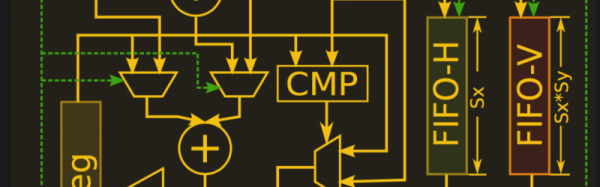
In case you didn’t make it to the ISCA (International Society for Computers and their Applications) session this year, you might be interested in a presentation by [Joel Emer] an MIT  professor and scientist for NVIDIA. Along with another MIT professor and two PhD students ([Vivienne Sze], [Yu-Hsin  Chen], and [Tien-Ju Yang]), [Emer’s] presentation covers hardware architectures for deep neural networks.

The presentation covers the background on deep neural networks and basic theory. Then it progresses to deep learning specifics. One interesting graph shows how neural networks are getting better at identifying objects in images every year and as of 2015 can do a better job than a human over a set of test images. However, the real key is using hardware to accelerate the performance of networks.

Hardware acceleration is important for several reasons. For one, many applications have lots of data associated. Also, training can involve many iterations which can take a long time.

Continue reading “Hardware For Deep Neural Networks”