Most Of What You Wish You Knew About Coils Of Wire But Were Afraid To Ask

If you are a novice electronic constructor, you will become familiar with common electronic components. Resistors, capacitors, transistors, diodes, LEDs, integrated circuits. These are the fodder for countless learning projects, and will light up the breadboards of many a Raspberry Pi or Arduino owner.

There is a glaring omission in that list, the inductor. True, it’s not a component with much application in simple analogue or logic circuits, and it’s also a bit more expensive than other passive components. But this omission creates a knowledge gap with respect to inductors, a tendency for their use to be thought of as something of a black art, and a trepidation surrounding their use in kits and projects.

We think this is a shame, so here follows an introduction to inductors for the inductor novice, an attempt to demystify them and encourage you to look at them afresh if you have always steered clear of them.

Continue reading “Most Of What You Wish You Knew About Coils Of Wire But Were Afraid To Ask”

Hoverboards Are Here – If You’re Crazy Enough To Try

A new video has been stirring questions on the internet this week. It shows a test of the Flyboard Air, a device that is somewhere between a Back to the Future Hoverboard and Green Goblin’s glider. The video depicts pilot [Frank Zapata] taking off, flying around, and landing an a platform not much larger than a milk crate. Plenty of folks are calling the video a fake. After a few back of the napkin calculations though, we’re coming out to say we think it’s real. Details are few and far between, so much of the information in this article is educated guessing based upon the video.

Here’s our hypothesis: Flyboard Air is a jet powered platform with little or no built-in intelligence. Balance, stability and control are all handled by the pilot. A hand controller simply provides throttle to adjust altitude, take off, and land.

jetfeetLet’s start with the jet powered part. During the video, [Frank] looks down at his board and the water below. Between his sneakers we can see two round openings – which look a lot like jet intakes. At the end of the video, [Frank] flies over the camera. stopping the action shows a split second where four exhaust holes are visible on the bottom of the board. These jets look quite a bit like model aircraft jet engines.

We don’t know exactly which engines [Frank] is using, but as an example, the Jet-Cat P 400 RX-G packs 88 lbs of thrust into a shell less than 6 inches in diameter, weighing less than 8 lbs. Four of those engines would provide 352 lbs of thrust. That’s plenty to lift [Frank], the board, and a few gallons of Jet-A strapped to his back.

Why no built-in intelligence? Even the smallest quadcopters have gyros, accellerometers, and PID loops keeping them upright. The problem boils down to the physics of jet engines. Active stability in a fixed pitch rotary blade system requires very fast throttle response. Quadcopters have this with their brushless motors. Turbines however, have throttle lag on the order of seconds. You can’t beat physics. Accelerating 3 or 4 pounds metal from 78,000 RPM (~70% throttle) to 98,000 RPM (~100 % throttle) takes time.

flyboard1Standing on a column of uncontrolled thrust would take quite a bit of skill on the part of the pilot. As it turns out, [Frank] is one of the world’s most experienced thrust riders. His previous invention, the Flyboard uses a personal watercraft to create a column of thrust which the rider stands on. These boards have become tremendously popular at vacation spots in the last few years. There are plenty of videos on [Frank’s] YouTube channel showing the amount of control a skilled ride has over the board. Loops, spins, and other aerobatics look easy.

With that much skill under his belt, [Frank] would have no problem keeping balanced on four jet engines.

Such a skilled rider means that control wouldn’t really be needed on the board. We’re betting that the only electronics are the remote throttle control and the Engine Control Computers (ECU) needed to keep the jets running and synchronized. The two electric ducted fans on the sides of the Flyboard Air appear to be running all the time, only shutting down when [Frank] lands the board.

One final thought – taking off and landing a jet vertically is difficult. Ground effects destabilize the craft. Engines can suck in their own exhaust, stalling them. These are problems faced by the harrier jump jet and the joint strike fighter. [Frank’s ] solution is not never get too close to the ground. If you watch closely, he takes off and lands from a perforated metal platform mounted off the back of a van. The metal doesn’t reflect enough thrust to cause the Flyboard to become unstable or stall.

So is the video real? We think so. This is an amazing achievement for [Frank Zapata]. Is it practical or safe? Heck no! Nor is it cheap – those engines cost €8,845.00 each.  That said, we’d love a chance to ride the Flyboard Air – after a few hours of training on the original Flyboard of course.

Continue reading “Hoverboards Are Here – If You’re Crazy Enough To Try”

All Quiet On The West Virginia Border: The National Radio Quiet Zone

Ask a hundred people why they like to escape to the forest and you’ll probably get a hundred reasons, but chances are good that more than a few will say they seek the peace and quiet of the woods. And while the woods can be a raucous place between the wildlife and the human visitors, it is indeed a world apart from a busy city street, at least in the audio frequencies. But on the EM spectrum, most forests are nearly as noisy as your average cube farm, and that turns out to be a huge problem if you happen to run exquisitely sensitive radio receivers.  That’s the reason for the National Radio Quiet Zone, a 13,000 square mile electromagnetic safe-zone in the woods west of Washington DC. Who’s listening to what and why are a fascinating part of this story, as are the steps that are taken to keep this area as electromagnetically quiet as possible.

Continue reading “All Quiet On The West Virginia Border: The National Radio Quiet Zone”

Rotating Plasma Vortex Speaker

[Anthony Garofalo] has made a fancier plasma speaker. Not content with a simple spark, he uses a plasma vortex. To make the vortex, the spark gap is swapped out for an electrode placed in the centre of a ring magnet. The Lorentz force experienced by the arc causes it to rotate rapidly enough round the arc of the magnet’s centre to appear as a continuous sheet of plasma.

The speaker gets its power from an inverter using a flyback transformer driven through a MOSFET by a 555-based pulse width modulator. You can see the result in the video below the break, it’s very impressive to look at but probably not quite ready to sit in your hi-fi stack. The resulting sound isn’t quite as good as that from a stationary arc, but it looks a lot cooler.

Continue reading “Rotating Plasma Vortex Speaker”

Arduino Comes To The Raspberry Pi, Linux ARM Devices

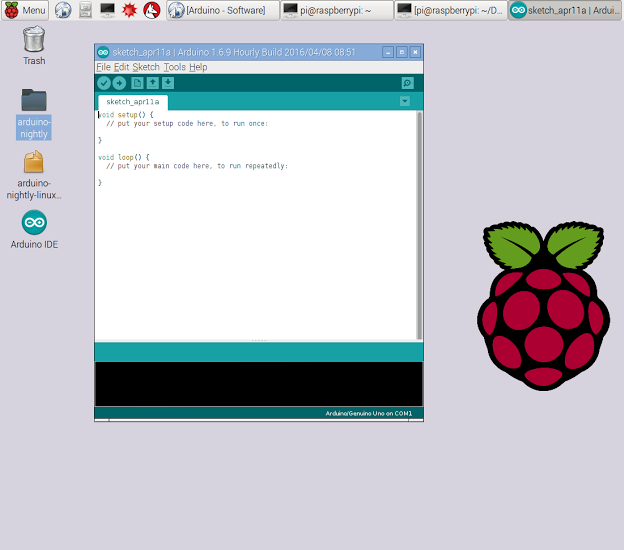
Arduino is the perfect introduction to microcontrollers and electronics. The recent trend of powerful, cheap, ARM-based single board Linux computers is the perfect introduction to computer science, programming, and general Linux wizardry. Until now, though, Arduino and these tiny ARM computers have been in two different worlds. Now, finally, there are nightly builds of Arduino IDE on the Raspberry Pi and other single board Linux computers.

The latest Arduino build for ARM Linux popped up on the arduino.cc downloads page early this week. This is the result of an incredible amount of work from dozens of open source developers across the Arduino project. Now, with just a simple download and typing ‘install’ into a terminal, the Arduino IDE is available on just about every single board Linux computer without having to build the IDE from source. Of course, Arduino has been available on the Raspberry Pi for a very long time with sudo apt-get install arduino, but this was an older version that cannot work with newer Arduino boards.

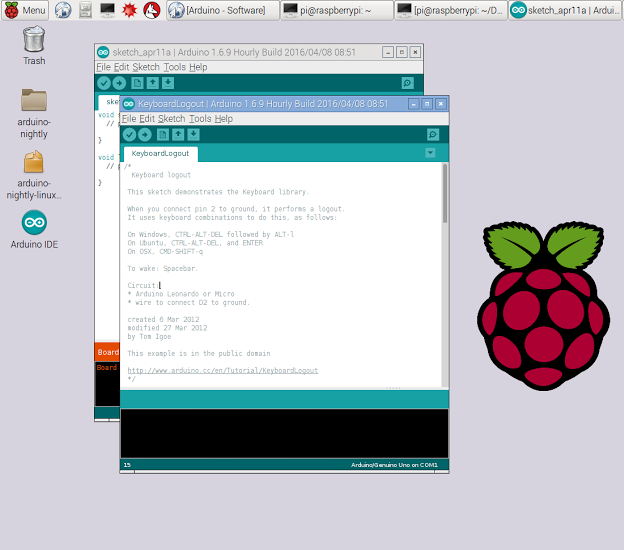
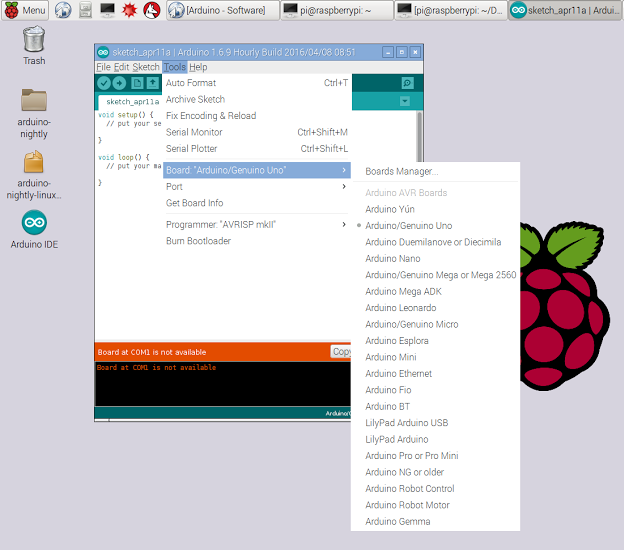
Is this distribution of the Arduino IDE the same you would find on OS X and Windows? Yep, everything is the same:

While this is really just arduino.cc improving their automated build process and putting a link up on their downloads page, it does make it exceptionally easy for anyone to set up a high school electronics lab. The Raspberry Pi is almost a disposable computing device, and combining it with Arduino makes for a great portable electronics lab.

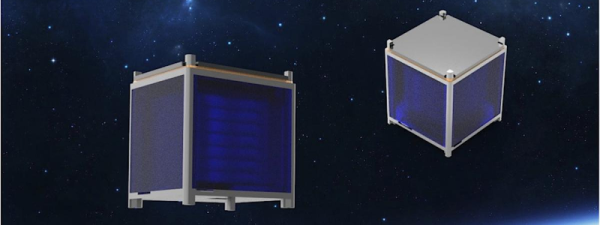
A $1000 Tiny Personal Satellite

If you ever read any old magazines, you might be surprised at how inexpensive things used to be. A U.S. postage stamp was six cents, a gallon of gas was $0.34, and the same amount of milk was $1.07. Everything is relative, though. The average household income back then was under $8,000 a year (compared to over $53,000 a year in 2014). So as a percentage of income, that milk actually cost about seven bucks.

The same is true of getting into orbit. Typical costs today just to get something into orbit has gone from–no pun intended–astronomical, to pretty reasonable. Lifting a pound of mass on the Space Shuttle cost about $10,000. On an Atlas V, it costs about $6,000. A Falcon Heavy (when it launches) will drop the cost to around $1,000 or so. Of course, that’s just the launch costs. You still have to pay for whatever you want to put up there. Developing a satellite can be expensive. Very expensive.

Continue reading “A $1000 Tiny Personal Satellite”

IPhone Microscopy And Other Adventures

CMOS imaging chips have been steadily improving, their cost and performance being driven by the highly competitive smartphone industry. As CMOS sensors get better and cheaper, they get more interesting for hacker lab projects. In this post I’m going to demonstrate a few applications of the high-resolution sensor that you’ve already got in your pocket — or wherever you store your cell phone.

CMOS vs CCD

First lets quickly review image sensors. You’ve probably head of CMOS and CCD sensors, but what’s the difference exactly?

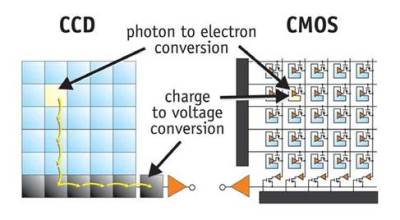
cddandcmos
CCD and CMOS imaging sensors: from this excellent page at CERN.

As the figure above shows, CCD and CMOS sensors are both basically photodiode arrays. Photons that hit regions on the chip are converted into a charge by a photodiode. The difference is in how this charge in shoved around. CCD sensors are analogue devices, the charge is shifted through the chip and out to a single amplifier. CMOS sensors have amplifiers embedded in each cell and also generally include on-chip analogue to digital conversion allowing complete “camera-on-a-chip” solutions.

Because CMOS sensors amplify and move the signal into the digital domain sooner, they can use cheaper manufacturing processes allowing lower-cost imaging chips to be developed. Traditionally they’ve also had a number of disadvantages however, because more circuitry is included in each cell, less space is left to collect light. And because multiple amplifiers are used, it’s harder to get consistent images due to slight fabrication differences between the amplifiers in each cell. Until recently CMOS sensors were considered a low-end option. While CCD sensors (and usually large cooled CCD sensors) are still often preferred for scientific applications with big budgets, CMOS sensors have now however gained in-roads in high performance DSLRs.

Continue reading “IPhone Microscopy And Other Adventures”