Today (September 13, 2015) is Programmer’s Day — a recognition day that started in Russia, but has been adopted by many countries. While it is great that there is a day recognizing the contribution of programmers to society, the really interesting part is why it is on September 13 (except on leap years).
The leap year part should be a clue. Today is Julian day 256. We’ll guess that anyone reading Hackaday doesn’t need to be told the rest of the story. While it might not be as good of an in-joke as May the 4th (be with you), it is satisfying to know that it isn’t just a random date from the calendar. Now if we could only get the day off as paid vacation…
One of the keys to nuclear fission is sustaining a chain reaction. A slow chain reaction can provide clean power for a city, and a fast one can be used to create a weapon that will obliterate a city. These days, kids can learn about Uranium and Plutonium in high school. But just a few generations ago, the idea of splitting the atom was just a lofty goal for the brightest physicists and mathematicians who gathered at Los Alamos National Laboratory under the Manhattan Project.
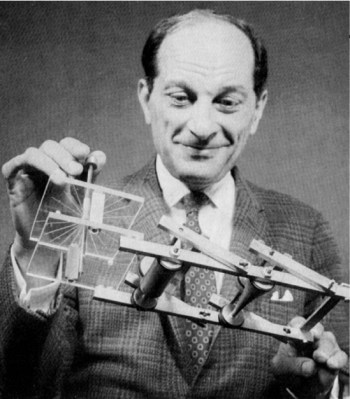
Decoding the mysteries of nuclear fission required a great deal of experimentation and calculations. One bright physicist in particular made great strides on both fronts. That man was [Enrico Fermi], one of the fathers of the atomic bomb. Perhaps his greatest contribution to moving the research beyond the Manhattan Project was creating a handheld analog computer to do the math for him. This computational marvel is known as the FERMIAC.
What is Fission?
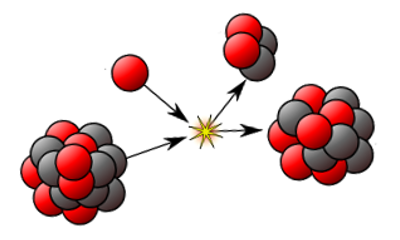
Nuclear fission occurs when a nucleus is split into fragments, a process that unleashes a great deal of energy. As a handful of neutrons travel through a reactor pile or other fissionable material, a couple of outcomes are possible. Any one neutron collision might result in fission. This means there will be some number of new neutrons whose paths must be tracked. If fission does not occur, the neutrons may simply scatter about upon collision, which changes their speed and trajectory. Some of the neutrons might be absorbed by the material, and others will simply escape it. All of these possibilities depend on the makeup of the material being bombarded and the speed of the neutron.
Every event that happens to a neutron comprises its genealogical history. If this history is recorded and analyzed, a statistical picture starts to emerge that provides an accurate depiction of the fissility of a given material. [Fermi]’s computer facilitated the creation of such a picture by performing mathematical grunt work of testing different materials. It identified which materials were most likely to sustain a reaction.
Before he left Italy and the looming threat of fascism, [Fermi] led a group of young scientists in Rome called the Via Panisperna boys. This group, which included future Los Alamos physicist [Emilio Segrè], ran many experiments in neutron transport. Their research proved that slow neutrons are much better candidates for fission than fast neutrons.
During these experiments, [Fermi] ran through the periodic table, determined to artificially irradiate every element until he got lucky. He never published anything regarding his methods for calculating the outcomes of neutron collisions. But when he got to Los Alamos, [Fermi] found that [Stanislaw Ulam] had also concluded that the same type of repeated random sampling was the key to building an atomic weapon.
The Monte Carlo Method: Shall We Play a Game?
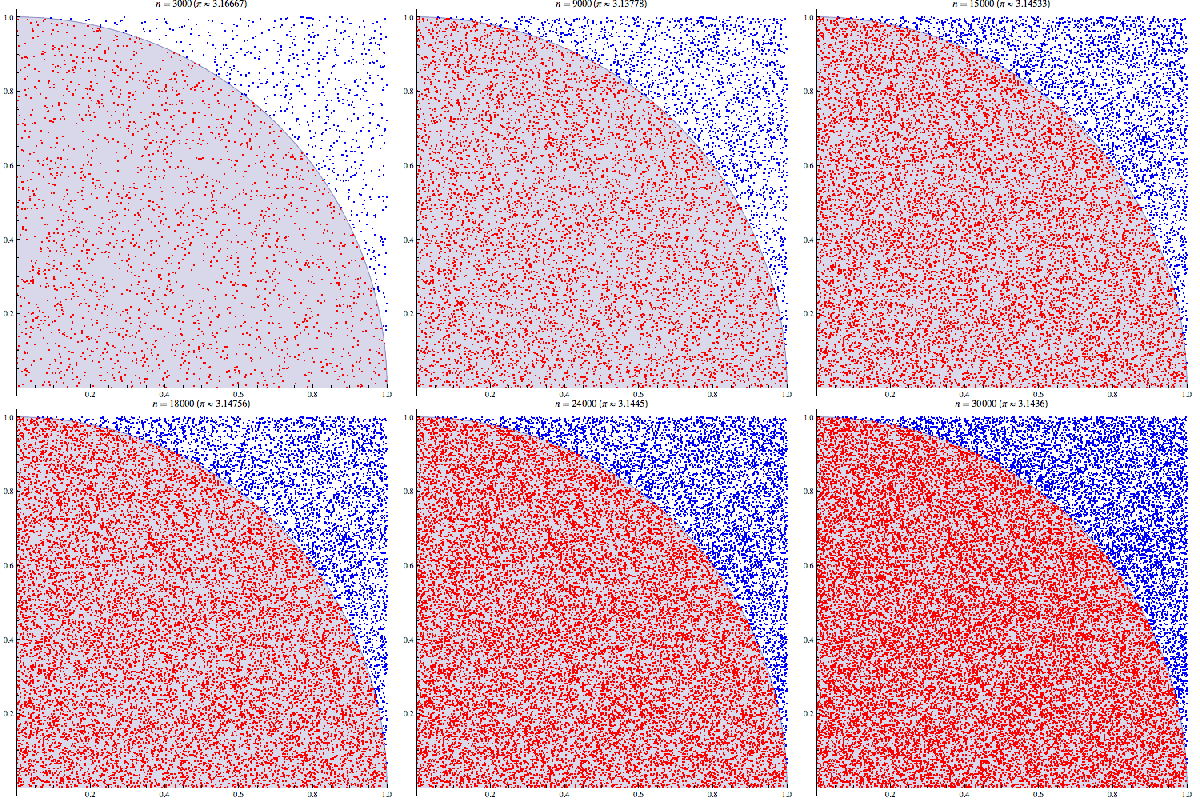
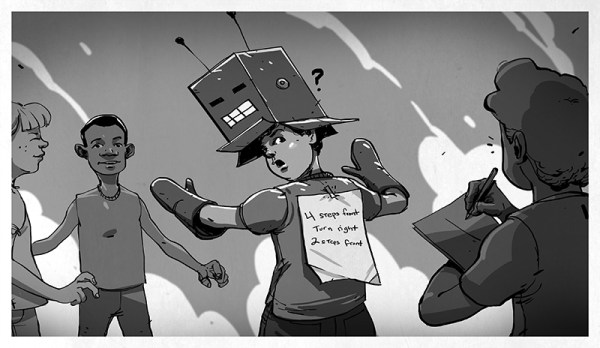
Monte Carlo method applied to approximating the value of π. by CaitlinJo
[Ulam], a Polish-born mathematician who came to the US in 1935, developed his opinion about random sampling due to an illness. While recuperating from encephalitis he played game after game of solitaire. One day, he wondered at the probability of winning any one hand as laid out and how best to calculate this probability. He believed that if he ran through enough games and kept track of the wins, the data would form a suitable and representative sample for modeling his chances of winning. Almost immediately, [Ulam] began to mentally apply this method to problems in physics, and proposed his ideas (PDF) to physicist and fellow mathematician [John von Neumann].
This top-secret method needed a code name. Another Los Alamos player, [Nick Metropolis] suggested ‘Monte Carlo’ in a nod to games of chance. He knew that [Ulam] had an uncle with a propensity for gambling who would often borrow money from relatives, saying that he just had to go to Monte Carlo. The game was on.
The Tricky Math of Fission
Determination of the elements most suitable for fission required a lot of calculations. Fission itself had already been achieved before the start of the Manhattan Project. But the goal at Los Alamos was a controlled, high-energy type of fission suitable for weaponization. The math of fission is complicated largely because of the sheer number of neutrons that must be tracked in order to determine the likelihood and speed of a chain reaction. There are so many variables involved that the task is monumental for a human mathematician.
[Stanislaw Ulam] and FERMIAC.
After [Ulam] and [von Neumann] had verified the legitimacy of the Monte Carlo method with regard to the creation of nuclear weaponry, they decided that these types of calculations would be a great job for ENIAC — a very early general purpose computer. This was a more intensive task than the one it was made to do: compute artillery firing tables all day and night. One problem was that the huge, lumbering machine was scheduled to be moved from Philadelphia to the Ballistics Research Lab in Maryland, which meant a long period of downtime.
While the boys at Los Alamos waited for ENIAC to be operational again, [Enrico Fermi] developed the idea forego ENIAC and create a small device that could run Monte Carlo simulations instead. He enlisted his colleague [Percy King] to build the machine. Their creation was built from joint Army-Navy cast off components, and in a nod to that great computer he dubbed it FERMIAC.
FERMIAC: Hacking Probabilities
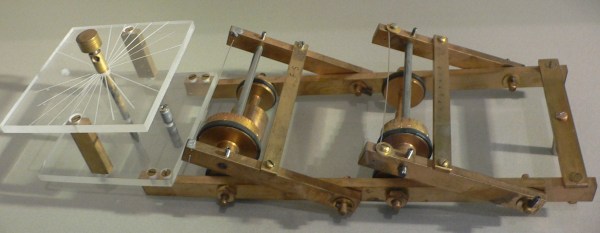
FERMIAC was created to alleviate the necessity of tedious calculations required by the study of neutron transport. This is something of an end-run around brute force. It’s made mostly of brass and resembles a trolley car. In order to use it, several adjustable drums are set using pseudorandom numbers. One of these numbers represents the material being traversed. A random choice is made between fast and slow neutrons. A second digit is chosen to represent the direction of neutron travel, and a third number indicates the distance traveled to the next collision.
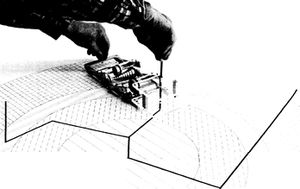
FERMIAC in action.
Once these settings are dialed in, the device is physically driven across a 2-D scale drawing of the nuclear reactor or materials being tested. As it goes along, it plots the paths of neutrons through various materials by marking a line on the drawing. Whenever a material boundary is crossed, the appropriate drum is adjusted to represent a new pseudorandom digit.
FERMIAC was only used for about two years before it was completely supplanted by ENIAC. But it was an excellent stopgap that allowed the Manhattan Project to not only continue unabated, but with rapid progress. FERMIAC is currently on display at the Bradbury Science Museum in Los Alamos, New Mexico alongside replicas of Fat Man and Little Boy, the weapons it helped bring to fruition. [Fermi]’s legacy is cemented as one of the fathers of the atomic bomb. But creating FERMIAC cements his legacy as a hacker, too.
After Los Alamos, [Stanislaw Ulam] would continue to make history in the field of nuclear physics. [Enrico Fermi] was opposed to participating in the creation of the exponentially more powerful hydrogen bomb, but [Ulam] accepted the challenge. He proved that Manhattan Project leader [Edward Teller]’s original design was unfeasible. The two men worked together and by 1951 had designed the Teller-Ulam method. This design became the basis for modern thermonuclear weaponry.
Today, the Monte Carlo method is used across many fields to describe systems through randomness and statistics. Many applications for this type of statistical modeling present themselves in fields where probabilities are concerned, like finance, risk assessment, and modeling the universe. Wherever the calculation of all possibilities isn’t feasible, the Monte Carlo method can usually be found.
UPDATE: Commentor [lwatchdr] pointed out that the use of the FERMIAC began after the Manhattan Project had officially ended in 1946. Although many of the same people were involved, this analog computer wasn’t put into use until about a year later.
If you are a Hackaday reader, it is a good bet that when you were a kid there was some adult who infected you with the madness you have for science, engineering, tinkering, or whatever it is that brings you here. Maybe it was a parent or a teacher. For many of us, it was a local ham radio operator. But it was probably someone who had the passion for this kind of thing and you caught it.
Paying that debt forward can be very rewarding. Schools and youth organizations are always looking for people to share their passions with kids and at the right age and the right school, you could be that one push that moves a kid off a bad path.
You have an old PC with a nonstandard RGB video out and you need to bring it to a modern PAL TV set. That’s the problem [svofski] had, so he decided to use an Altera-based DE1 board to do the conversion. Normally, you’d expect reading an RGB video signal would take an analog to digital converter, which is not typically present on an FPGA. Instead of adding an external device, [svofski] used a trick to hijack the FPGA’s LVDS receivers and use them as comparators.
Last week we saw a lot of interest in faux visualization of wireless signals. It used a tablet as an interface device to show you what the wireless signals around you looked like and was kind of impressive if you squinted your eyes and didn’t think too much about it. But for me it was disappointing because I know it is actually possible to see what radio waves look like. In this post I will show you how to actually do it by modifying a coffee can radar which you can build at home.
The late great Prof. David Staelin from MIT once told me once that, ‘if you make a new instrument and point it at nature you will learn something new.’ Of all the things I’ve pointed Coffee Can Radars at, one of the most interesting thus far is the direct measurement and visualization of 2.4 GHz radiation which is in use in our WiFi, cordless phones (if you still have one) and many other consumer goods. There is no need to fool yourself with fake visualizations when you can do it for real.
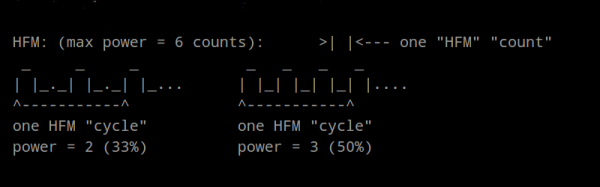
[esot.eric] was trying to drive a motor and naturally thought of using pulse width modulation (PWM) to control the motor speed. However, he found that even with a large capacitor, his underpowered power supply would droop before the PWM cycles were complete. So instead of PWM he decided to experiment with pulse density modulation.
The idea is to use smaller pulses over a longer period of time and make the average power equal to the percentage motor speed desired. With a PWM system, for example, if the time period is T, a 50% PWM drive would have the drive high for T/2 and low for the other half of the cycle. With pulse density, each pulse might be T/10 (as an example) and then the output would be on for 1/10, off for 1/10, on for 1/10 and so on, until by time T you’d still get to 50%. The advantage is the output capacitor gets a kick more often and has less opportunity to droop.
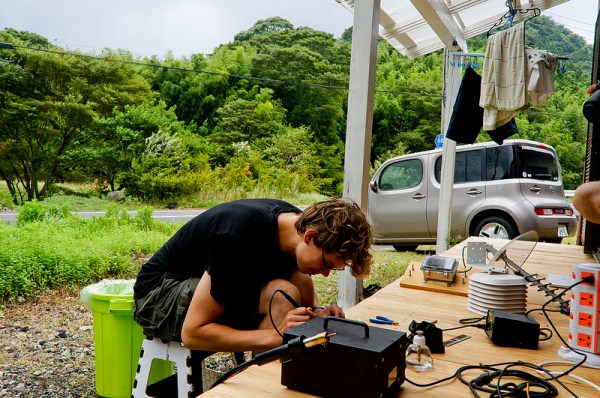
On the far side of the Boso peninsula lies Kamogawa. This isn’t the Japan of LEDs, Otaku and maid cafes, or that of wage slave salarymen collapsing from exhaustion. This is the Japan of rice farmers and fields, fresh fish and wild boar, electron microscopes and gigabit fiber, SMD assembly and 500Mhz 5 Gigasample oscilloscopes.
The world has changed. In the 20th century the life of a rural hacker was a constant hunt for technological innovation. We scratched around for whatever we could find. A (usually national) periodical would give its monthly injection of technological curios. And knowledge was locked tight within expensive textbooks, which even if you could afford them might take weeks to arrive.
So, as had been the case for the preceding 1000 years, innovation clustered around technological hubs, San Francisco, Cambridge, and Tokyo among others. And Hackers flocked to these centers where innovation flourished while Hackers exchanged knowledge and tools.
But then the world of the rural Hacker began to expand. The technological hubs that so many rural hackers had migrated to began to connect the world. Young Hackers could learn to program (as I learned C) from textfiles posted on BBSs and exchange knowledge linking national communities. Shortly after that the Internet came bringing its Eternal September. Hackers across the world, regardless of location could communicate.
On the flip-side tech centers were changing too. Venture capital, rather than bootstrapping became the norm. With the influx of cash the demand for skilled Hackers rose, increasing wages and further focusing tech talent around these hubs. But rents and expenses rose too. And Hackers became locked into their expensive lifestyles; eyes firmly focused on the promised million dollar payoff and the eternal dream of an “exit”.
For some though, the freedom to Hack is more important than that million dollar exit and so a new model is emerging. Groups of Hackers in rural communities with low cost lifestyles and access to the world’s best technical talent and equipment that would put the best startups to shame.