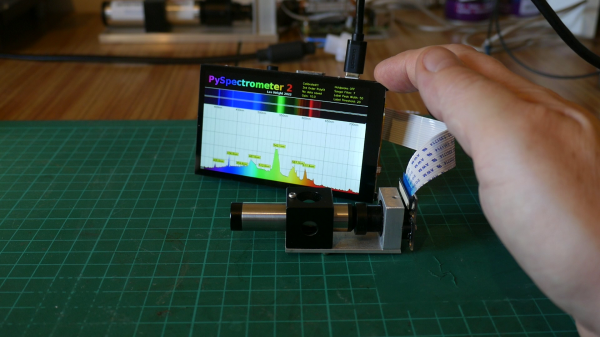
PySpectrometer version 2, showing mini spectroscope, 4 inch display and hand for scale

Pi-based Spectrometer Gets An Upgrade

Here at Hackaday, we love to see projects re-visited and updated after we’ve covered them on the site. It’s always exciting to see what the creators come up with next, and this Pi-Based Spectrometer project is a great example of that.

[LesWright] found himself with a problem when the new version of Raspberry Pi operating system was released (Bullseye), and it broke some functionality on his original software. Rather than just fix the issues, [Les] chose to rewrite the software more dramatically and has ended up with a much more capable spectrometer that is able to match professional devices costing many times more.

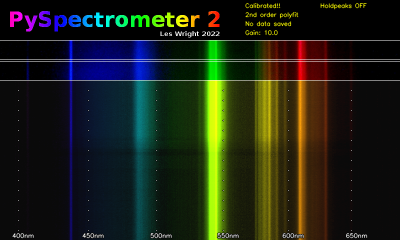
Screenshot of Waterfall Display for PySpectrometer 2

By using multi-wavelength calibration and polynomial regression data, the new version is much more accurate and can now resolve wavelengths down to +/- 1nm.

The whole project is now written in OpenCV, and there’s a nifty new waterfall spectrum display, that will show changes in measured spectra over time.

A low-cost benchtop spectroscope is coupled to a RaspberryPi Camera via a CCTV zoom lens and the whole setup is mounted to a small block of aluminium for thermal and mechanical stability. The spectroscope is pointed at a fluorescent lamp and the user is guided through a calibration routine to tune the software to the hardware.

We’re impressed with the precision [Les] has achieved with his builds, and the write-up is sufficiently detailed to allow others to follow in his footsteps. We’d love to see if readers build one themselves, and what they use them for!

If you want to read up on the original build, you can find our article here. We’ve covered several spectrometry projects in the past, including this Gamma-Ray Spectrometer and this one based around an STM32 Nucleo board. Continue reading “Pi-based Spectrometer Gets An Upgrade”

Bare-Metal STM32: Setting Up And Using SPI

The Serial Peripheral Interface (SPI) interface was initially standardized by Motorola in 1979 for short-distance communication in embedded systems. In its most common four-wire configuration, full-duplex data transfer is possible on the two data (MOSI, MISO) lines with data rates well exceeding 10 Mb/s. This makes SPI suitable for high-bandwidth, full-duplex applications like SD storage cards and large resolution, high-refresh displays.

STM32 devices come with a variable number of SPI peripherals, two in the F042 at 18 Mb/s and five in the F411. Across the STM32 families, the SPI peripheral is relatively similar, with fairly minor differences in the register layout. In this article we’ll look at configuring an SPI peripheral in master mode.

Continue reading “Bare-Metal STM32: Setting Up And Using SPI”

Arduino IDE v2.0 screen with callout tags to identify features

Arduino IDE 2.0 Is Here

Arduino have released the latest version of their Integrated Development Environment (IDE), Version 2.0 and it is a big step up from the previous release, boasting plenty of new features to help you to develop your code more easily.

As the de-facto way for beginners to get into programming hardware, more experienced users have sometimes complained about what they see as the over-simplistic IDE — even lacking relatively basic features such as autocomplete. The new version provides this, and much more besides. Continue reading “Arduino IDE 2.0 Is Here”

A Spreadsheet For The Python Hacker

You can write a Python program or use a Jupyter Notebook to do almost anything. But you can also get a lot of things done quickly using a spreadsheet. Grist is a “hacker’s” spreadsheet that merges these worlds. It looks like a spreadsheet, but underneath are SQLite tables and the formula language is Python.

The code is open source and if you want it hosted, there are free and paid plans. You can even try it out without even logging in and either start with a blank screen or use a template. You can see an introductory video below.

Continue reading “A Spreadsheet For The Python Hacker”

OpenAI Hears You Whisper

Should you wish to try high-quality voice recognition without buying something, good luck. Sure, you can borrow the speech recognition on your phone or coerce some virtual assistants on a Raspberry Pi to handle the processing for you, but those aren’t good for major work that you don’t want to be tied to some closed-source solution. OpenAI has introduced Whisper, which they claim is an open source neural net that “approaches human level robustness and accuracy on English speech recognition.” It appears to work on at least some other languages, too.

If you try the demonstrations, you’ll see that talking fast or with a lovely accent doesn’t seem to affect the results. The post mentions it was trained on 680,000 hours of supervised data. If you were to talk that much to an AI, it would take you 77 years without sleep!

Continue reading “OpenAI Hears You Whisper”

Fork And Run: The Definitive Guide To Getting Started With Multiprocessing

Since the early 2000s, the CPU industry has shifted from raw clock speed to core counts. Pat Gelsinger famously took the stage in 2002 and gave the talk the industry needed, stating processors needed specialty silicon or multiple cores to reduce power requirements and spread heat. A few years later, the Core series was introduced with two or four-core configurations to compete with the AMD Athlon 64 x2.

Nowadays, we’re seeing heterogeneous chip designs with big and little cores, chiplets, and other crazy fabrication techniques that are fundamentally the same concept: spread the thermal load across multiple pieces of silicon. This writer is willing to put good money into betting that you’ll see consumer desktop machines with 32 physical cores in less than five years. It might be hard to believe, but a 2013 Intel Haswell i7 came with just four cores compared to the twenty you’ll get in an i7 today. Even an ESP32 has two cores with support in FreeRTOS for pinning tasks to different cores. With so many cores, how to even write software for that? What’s the difference between processes and threads? How does this all work in straight vanilla C98?

Continue reading “Fork And Run: The Definitive Guide To Getting Started With Multiprocessing”

C23 Programming For Everyone

Here’s a history quiz: What architecture did the first C++ compiler target? Of course, it is a trick question. The original C++ — known then as C with classes — compiler wrote out standard C code that you then compiled for whatever your target was. This has a lot of advantages since C compilers are everywhere. Now we are seeing a similar approach to bring C23 to the world with Cake. Cake can translate C23 or other versions to C99 which you can then compile with normal compilers.

While the old C++ compiler, cfront, needed special steps to compile (since it was built using C++), you can build cake for Windows or Linux easily. However, it can also be built with emscripten and you can try it yourself in your web browser.

Continue reading “C23 Programming For Everyone”