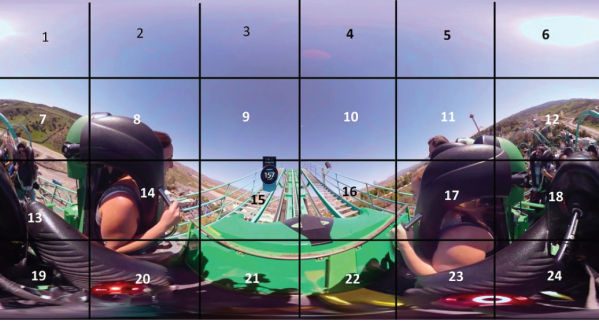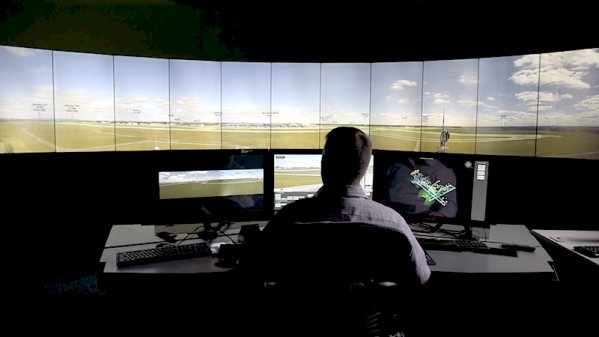
This past semester I added research to my already full schedule of math and engineering classes, as any masochistic student eagerly would. Packed schedule aside, how do you pass up the chance to work on implementing 360° virtual teleportation to anywhere in the world, in real-time. Yes, it is indeed the same concept as the cult worshipped Star Trek transporter, minus the ability to physically be at the location. Perhaps we can add a, “beam me up, Scotty” command when shutting down.
The research lab I was working with is the Laboratory for Immersive CommunicatiON (LION). It’s funded by NSF, Microsoft, and Adobe and has been on the pursuit of VR teleportation for some time now. There’s a lot of cool technologies at work here, like drones which are used as location collection devices. A network of drones will survey landscape anywhere in the world and build the collection assets needed for recreating it in VR. Okay, so a swarm of drones might seem a little intimidating at first, but when has emerging technology not?
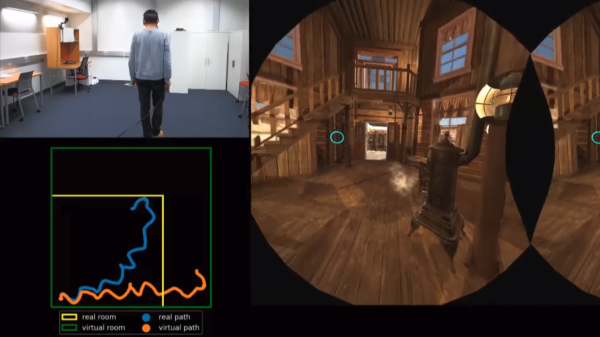
[Anjul Patney] and [Qi Sun] demonstrated a fascinating new technique at NVIDIA’s GPU Technology Conference (GTC) for tricking a human into thinking a VR space is larger than it actually is. The way it works is this: when a person walks around in VR, they invariably make turns. During these turns, it’s possible to fool the person into thinking they have pivoted more or less than they have actually physically turned. With a way to manipulate perception of turns comes a way for software to gently manipulate a person’s perception of how large a virtual space is. Unlike other methods that rely on visual distortions, this method is undetectable by the viewer.
Saccadic movements
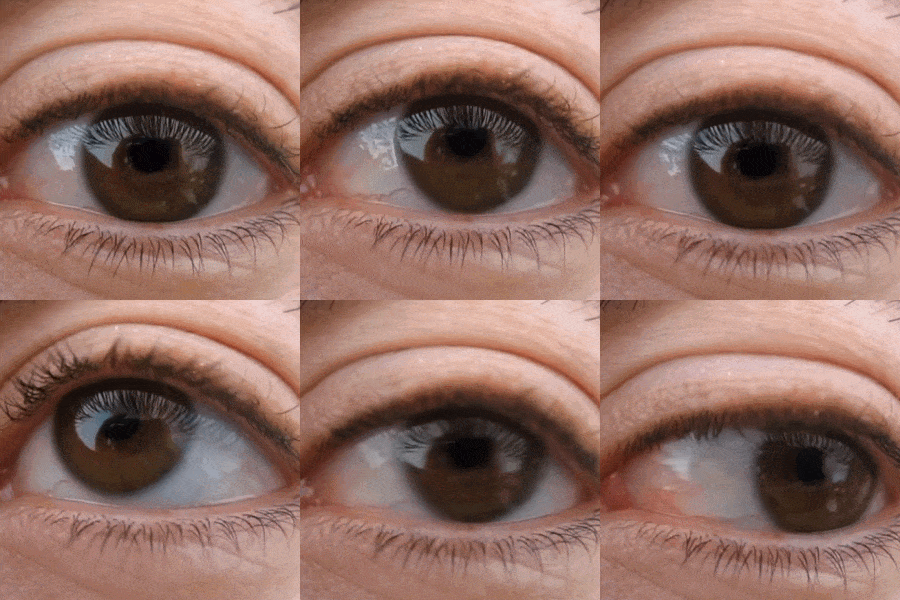
The software essentially exploits a quirk of how our eyes work. When a human’s eyes move around to look at different things, the eyeballs don’t physically glide smoothly from point to point. The eyes make frequent but unpredictable darting movements called saccades. There are a number of deeply interesting things about saccades, but the important one here is the fact that our eyes essentially go offline during saccadic movement. Our vision is perceived as a smooth and unbroken stream, but that’s a result of the brain stitching visual information into a cohesive whole, and filling in blanks without us being aware of it.
Part one of [Anjul] and [Qi]’s method is to manipulate perception of a virtual area relative to actual physical area by making a person’s pivots not a 1:1 match. In VR, it may appear one has turned more or less than one has in the real world, and in this way the software can guide the physical motion while making it appear in VR as though nothing is amiss. But by itself, this isn’t enough. To make the mismatches imperceptible, the system watches the eye for saccades and times its adjustments to occur only while they are underway. The brain ignores what happens during saccadic movement, stitches together the rest, and there you have it: a method to gently steer a human being in a way that a virtual space is larger than the physical area available.
Embedded below is a video demonstration and overview, which mentions other methods of manipulating perception of space in VR and how it avoids the pitfalls of other methods.
Built-in Leap Motion camera for precise hand tracking
Yes, you read that last line correctly. The North Star will be open source hardware. Leap Motion is planning to drop all the hardware information next week.
Now that we’ve got you excited, let’s mention what the North Star is not — it’s not a consumer device. Leap Motion’s idea here was to create a platform for developing Augmented Reality experiences — the user interface and interaction aspects. To that end, they built the best head-mounted display they could on a budget. The company started with standard 5.5″ cell phone displays, which made for an incredibly high resolution but low framerate (50 Hz) device. It was also large and completely unpractical.
The current iteration of the North Star uses much smaller displays, which results in a higher frame rate and a better overall experience. The secret sauce seems to be Leap’s use of ellipsoidal mirrors to achieve a large FOV while maintaining focus.
We’re excited, but also a bit wary of the $100 price point — Leap Motion is quick to note that the price is “in volume”. They also mention using diamond tipped tooling in a vibration isolated lathe to grind the mirrors down. If Leap hasn’t invested in some injection molding, those parts are going to make the whole thing expensive. Keep your eyes on the blog here for more information as soon as we have it!
Looking for ideas for your haptics projects? [Destin] of the Smarter Every Day YouTube channel got a tour from the engineers at HaptX of their full-featured VR glove with amazing haptic feedback both with a very fine, 120-point sense of touch, force feedback for each finger, temperature, and motion tracking.
Inflatable bladders for touch
In hacks, we usually stimulate the sense of touch by vibrating something against the skin. With this glove, they use pneumatics to press against the skin. A single fingertip has multiple roughly 1/8 inch air bladders in contact with it. Each bladder is separately pneumatically controlled by pushing air into it. The air pressure can vary continuously so that the bladders can push lightly, harder or anywhere in between. The glove has 120 of these bladders spread out over the fingers and the palm. Unfortunately, they didn’t allow him to see the valves controlling the pneumatics, but if you are looking for a low-frequency, low-cost way to actuate valves you might consider using syringes. The engineers do tell [Destin] that if your VR scene shows something pressing against your virtual finger, as long as your haptics push against your real finger within around 1/8th of a second, your brain won’t notice the delay.
They’re also working on using hot and cold fluids to give a sense of temperature within a glove. This is demonstrated in the first video below when [Destin] feels heat while a dragon in the VR world breathes fire on his hand. Fortunately one of the engineers mentions that our sense of temperature is one of the slower ones, it can handle longer latencies than even touch. We can see implementing this in a hack using a bladder pressing against the skin while tubes circulate different temperature fluids through it. But maybe there’s a way to do it electrically, possibly with thermoelectric modules as is done with this drinks cooler? Though safety issues might prohibit that.
Other features mentioned are force feedback for each finger, and their custom motion tracking which uses both magnetic and optical means to track fingertips. But we’ll leave the rest to the videos below. The first is the technical tour and the second is the glove being used in the VR world.
Light Field technology is a fascinating area of Virtual Reality research that emulates the way that light behaves to make a virtual scene look more realistic. By emulating light coming from multiple angles entering the eye, the scenes look more realistic because they look closer to reality. It is rumored to be part of the technology included in the forthcoming Magic Leap headset, but it looks like Google is trying to steal some of their thunder. The VR research arm of the search giant has released a VR app called Welcome to Light Fields that uses a similar technique on existing VR headsets, such as those from Oculus and Microsoft.
We love a bit of reverse engineering here at Hackaday, figuring out how a device works from the way it communicates with the world. This project from [Jim Yang] is a great example of this: he reverse-engineered the Samsung Gear VR controller that accompanies the Gear VR add-on for their phones. By digging into the APK that links the device to the phone, he was able to figure out the details of the Bluetooth connection that the app uses to connect to the device. Specifically, he was able to find the commands that were used to get the device to send data, and was able to read this data to determine the state of the device. He was then able to use this to create his own web app to use this data.
Taking a dive into VR or augmented reality — once, dreamed-of science fiction — is not only possible for the average consumer, but crafting those experiences is as well! Hackaday.io user [kvtoet]’s HandHolo is a homebrew method to cut your teeth on peeking into a virtual world.
This project requires a smartphone running Android Oreo as its backbone, a Bluetooth mouse, a piece of cardboard and a small mirror or highly reflective surface. The phone is slotted into the cardboard housing — prototype with what you have! — above the mouse, and the mirror angled opposite the screen reflects the image back to the user as they explore the virtual scene.
Within Unity, [kvtoet]’s used a few scripts that access phone functions — namely the gyroscope, which is synchronised to the mouse’s movements. That movement is translated into exploration of the virtual space built in Unity and projected onto the portal-like mirror. Check it out!