Jacket Turned Cyberpunk Wearable OLED Display

If you’ve played Cyberpunk 2077, you might have seen the rad jacket that has a screen in the collar. Once upon a time, such a thing would be solely the preserve of science fiction—you certainly wouldn’t be achieving that look with cathode ray tubes, that much is for sure. However, technology has advanced to the point where [Zibartas] was able to produce just such a jacket in real life.

The key to the build is the advent of the flexible OLED screen. [Zibartas] was able to source four such panels in a smartphone-like aspect ratio, which came in at the hefty price of $300 each. Two Raspberry Pi 4s were enlisted to drive two screens each. The older model Pi was chosen as it was capable of achieving a neat hack to better play smooth video across two displays. A rudimentary sync system was whipped up using GPIO pins to keep video from both Pis playing together. From there, it was simply a matter of figuring out how to create a structure to hold the screens within the large collar of the scratch built cyberpunk-styled jacket. As it turns out they don’t actually flex much in the final install, as they’re held in a 3D printed structure to keep them safe from damage.

The final result is quite something, very accurately recreating the jacket from the game itself. While technically a simple build, actually pulling it off required some delicate work and smart design decisions to make it practical to wear. We’ve featured some other fun jackets over the years, too.

Continue reading “Jacket Turned Cyberpunk Wearable OLED Display”
Building A Pip Boy Themed Smartwatch

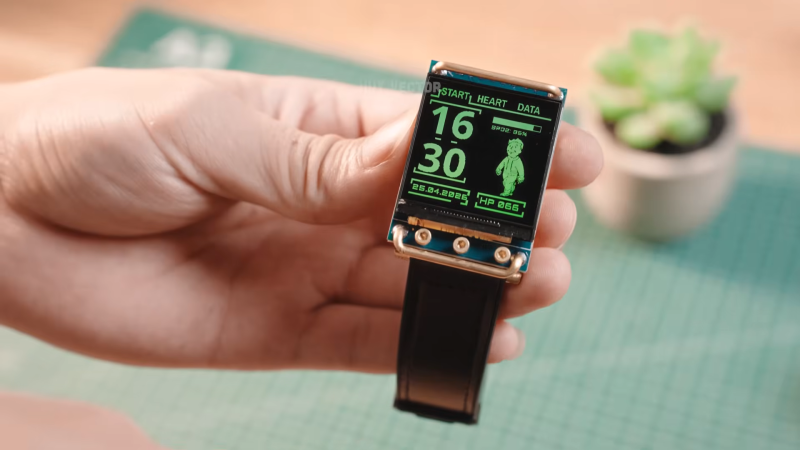
One of the problems with good science fiction is that it introduces us to all kinds of cool devices that we can’t actually have in real life. [Huy Vector] has tried to fix that a little with this fantastic smartwatch build inspired by everybody’s favorite wrist computer from the Fallout series.

The build is based around a Xiao ESP32-S3 board, which hosts the capable microcontroller and has all that useful wireless connectivity built in. It’s hooked up to a MAX30102 heart rate sensor to collect the wearer’s vital signs, as well as a 1.54″ LCD screen for displaying the fantastic Pip Boy themed interface. Power is courtesy of a small lithium-ion cell tucked in behind the display. A little copper tubing and brass hardware helps tie everything together, with the latter serving as capacitive touch points for controlling the device. A simple leather watch strap completes the build.

It’s a bit of a diversion from the classic Pip Boy design, in that it’s a small smartwatch instead of a chunky device that takes up most of the wearer’s forearm. However, this isn’t so bad in reality—it’s far more practical while still rocking those classic green-on-black graphics that we all love so much.

If you’re craving a more authentic Pip Boy recreation, we’ve featured a few of those, too.

Continue reading “Building A Pip Boy Themed Smartwatch”

LightInk, A Solar Powered ESP32 Smartwatch

There’s something about the ESP32 family of microcontrollers and timekeeping. We probably see it in clocks as often as we do anything else; we also probably see more clocks with one as the beating heart than any of the many other possible timekeeping options.

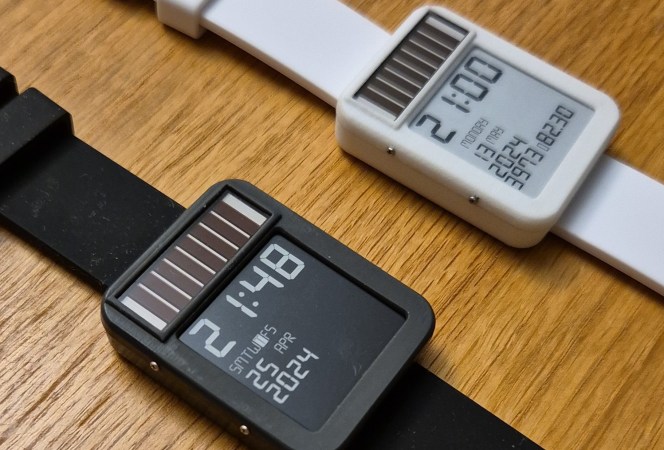
[Daniel Ansorregui]’s LightInk watch is no different in that regard — but it is very different in one important detail, because like any other smartwatch, you won’t have to worry about battery life. Outside of gloomiest Gotham, its built-in solar panel should be able to keep it charged.

That’s for a few reasons. The obvious one is the e-ink display, which only takes a sip of power during updates. That’s hardly unique to [Daniel]’s projec t– he quite explicitly calls out the Watchy project, which we featured previously, as where he got the idea of putting e-ink and an ESP32-PICO together on his wrist. What is unique is the delightful hack [Daniel] is using to minimize power usage, which is our favorite part.

Continue reading “LightInk, A Solar Powered ESP32 Smartwatch”

Fluidic Contact Lens Treats Glaucoma

We’ve always been interested in fluidic computers, a technique that uses moving fluids to perform logic operations. Now, Spectrum reports that researchers have developed an electronics-free contact lens that monitors glaucoma and can even help treat it.

The lens is made entirely of polymer and features a microfluidic sensor that can monitor eye pressure in real time. It also has pressure-activated drug reservoirs that dispense medicine when pressure exceeds a fixed threshold. You can see Spectrum’s video on the device below.

This isn’t the first attempt to treat glaucoma, which affects more than 80 million people, with a contact lens. In 2016, Triggerfish took a similar approach, but it used electronic components in the lens, which poses problems for manufacturing and for people wearing them.

Naturally, the device depends on 3D printed molds to create channels and reservoirs in the lens. A special silk sponge in the reservoirs can absorb up to 2,700 times its weight. One sponge holds a red fluid that is forced by pressure into a serpentine microchannel. A phone app uses a neural network to convert the image of the red fluid into a pressure reading.

Two more sponges hold drugs that release at a given pressure determined by the width of the associated microchannel. This allows the possibility of increasing the dose at a higher pressure or even delivering two drugs at different pressure levels.

It is fairly hard to hack your own contact lenses, although we’ve seen it at least once. But smart contacts are not as rare as you might think.

Continue reading “Fluidic Contact Lens Treats Glaucoma”

A wearable circuit sculpture in the form of a smart bracelet that shows daily to-dos.

Wearable Circuit Sculpture Is One Smart Bracelet

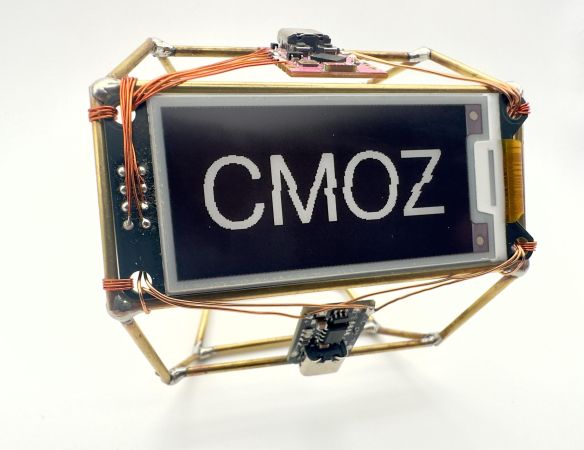
Well, this might just be a Hackaday first. Certainly not the circuit sculpture part, nor the wearable aspect, but the glorious combination of the two. Behold [CMoz]’s Fashionably on Task: a Smart Bracelet for Forgetfulness. The name may be long, but the intent is concise: to showcase your top five must-dos for the day.

This lovely bracelet uses a tri-color e-paper display, and it’s WiFi enabled in order to receive input from the corresponding phone app. Although the cute pink ESP32-C3 is programmed in PlatformIO, the code will work with the Arduino IDE as well.

To get down to business, just power on the bracelet. If it can’t connect to the network you’ve hard-coded, it will broadcast it’s own access point. Connect with your phone to the custom web page, and Bob’s your uncle. From here, you can enter the tasks, change the colors around, mark tasks as complete, and remove tasks or reset recurring reminders.

The nifty part is that e-paper screen, since it will of course continue to display your list once powered down. Here’s the full code. Then you can deep-dive into the graph theory of circuit sculptures.

MotoGP Rubber = Better Climbing?

Walking on grass, it’s easy, no matter the shoe. How about an inclined trail? Some hiking shoes or nice tennis shoes will do the trick. How about climbing a mountain? Now we are gonna need something special. [Magnus Midtbø] is a professional climber with an acute awareness of this fact and has used shoes of all kinds; however, today is something special.

Imagine if you could use the technology of MotoGP to give you the same grip as a 1-liter bike. That is exactly what he tried out. RAToM is a company that has started to market a unique product, recycled MotoGP tires. Viral vids of this rubber being used have been going around with shoes even being able to stick to themselves. He decided to put it to the test by requesting some of this special rubber stock and applying it to his own shoes.

After extensive, though simple, testing along the bouldering wall he admitted to the effectiveness of the special soled shoes. This shouldn’t be too surprising with MotoGP’s intensive material science innovations involving their tire material. These tires include a variety of additives, from silicone dioxide to the traditional carbon black. What has not been able to be tested to its required extent is the durability of the material over long periods of bouldering.

Even though most of this specialized rubber material is primarily supplied by one company, the source material is recycled from any used MotoGP tire. This could mean DIY alternatives better than the current leading shoes could be possible with sufficient care if you get a hold of a tire or two… While this would not be an easy process, don’t be too scared to try! Maybe you could learn a thing or two from this case study on homebrewing a running shoe!

Rust-y Firmware For Waveshare Smartwatch

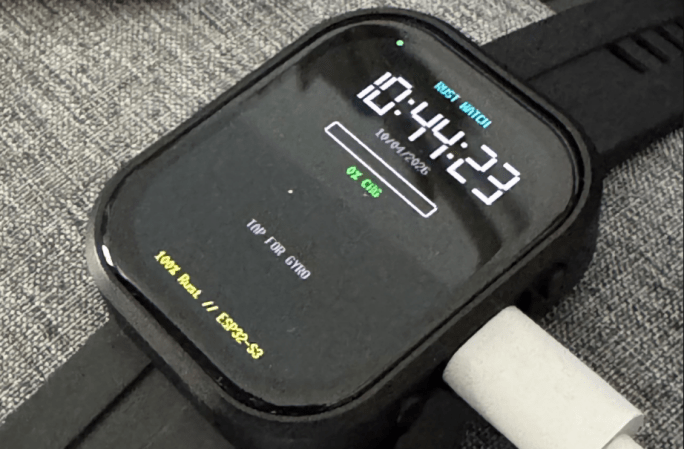
Waveshare makes a nifty little ESP32-S3 based smartwatch product, but its firmware is apparently not to everyone’s liking. Specifically, it’s not to [infiniton] a.k.a [Bright_Warning_8406]’s liking, as they rewrote the entire code base in Rust. No_std Rust, to be specific, but perhaps that doesn’t need to be specified when dealing with ESP32.

On the Reddit thread about the project, he lists some of the advantages. For one thing, the size of the binary has dropped from 1.2 MB to 579 kB while maintaining the same functionality. More interesting is that he’s been able to eliminate polling entirely: the firmware is purely event-driven. The CPU is not just idle but parked until a timer or GPIO event wakes it up. For this form factor, that’s a big deal — you can’t fit a very large battery in a watch, after all.

Getting drivers for the AMOLED display, touch sensor, audio, and RTC modules written from scratch is an impressive accomplishment. Apparently the screen driver in particular was “a nightmare” and we believe it. There’s a reason most people go for existing libraries for this stuff. [Bright_Warning] did not post screenshots or video, but claims his version of the watch watch can make HTTP calls to Smart Home, play MP3s, play the old phone games– Snake, 2048, Tetris, Flappy Bird, Maze– and even comes with a T9 keyboard for text input.

If you’re looking to get closer to bare metal, and don’t mind it being Rust-y, take a look at the code on GitHub in the first link above. This author isn’t enough of a rustacean to say if the code is as good as it sounds at a glance, but nothing egregious jumps out. The documentation describing exactly what’s going on under the hood isn’t half-bad, either. If you aren’t into Waveshare products, you could easily adapt this code into a more DIY ESP32 watch, too.

If you’re not into Rust, uh… washing soda and electric current can get it off of steel, and probably microcontrollers too. We can’t say that the chip will work after that, but hey — no rust.