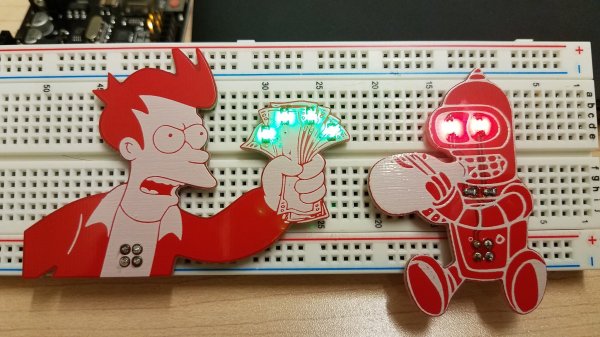
This Is The Year Conference Badges Get Their Own Badges

Over the last few years, the art and artistry of printed circuit boards has moved from business cards to the most desirable of all disposable electronics. I speak, of course, of badgelife. This is the community built on creating and distributing independent electronic conference badges at the various tech and security conferences around the globe.

Until now, badgelife has been a loose confederation of badgemakers and distributors outdoing themselves each year with ever more impressive boards, techniques, and always more blinky bling. The field is advancing so fast there is no comparison to what was being done in years past; where a simple PCB and blinking LED would have sufficed a decade ago, now we have customized microcontrollers direct from the factory, fancy new chips, and the greatest art you’ve ever seen.

Now we have reached a threshold. The badgelife community has gotten so big, the badges are getting their own badges. This is the year of the badge add-on. We’re all building tiny trinkets for our badges, and this time, they’ll all work together. We’re exactly one year away from a sweet Voltron robot made of badges.

Continue reading “This Is The Year Conference Badges Get Their Own Badges”

Joe Grand Is Hiding Data In Plain Sight: LEDs That Look Solid But Send A Message

Thursday night was a real treat. I got to see both Joe Grand and Kitty Yeung at the HDDG meetup, each speaking about their recent work.

Joe walked us through the OpticSpy, his newest hardware product that had its genesis in some of the earliest days of data leakage. Remember those lights on old modems that would blink when data is being transmitted or received? The easiest way to design this circuit is to tie the status LEDs directly to the RX and TX lines of a serial port, but it turns out that’s broadcasting your data out to anyone with a camera. You can’t see the light blinking so fast with your eyes of course, but with the right gear you most certainly could read out the ones and zeros. Joe built an homage to that time using a BPW21R photodiode.

Transmitting data over light is something that television manufacturers have been doing for decades, too. How do they work in a room full of light sources? They filter for the carrier signal (usually 38 kHz). But what if you’re interested in finding an arbitrary signal? Joe’s bag of tricks does it without the carrier and across a large spectrum. It feels a bit like magic, but even if you know how it works, his explanation of the hardware is worth a watch!

Continue reading “Joe Grand Is Hiding Data In Plain Sight: LEDs That Look Solid But Send A Message”

Stretching My Skills: How (and Why) I Made My Own Compression Sleeves

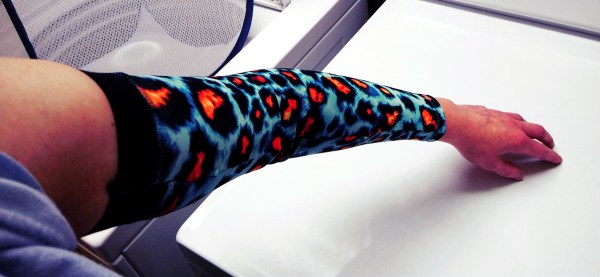
Have you ever noticed how “one size fits all” often means “one size poorly fits all”? This became especially clear to me when I started using a compression sleeve on my arm. Like any hacker, this seemed like something I could fix, so I gave it a shot. Boy, did I learn a lot in the process.

A little over a year ago, I started dropping things. If I was holding something in my left hand, chances were good that it would suddenly be on the ground. This phenomenon was soon accompanied by pain and numbness, particularly after banging on a keyboard all day.

At best, my pinky and ring fingers were tired all the time and felt half dead. At worst, pain radiated from my armpit all the way to my fingertips. It felt like my arm had been electrocuted. Long story short, I saw a neurologist or two, and several co-pays later I had a diagnosis: cubital tunnel syndrome.

Continue reading “Stretching My Skills: How (and Why) I Made My Own Compression Sleeves”

Ears To You: Sensing Facial Expressions With An Ear Plug

Electronics keep getting smaller, but human fingers don’t. This leads to a real challenge with highly-embedded wearable computers. Sure, voice command has come a long way, but it has its own challenges. You might not want to verbally command your Borg implants in some situations. Maybe you need to be quiet. Or perhaps you are worried about accidentally triggering the device. Researchers in Germany want to monitor facial expressions instead. So to snap a picture, you might wink and to fast forward your movie playing on the inside of your eyelids, perhaps you’d look to the right twice. You can see a video presentation about the paper, below.

The paper looks at several different methods to read facial movements. Some were pretty intrusive. However, a promising technique used Ear Field Sensing (EarFS). An earplug with an electrode senses electrical changes in the ear canal resulting from facial muscle movement. Other techniques examined included electromyography, capacitive sensing, and a different form of electrical field sensing.

Continue reading “Ears To You: Sensing Facial Expressions With An Ear Plug”

People With Dementia Can DRESS Smarter

People with dementia have trouble with some of the things we take for granted, including dressing themselves. It can be a remarkably difficult task involving skills like balance, pattern recognition inside of other patterns, ordering, gross motor skill, and dexterity to name a few. Just because something is common, doesn’t mean it is easy. The good folks at NYU Rory Meyers College of Nursing, Arizona State University, and MGH Institute of Health Professions talked with a caregiver focus group to find a way for patients to regain their privacy and replace frustration with independence.

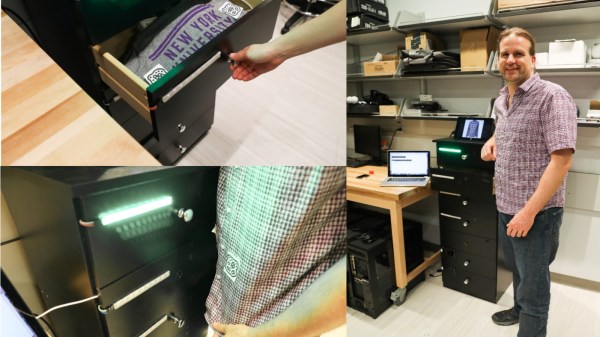
Although this is in the context of medical assistance, this represents one of the ways we can offload cognition or judgment to computers. The system works by detecting movement when someone approaches the dresser with five drawers. Vocal directions and green lights on the top drawer light up when it is time to open the drawer and don the clothing inside. Once the system detects the article is being worn appropriately, the next drawer’s light comes one. A camera seeks a matrix code on each piece of clothing, and if it times out, a caregiver is notified. There is no need for an internet connection, nor should one be given.

Currently, the system has a good track record with identifying the clothing, but it is not proficient at detecting when it is worn correctly, which could lead to frustrating false alarms. Matrix codes seemed like a logical choice since they could adhere to any article of clothing and get washed repeatedly but there has to be a more reliable way. Perhaps IR reflective threads could be sewn into clothing with varying stitch lengths, so the inside and outside patterns are inverted to detect when clothing is inside-out. Perhaps a combination of IR reflective and absorbing material could make large codes without being visible to the human eye. How would you make a machine-washable, machine-readable visual code?

Helping people with dementia is not easy but we are not afraid to start, like this music player. If matrix codes and barcodes get you moving, check out this hacked scrap-store barcode scanner.

Thank you, [Qes] for the tip.

Intra-Oral Device Detects Opioid Overdose

As you may have heard, the U.S. is in the grips of an opioid epidemic. Overdose deaths from heroin, oxycontin, and fentanyl have quadrupled since 1999. The key to detecting opioid overdose before it’s too late is in monitoring respiration. Opioids in particular cause depressed respiration, which is slow and ineffective breathing that’s inadequate for the gas exchange that keeps us alive. Depressed respiration becomes fatal unless the patient is given nalaxone, an antidote that works by blocking opioid receptors in the brain.

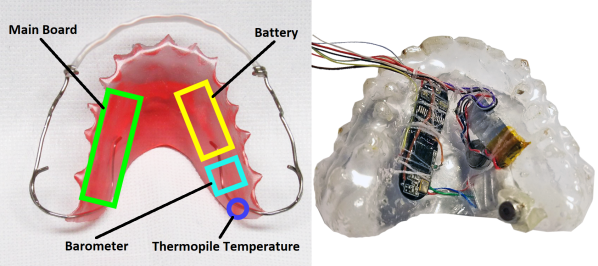
[Curt White] is developing an intra-oral device to prevent opioid overdose via early detection. It tracks a patient’s inhale/exhale rate and sends the data over Bluetooth to an open-source website.  The tiny device uses an air pressure sensor, a humidity sensor, and a thermopile thermometer to accurately track a person’s full respiration waveform whether their mouth is open or closed. The brain is one of [Curt]’s hacked $35 activity trackers that we told you about a few days ago.

All of the hardware including the battery is embedded in a custom retainer made from thermoplastic. [Curt] used Tyvek and surgical tape to isolate the air pressure sensor. Both are waterproof and breathable, which means that air can get to the sensor, but not saliva. Hold your breath and click past the break to watch [Curt] demonstrate this amazing tool on himself.

Continue reading “Intra-Oral Device Detects Opioid Overdose”

Is That A Tweet On Your Belt Buckle Or Are You Just Happy To See Me?

What a time to be alive! The range of things you never knew you needed but absolutely must have expands at a breakneck pace, such that it’s now possible to pick up a belt buckle with an embedded LED matrix to scroll messages. We have no idea what the use case for something like this is, but some people will buy anything.

One such person was a friend of [Brian Moreau], who doubled down after being gifted the glowing bauble by turning it into a WiFi enabled Tweet-scrolling belt buckle. It appears to be a just for fun project, and to be honest one would need a heck of a belt for the buckle after his mods. He added an ESP8266 to take care of monitoring his Twitter account and driving the display on the belt buckle, a non-trivial task given that the thing is programmed with only two buttons that scroll through characters to compose a message. The microcontroller might have fit inside the original buckle or only added a little to its bulk, but [Brian] decided to replace the two coin cells powering it with an external 6-volt battery pack. That required a buck converter to power the ESP, so the whole thing ended up being thrown in a case and acting more like a neat display than a flashy fashion statement.

We’d bet some tradeoffs could be made to reduce the bulk and get that buckle back where it belongs, though. Once it does, maybe it’ll be part of a complete LED-laden ensemble, from head to toe.