Homebrew SDR Ham Radio In 9 Parts

It used to be homebrew ham gear meant something simple. A couple of active devices that could send CW. Maybe a receiver with a VFO. But only the most advanced builders could tackle a wide range SSB transceiver. Today, that goal is still not trivial, but it is way easier due to specialty ICs, ready access to high-speed digital signal processing, and advances in software-defined radio techniques. [Charlie Morris] decided to build an SSB rig that incorporated these technologies and he shared the whole process from design to operation in a series of nine videos. You can see the first one below.

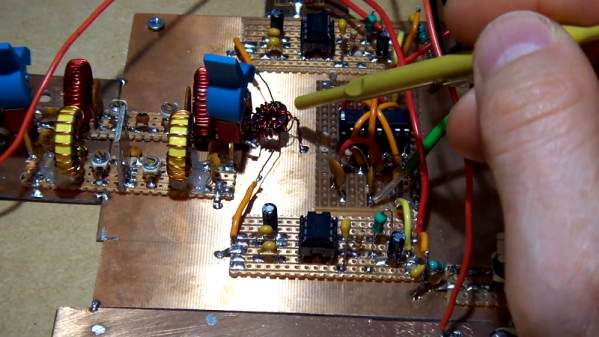
The NE612 is a child of the popular NE602 chip, which contains a Gilbert-cell mixer, and an oscillator that makes building a receiver much easier than it has been in the past. The chips are set up as direct conversion receivers and feed a Teensy which does the digital signal processing on the recovered audio.

Continue reading “Homebrew SDR Ham Radio In 9 Parts”

Dead Simple Ultrasonic Data Communication

Some of the best hacks are the ones which seem perfectly obvious in hindsight; a solution to the problem that’s so elegant, you wonder how it never occurred to you before. Of course we also love the hacks that are so complex your eyes start to water, but it’s nice to have a balance. This one, sent in by [Eduardo Zola] is definitely in the former group.

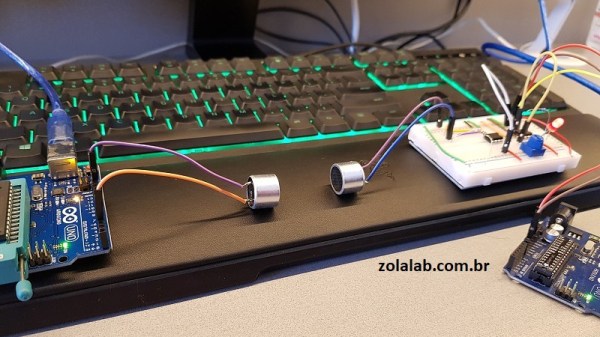
In the video after the break, [Eduardo] demonstrates his extremely simple setup for using ultrasonic transducers for one-way data communication. Powered by a pair of Arduinos and using transducers salvaged from the extremely popular HC-SR04 module, there’s a good chance a lot of readers can recreate this one on their own bench with what they’ve got lying around. In this example he’s sending strings of text from one computer to another, but with a little imagination this can be used for all sorts of projects.

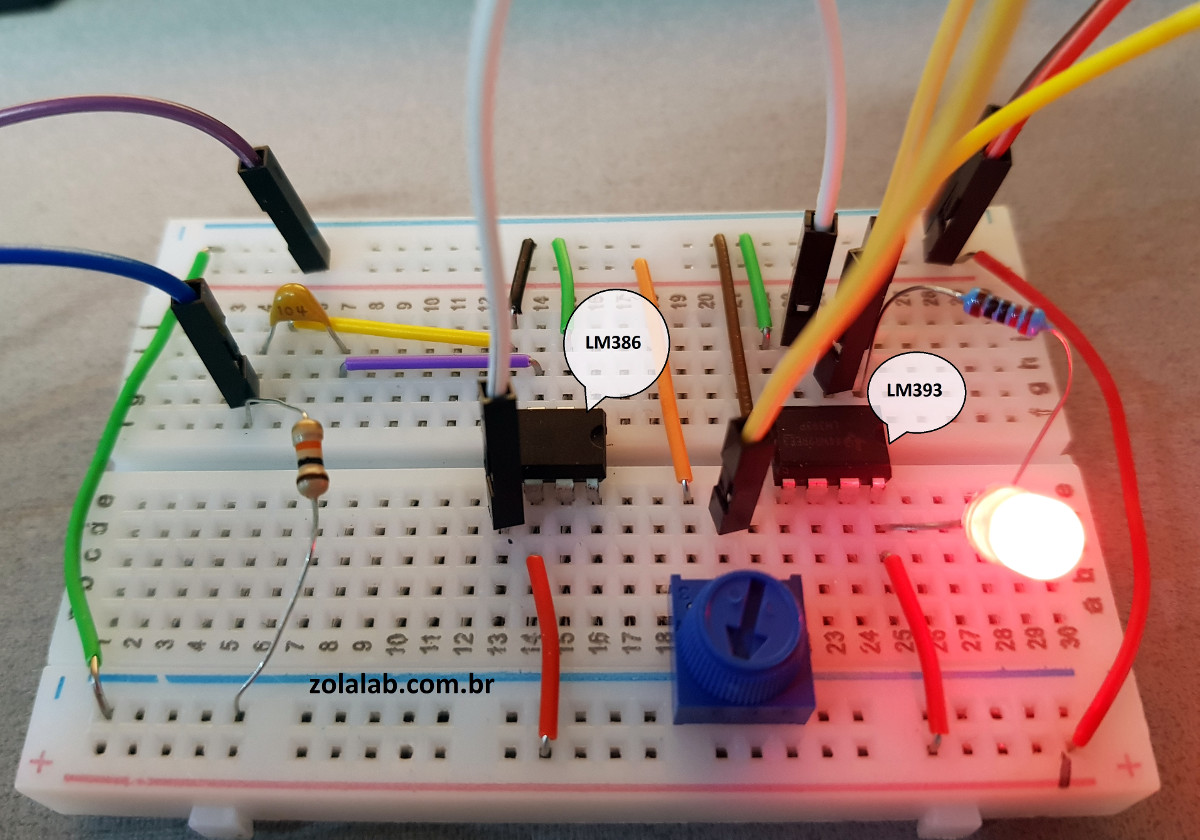
For the transmitter, the ultrasonic transducer is simply tied to one of the digital pins on the Arduino. The receiver is a bit more complex, requiring a LM386 amplifier and LM393 comparator to create a clean signal for the second Arduino to read.

But how does it work? Looking through the source code for the transmitter and receiver, we can see it’s about as basic as it gets. The transmitter Arduino breaks down a given string into individual characters, and then further converts the ASCII to eight binary bits. These bits are sent out as tones, and are picked up on the receiving end. Once the receiver has collected a decent chunk of tones, it works through them and turns the binary values back into ASCII characters which get dumped over serial. It’s slow, but it’s simple.

If you’re looking for something a bit more robust, check out this guide on using GNU Radio with ultrasonics.

Continue reading “Dead Simple Ultrasonic Data Communication”

How Hertha Ayrton Enabled The Titanic To Call SOS

[Kathy] recently posted an interesting video about the connection of an electronics pioneer named [Hertha Ayrton] to the arc transmitter. The story starts with the observation of the arc lamp — which we learned was a typo of arch lamp.

[Hertha] was born into poverty, but — very odd for the day — obtained a science education. That’s probably a whole story in of itself. During her schooling, she fell in love with her professor [William Ayrton] and they wed.

Continue reading “How Hertha Ayrton Enabled The Titanic To Call SOS”

ESP32 Boards With Displays: An Overview

The ESP8266 has become practically the 555 chip of WiFi connected microcontrollers. Traditionally, you’d buy one on a little breakout board with some pins and a few connectors, and then wire up anything else you need. The ESP8266’s big brother, the ESP32, hasn’t quite taken over from the ESP8266, but it has a lot more power and many more options. [Andreas] has a new video that shows seven new ESP32 boards that have integral displays. These boards can simplify a lot of applications where you need both WiFi and a user interface.

Of the boards examined, six of them have OLED displays, but one has an E-paper display. To summarize results, [Andreas] summarized his findings on these seven along with others in an online spreadsheet.

Continue reading “ESP32 Boards With Displays: An Overview”

LoRa System Commands Drones From A Distance

LoRa has been making quite a stir in hacker circles over the past couple of years, as it offers a fascinating combination of long range, low power, and low cost. It does this by using spread spectrum techniques on unlicensed frequency bands, meaning it can send data a surprising distance and that you don’t need a radio license to use it. It is mainly used for Internet of Things things, but [Paweł Spychalski] has other ideas: he’s building a system to use it to control a quadcopter drone over distances of 5 kilometers or more. That’s an ambitious aim, considering that the parts he is using cost only a few bucks.

He’s using an off-brand Adafruit Feather LoRa board and a couple of home-made antennas with his own software that takes the data from the Taranis control port of the RC controller, encodes it and chirps it out over the LoRa radio. At the other end, a similar radio receives and decodes the data, feeding it out to the drone.

This is definitely still a work in progress, but he has got it working, flying his drone over the link, keeping control of it out to several hundred meters. At the moment, he can’t go much further as it seems that his LoRa radio is being overwhelmed by the video link on the drone, but he is working on changing the frequency spread & hopping and using a better antenna to provide longer range. We’ve seen some interesting stuff from [Pawel] before, like his DIY telemetry system, so this project is worth keeping an eye on if you are a drone fan.

Continue reading “LoRa System Commands Drones From A Distance”

Giving An LED Bulb Some Smarts

How many of your projects been spawned purely out of bored daydreaming? For want of something more productive to do, [dantheflipman] hacked a standard LED bulb from Wal-Mart into a smart bulb.

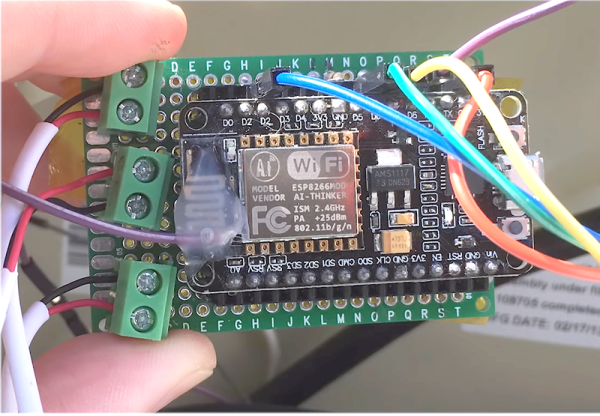
After pulling it apart, they soldered wires to the threaded socket and added a connector for a Hi-Link hlk-pm01 power module. The output caps at 5 V and 600 mA, but who says this was going to be a searchlight? A Wemos D1 Mini clone slides nicely beside the power module, and stacked on top is a NeoPixel Jewel 7. [dantheflipman] admits he has yet to add a capacitor to ahead of the Jewel, so we’ll see how long the LEDs last. Crammed back together, the bulb is controlled via a prototype Blynk app. Good enough for a quick hack.

[dantheflipman] is upfront about messing with mains voltages: don’t do it unless you absolutely know what you’re doing. In this case, he has taken care with their soldering and epoxied all wire and solder joints to be sure nothing will come loose and short, and a ‘stress test’ is forthcoming.

Smart bulbs are cool no matter how you slice it, so a little more insight into how smart bulbs work with some of the nitty gritty that goes into hacking them might sate your thirst for knowledge.

[Via /r/arduino]

A Mobile Terminal For Guerrilla Communications

We use the Internet to do everything from filing our taxes to finding good pizza, but most critically it fulfills nearly all of our communication needs. Unfortunately, this reliance can be exploited by those pulling the strings; if your government is trying to do something shady, the first step is likely to be effecting how you can communicate with the outside world. The Internet is heavily censored and monitored in China, and in North Korea the entire country is effectively running on an intranet that’s cutoff from the wider Internet. The need for decentralized information services and communication is very real.

While it might not solve all the world’s communication problems, [::vtol::] writes in to tell us about a very interesting communication device he’s been working on that he calls “Hot Ninja”. Operating on the principle that users might be searching for accessible Wi-Fi networks in a situation where the Internet has been taken down, Hot Ninja allows the user to send simple messages through Wi-Fi SSIDs.

We’ve all seen creatively named Wi-Fi networks before, and the idea here is very much the same. Hot Ninja creates a Wi-Fi network with the user’s message as the SSID in hopes that somebody on a mobile device will see it. The SSID alone could be enough depending on the situation, but Hot Ninja is also able to serve up a basic web page to devices which actually connect. In the video after the break, [::vtol::] even demonstrates some rudimentary BBS-style functionality by presenting the client devices with a text field, the contents of which are saved to a log file.

In terms of hardware, Hot Ninja is made up of an Arduino Mega coupled to three ESP8266 boards, and a battery to keep it all running for up to eight hours so you can subvert a dictatorship while on the move. The user interface is provided by a small OLED screen and a keyboard made entirely of through-hole tactile switches, further reinforcing the trope that touch-typing will be a must have skill in the dystopian future. It might not be the most ergonomic device we’ve ever seen, but the fact it looks like something out of a Neal Stephenson novel more than makes up for it in our book.

This is not the first time we’ve seen Wi-Fi SSIDs used as a method of communication, thanks largely to how easy the ESP8266 makes it. For his part, [::vtol::] has previously experimented with using them to culturally enrich the masses.

Continue reading “A Mobile Terminal For Guerrilla Communications”