
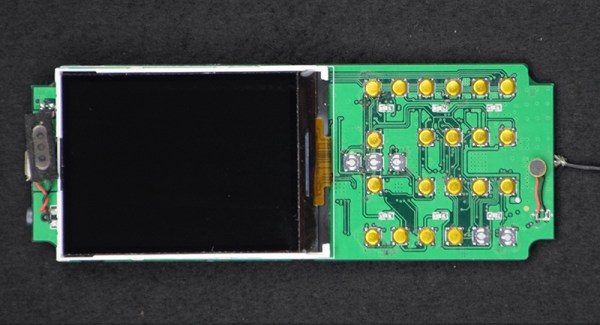
Over the years, we’ve seen dozens of projects that sell themselves as an ‘Open Source’ cellphone, a hackable cellphone, or some other confabulation of a microcontroller, screen, and a cellular module. The WiPhone is not one of these projects. That’s not to say it’s not an Open Source phone that’s intended to be hackable. No, this is a DIY phone that doesn’t make cellular calls, because this is a phone that only works with SIP and VoIP apps. It’s a WiPhone, and something a lot of us have been waiting for.
The hardware for this WiFi enabled phone is extremely minimal, but there are some interesting tricks up its sleeve. Instead of letting the main microcontroller handle capturing all the button presses, the team behind the WiPhone are using a SN7326 key-scan controller. This cheap part is able to scan 64 buttons, although there are only 25 buttons on the phone. The audio board is a WM8750BL, a cheap codec with a stereo microphone interface and a 400 mW speaker driver. The display is a simple SPI TFT, and apart from the microcontroller, that’s about it.
But it’s the microcontroller that makes it, and for that we turn to the incredible ESP-32. This chip has enough power to play Doom, be a Game Boy, and in this case, make and receive calls from a VoIP provider, scan and connect to WiFi networks, and yes, it can even play snake.
While this is just about the simplest phone you can imagine, and it only works where there’s a WiFi network, a device like this could be invaluable. And really, these days how far are you from a WiFi network you’re already connected to anyway?
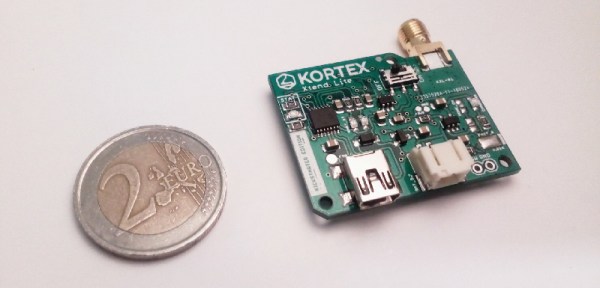



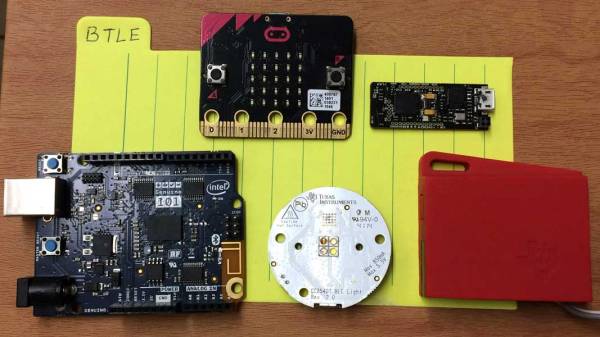
 Over the years, a number of gadgets with BLE have popped up such as the LightBlue Bean, BLE Beacons as well as quadcopters like the FlexBot that rely on BLE for communication. Android or iOS apps are the predominant method of talking to these wonderful gadgets though there are alternatives.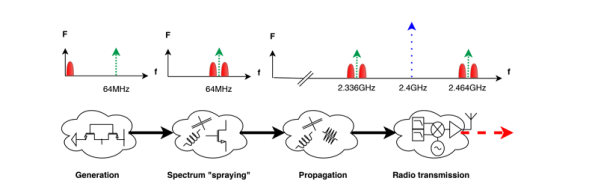
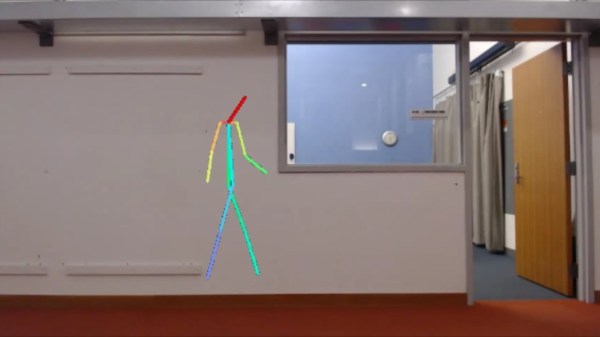
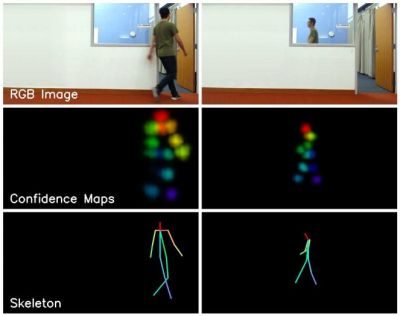 This is the work of a group at the MIT Computer Science and Artificial Intelligence Laboratory (CSAIL). The seeing-through-the-wall part is done using an RF transmitter and receiving antennas, which isn’t very new. Our own [Gregory L. Charvat]








