Hackaday Podcast 242: Mechanical Math, KaboomBox, And Racing The Beam

This week, Editor-in-Chief Elliot Williams and Kristina Panos met up from their separate but equally pin drop-quiet offices to discuss the best hacks of the previous week. Well, we liked these one, anyway.

First up in the news, it’s finally time for Supercon! So we’ll see you there? If not, be sure to check out the talks as we live-stream them on our YouTube channel!

Don’t forget — this is your last weekend to enter the 2023 Halloween Hackfest contest, which runs until 9 AM PDT on October 31st. Arduino are joining the fun this year and are offering some spooky treats in addition to the $150 DigiKey gift cards for the top three entrants.

It’s time for a new What’s That Sound, and Kristina was able to stump Elliot with this one. She’ll have to think of some more weirdo sounds, it seems.

Then it’s on to the hacks, beginning with an insanely complex mechanical central air data computer super-teardown from [Ken Shirriff]. We also learned that you can 3D-print springs and things by using a rod as your bed, and we learned whole lot about rolling your own electrolytic capacitors from someone who got to visit a factory.

From there we take a look at a Commodore Datassette drive that sings barbershop, customizing printf, and a really cool dress made of Polymer-dispersed Liquid Crystal (PDLC) panels. Finally we talk about racing the beam when it comes to game graphics, and say goodbye to Kristina’s series on USPS technology.

Check out the links below if you want to follow along, and as always, tell us what you think about this episode in the comments!

Download and savor at your leisure.

Continue reading “Hackaday Podcast 242: Mechanical Math, KaboomBox, And Racing The Beam”

Hackaday Links Column Banner

Hackaday Links: October 8, 2023

Too much of a good thing is generally a bad thing, but a surfeit of asteroid material is probably a valid exception to that rule. Such was NASA’s plight as it started to unpack the sample return capsule recently dropped off by the OSIRIS-REx spacecraft as it flew by Earth, only to discover it was packed to overflowing with samples of asteroid Bennu. The spacecraft, which arrived at Bennu in 2018 and spent a good long time mapping the near-Earth asteroid, apparently approached its carefully selected landing site a bit too energetically and really packed the sample container full of BennuBits™ — so much so that they could actually see sample shedding off into space before stowing it for the long trip back to Earth. The container is now safely in the hands of the sample analysis team, who noted that everything in the TAGSAM (Touch and Go Sample Acquisition Module), even the avionics deck, is covered with black particles, each precious one of which needs to be collected and cataloged. The black stuff is especially interesting to planetary scientists, as it might be exactly what they were after when they selected Bennu, which may have broken off a much larger carbon-rich asteroid a billion or so years ago. It’ll be interesting to see if these interplanetary hitchhikers have anything to tell us about the origin of life in the solar system.

Continue reading “Hackaday Links: October 8, 2023”

Farewell American Computer Magazines

I grew up in a small town with a small library. The next town over had what I thought at the time was a big library, but it was actually more like my town had a tiny library, and the next one over had an actual small library. When I left to go to University, I found out what a real library looked like, and I was mesmerized. Books! Lots of books, many of them written in the current decade. My grades probably suffered from the amount of time I spent in the library reading things that didn’t directly relate to my classes. But there was one thing I found that would turn out to be life-changing: A real computer magazine. Last month, Harry McCracken pointed out that the last two widely-distributed American consumer computer magazines ceased paper publication. It is the end of an era, although honestly, it is more like a comatose patient expiring than a shocking and sudden demise.

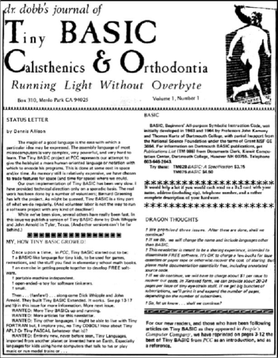
Dr. Dobb’s first issue was far from the slick commercial magazine it would become.

Actually, before I had gone to college, I did have a subscription to Kilobaud, and I still have some copies of those. No offense to Wayne Green, but Kilobaud wasn’t that inspiring. It was more an extension of his magazine “73”, and while I enjoyed it, it didn’t get me dreaming. Dr. Dobb’s Journal — the magazine I found in the stacks of my University’s library — was tangibly different. There was an undertone of changing the world. We weren’t sure why yet, but we knew that soon, everyone would have a computer. Maybe they’d balance their checkbook or store recipes. A few people already saw the potential of digital music reproduction, although, I must admit, it was so poor at the time, I couldn’t imagine who would ever care.

I say it was life-changing to discover the few issues of Dr. Dobb’s that were published back then because I would go on to contribute to Dr. Dobb’s throughout its storied history. I wrote the infamous DOS extender series, produced special issues, and, when it went mostly digital, was the embedded system blogger for them for more years than I care to admit. In fact, I have the dubious distinction of having the final blog posted; although the website has suffered enough bit rot, I’m not sure any of it has survived other than, maybe, on the Wayback machine. While I wasn’t with the magazine for its entire 38-year run, I read it for at least 35 and had some function there for about 24 of those.

Continue reading “Farewell American Computer Magazines”

A Simple Touch Probe Made With Basic Tools

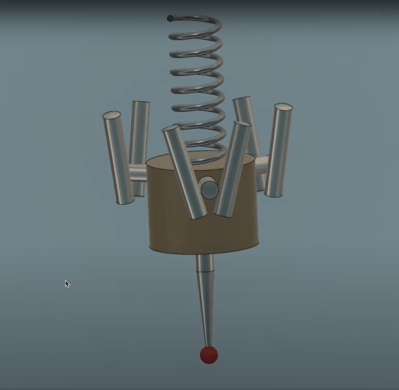
Six points of contact detect any displacement.

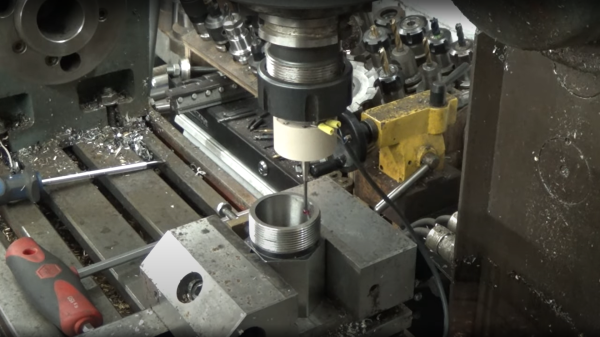
LinuxCNC contributor and machining enthusiast [Andy Pugh] is certainly not afraid to try making specialised tools to see how well they work out, and this time he’s been busy making a touch probe (video, embedded below) for checking the accuracy of machining operations and general measuring applications.

These things are not cheap, since they are essentially ‘just’ a switch with a long probe, But, as with anything specialised and machined with tight tolerances, you can understand why they cost what they do.

After inspecting and spending some time reverse-engineering such a unit, [Andy] then proceeded to grab some PEEK bar he had lying around and chuck it into the lathe (get it?). He notes Delrin would be more cost effective for those wishing to reproduce this, but as long as you have the ability to machine it and it’s non-conductive, there are many other options you could try.

Using no special tools other than a collet block (like this one) all the angled holes and slots were made with ease, with the help of a specially 3D-printed mount for the vise. A nice, simple approach, we think!

[Andy] tested the repeatability of the probe, mounted over his CNC-converted Holbrook lathe, reporting a value of 1 um, which seems rather good. Centering of the probe tip within the probe body was off a bit, as you’d expect for something made practically by hand, but that is less of a problem as it would seem, as it results in a fixed offset that can be compensated for in software. Perhaps the next version will have some adjustability to dial that out manually?

The whole assembly is formed from two plastic parts, a handful of ground-finished hardened steel pins, and a big spring. The only part remotely special is an off-the-shelf probe tip. During the electrical hookup, you may notice the use of a self-fluxing verowire pen, which was something this scribe didn’t know existed and has already placed an order for!

The reference 3D model for the design is shared from [Andy]’s Autodesk Drive for your viewing pleasure.

Of course, this isn’t the first DIY touch probe we’ve seen, here’s one for example, and over on Hackaday.IO, here’s an attempt to make one using a piezoelectric transducer.

Continue reading “A Simple Touch Probe Made With Basic Tools”

Ordering prototypes like they were fast food

Made To Spec: The Coming Age Of Prototyping As A Service

In the last decade, the price for making a single PCB plummeted. And we’ve featured tons of hacks with boards hailing from places like OSH Park or Seeed Studio. But this phenomenon isn’t isolated, and all sorts of one-off prototyping services are becoming cheaper and looking to satiate both hobbyist and engineer alike.

Today, I want to blow the lid off a few places offering one-off mechanical prototyping services. I’ll take us through some history of how we got here, introduce a few new players, and finally highlight some important tradeoffs before you start ordering bespoke aluminum parts straight to your doorstep.

Now go get your ANSI Z87+ safety glasses, and let’s get started.

Continue reading “Made To Spec: The Coming Age Of Prototyping As A Service”

Axe Hacks: New Sounds For Your Electric Guitar Beginning From What Makes Them Tick

Creating music is a perfect hobby for anyone into hacking, and the amount of musical hacks and self-made instruments we come across here makes that supremely evident. It’s just a great match: you can either go full-on into engineering mode as music is in the end “just” applied physics, or simply ignore all of the theory and take an artistic approach by simply doing whatever feels right. The sweet spot is of course somewhere in between — a solid grasp of some music theory fundamentals won’t hurt, but too much overthinking eventually will.

The obvious choice to combine a favorite pastime like electronics or programming with creating music would be in the realm of electronic music, and as compelling as building synthesizers sounds, I’ll be going for the next best thing instead: the electric guitar. Despite its general popularity, the enormous potential that lies within the electric guitar is rarely fully utilized. Everyone seems to just focus on amp settings and effect pedals when looking for that special or unique sound, while the guitar itself is seen as this immutable object bestowed on us by the universe with all its predestined, magical characteristics. Toggle a pickup switch, and if we’re feeling extra perky, give that tone pot a little spin, that’s all there is to it.

The thing is, the guitar’s electrical setup — or wiring — in its stock form simply is as boring and generic as it can get. Sure, it’s a safe choice that does the job well enough, but there’s this entirely different world of tonal variety and individual controllability locked inside of it, and all it really takes is a screwdriver and soldering iron to release it. Plus, this might serve as an interesting application area to dive into simple analog electronics, so even if guitars aren’t your thing yet, maybe this will tickle your creativity bone. And if bass is more your thing, well, let me be ignorant and declare that a bass is just a longer guitar with thicker, lower-tuned strings, meaning everything that follows pretty much applies to bass as well, even if I talk about guitars.

However, in order to modify something, it helps to understand how it functions. So today, we’ll only focus on the basics of an electric guitar, i.e. what’s inside them and what defines and affects their tone. But don’t worry, once we have the fundamentals covered, we’ll be all settled to get to the juicy bits next time.

Continue reading “Axe Hacks: New Sounds For Your Electric Guitar Beginning From What Makes Them Tick”

Frances Allen Optimised Your Code Without You Even Knowing

In 2020, our digital world and the software we use to create it are a towering structure, built upon countless layers of abstraction and building blocks — just think about all the translations and interactions that occur from loading a webpage. Whilst abstraction is undoubtedly a great thing, it only works if we’re building on solid ground; if the lower levels are stable and fast. What does that mean in practice? It means low-level, compiled languages, which can be heavily optimised and leveraged to make the most of computer hardware. One of the giants in this area was Frances Allen, who recently passed away in early August. Described by IBM as “a pioneer in compiler organization and optimization algorithms,” she made numerous significant contributions to the field. Continue reading “Frances Allen Optimised Your Code Without You Even Knowing”