Sloth Door Greeter Uses Neat Fold-Up Electronics Enclosures

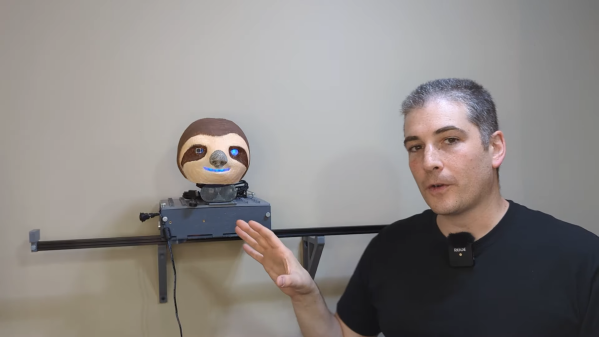
[Alan Reiner] is building a sloth-like door greeter for his house. Sloxel, as he is affectionately known, can move around and even talk, with [Alan] using some nifty tricks in the design process

Sloxel’s job is to vet visitors to [Alan’s] house, before inviting them to knock on the door or to leave their details and go away. There’s still plenty of work to do on that functionality, which [Alan] plans to implement using ChatGPT. In the meantime, though, he’s been working hard on the hardware platform that will power Sloxel. A Raspberry Pi 3B+ is charged with running the show, including talking to the ChatGPT API and handling Sloxel’s motion along a linear rail with a number of stepper motors.


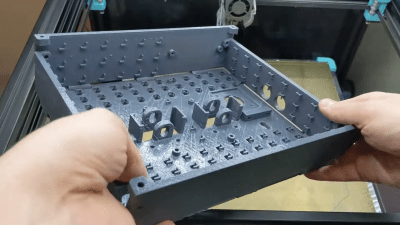
What we really love about this build, though, is the enclosure. [Alan] designed a housing for everything that can be 3D printed as a single part with print-in-place hinges. The four sides of the enclosure can then be folded up and into place with a minimum of fuss. Plus, the enclosure has plenty of nifty features that makes it easy to mount all the required hardware. It’s a neat design that we’d love to repurpose for some of our own projects.

We’ve seen other neat ideas in this area before, like using PCBs themselves as an enclosure. Video after the break.

Continue reading “Sloth Door Greeter Uses Neat Fold-Up Electronics Enclosures”

An Open-Source Antikythera Mechanism

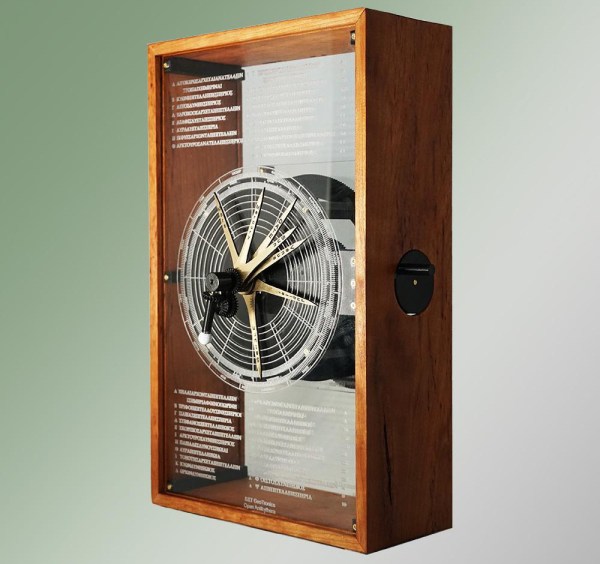
When the Antikythera Mechanism was first discovered, it wasn’t viewed as the wonder that we know it today. Originally the divers who found the device and the first scientists to look at it wrote it off as an astrolabe or other some other common type of clock. It wasn’t until decades later when another set of scientists x-rayed the device and surveyed more of the shipwreck where it was found that it began to become one of the more important archaeological discoveries in history. There have been plenty of attempts to recreate this device, and this replica recreates the mechanisms of the original but is altered so it can be built in a modern workshop.

The build, which took the creators several years of research and development to complete, started off with the known gear schemes found on the original device. However, the group wanted to make it with modern technology including 3D printers and laser cutters, so although they worked from an understanding of the original 2000-year-old device there are some upgrades and changes to accommodate those who want to build this in a modern workshop. Gears made from plastic instead of brass have more friction, which needed to be reduced by building custom bearings machined out of brass. And to complete the machine a number of enclosures of various styles are available to use as well.

Additionally, all of the designs and schematics for this build are open source for anyone to build or modify as they would like, although the group putting this together does plan to sell various parts for this as well. There will be some issues with use, as they point out, since the ancient Greeks didn’t have a full enough understanding of cosmology to get a machine like this to stay accurate for two thousand years, but it’s a fascinating build nonetheless. Reasearchers are still discovering new things about this device too, including the recent find of an earliest possible start date for the machine.

Reliable 3D Printing With Ceramic Slurry

3D printing is at its most accessible (and most affordable) when printing in various plastics or resin. Printers of this sort are available for less than the cost of plenty of common power tools. Printing in materials other than plastic, though, can be a bit more involved. There are printers now for various metals and even concrete, but these can be orders of magnitude more expensive than their plastic cousins. And then there are materials which haven’t really materialized into a viable 3D printing system. Ceramic is one of those, and while there are some printers that can print in ceramic, this latest printer makes some excellent strides in the technology.

Existing technology for printing in ceramic uses a type of ceramic slurry as the print medium, and then curing it with ultraviolet light to solidify the material. The problem with ultraviolet light is that it doesn’t penetrate particularly far into the slurry, only meaningfully curing the outside portions. This can lead to problems, especially around support structures, with the viability of the prints. The key improvement that the team at Jiangnan University made was using near-infrared light to cure the prints instead, allowing the energy to penetrate much further into the material for better curing. This also greatly reduces or eliminates the need for supports in the print.

The paper about the method is available in full at Nature, documenting all of the details surrounding this new system. It may be a while until this method is available to a wider audience, though. If you can get by with a print material that’s a little less exotic, it’s not too hard to get a metal 3D printer, as long as you are familiar with a bit of electrochemistry.

Cheap Deburring Tool Is Game Changer For 3D Printing

3D printing’s real value is that you can whip up objects in all kinds of whacky geometries with a minimum of fuss. However, there’s almost always some post-processing to do. Like many manufactured plastic objects, there are burrs, strings, and rough edges to deal with. Fussing around with a knife to remove them is a poor way to go. As explained by [Adrian Kingsley-Hughes] on ZDNet, a deburring tool is the cheap and easy solution to the problem.

If you haven’t used one before, a deburring tool simply consists of a curved metal blade that swivels relative to its straight handle. You can drag the curved blade over the edge of a metal, wooden, or plastic object, and it neatly pulls away the burrs. There’s minimal risk of injury, unlike when pulling a regular blade towards yourself. The curved, swiveling blade is much less liable to slip or jump, and if it does, it’s far less likely to cut you.

For plastic use, just about any old deburring tool will do. They last a long time with minimal maintenance. They will wear out faster when used on metals, but you can get replacement blades cheap if you happen to need them. It’s a tool every workshop should have, particularly given they generally cost less than $20.

Given the ugly edges and rafts we’re always having to remove from our 3D prints, it’s almost egregious that printers don’t come with them bundled in the box. They’re just a bit obscure when it comes to tools; this may in fact be the first time Hackaday’s ever covered one. If you’ve got your own quality-of-life hacks for 3D printing, sound off below, or share them on the tipsline! We have able staff waiting for your email.

3D Printed Artificial Nose Is Totally Vegan

Prosthetics are complicated, highly personal things. They must often be crafted and customized precisely to suit the individual. Additive manufacturing is proving a useful tool in this arena, as demonstrated by a new 3D printed nose design developed at Swansea University. And a bonus? It’s vegan, too!

Often, cartilage from the ribcage is used when reconstructing a patient’s nose. However, this procedure is invasive and can lead to health complications. Instead, a nanocellulose hydrogel made from pulped softwood, combined with hyaluronic acid, may be a viable printable material for creating a scaffold for cartilage cells. The patients own cartilage cells can be used to populate the scaffold, essentially growing a new nose structure from scratch. The technique won’t just be limited to nose reconstructions, either. It could also help to recreate other cartilage-based structures, such as the ear.

As with all new medical technologies, the road ahead is long. Prime concerns involve whether the material is properly bio-compatible, particularly where the immune system is concerned. However, the basic idea is one that’s being pursued in earnest by researchers around the world, whether for cosmetic purposes or to grow entire organs. As always, if you’re secretly 3D printing functional gallbladders in your basement, don’t hesitate to drop us a line.

Robot 3D Prints Giant Metal Parts With Induction Heat

While our desktop machines are largely limited to various types of plastic, 3D printing in other materials offers unique benefits. For example, printing with concrete makes it possible to quickly build houses, and we’ve even seen things like sugar laid down layer by layer into edible prints. Metals are often challenging to print with due to its high melting temperatures, though, and while this has often been solved with lasers a new method uses induction heating to deposit the metals instead.

A company in Arizona called Rosotics has developed a large-scale printer based on this this method that they’re calling the Mantis. It uses three robotic arms to lay down metal prints of remarkable size, around eight meters wide and six meters tall. It can churn through about 50 kg of metal per hour, and can be run off of a standard 240 V outlet. The company is focusing on aerospace applications, with rendered rocket components that remind us of what Relativity Space is working on.

Nothing inspires confidence like a low-quality render.

The induction heating method for the feedstock not only means they can avoid using power-hungry and complex lasers to sinter powdered metal, a material expensive in its own right, but they can use more common metal wire feedstock instead. In addition to being cheaper and easier to work with, wire is also safer. Rosotics points out that some materials used in traditional laser sintering, such as powdered titanium, are actually explosive.

Of course, the elephant in the room is that Relativity recently launched a 33 meter (110 foot) tall 3D printed rocket over the Kármán line — while Rosotics hasn’t even provided a picture of what a component printed with their technology looks like. Rather than being open about their position in the market, the quotes from CEO Christian LaRosa make it seem like he’s blissfully unaware his fledgling company is already on the back foot.

If you’ve got some rocket propellant tanks you’d like printed, the company says they’ll start taking orders in October. Though you’ll need to come up with a $95,000 deposit before they’ll start the work. If you’re looking for something a little more affordable, it’s possible to convert a MIG welder into a rudimentary metal 3D printer instead.

3D-Printed Parts Don’t Slow Down This Speedy Printer

Truth be told, we generally find speed sports to be a little boring. Whether it’s cars going around in circles for hours on end or swimmers competing to be a few milliseconds faster than everyone else, we just don’t feel the need for speed. Unless, of course, you’re talking about speedy 3D printers like “The 100”, which claims to produce high-quality prints in a tenth the time of an ordinary printer. In that case, you’ve got our full attention.

What makes [Matt the Printing Nerd]’s high-speed printer interesting isn’t the fact that it can do a “Speedboat Run” — printing a standard Benchy model — in less than six minutes. Plenty of printers can do the same thing much, much faster. The impressive part is that The 100 does it with a 3D-printed frame. In fact, most of the printer’s parts are 3d printed, a significant departure from most speed printer builds, which generally shy away from printed structural elements. [Matt]’s design also aims to keep the center of gravity of all the printer’s components within a very small area, which helps manage frame vibrations that limit print quality. The result is that the CoreXY gantry is capable of a speed of 400 mm/s and an eye-popping 100,000 mm/s² acceleration. What also sets [Matt]’s printer apart is that The 100 is designed to be a daily driver. It has a generous 165 mm x 165 mm print bed, which is far more useful than a bed that’s barely bigger than a standard Benchy.

The video below has much more details on the open-source build, plus some nice footage of some speed runs. The quality of the prints, even done at speed, is pretty impressive. Perhaps there is a point to speed sports after all.

Continue reading “3D-Printed Parts Don’t Slow Down This Speedy Printer”