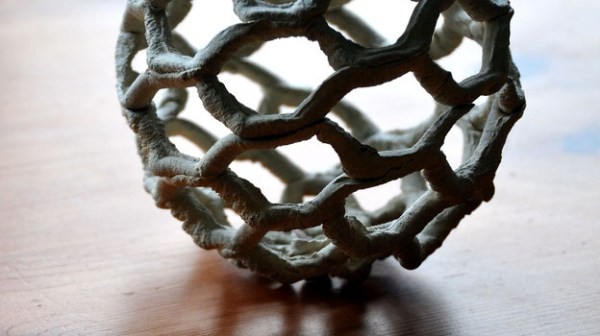
Printing Liquid Concrete

In the world of additive manufacturing, there’s always need materials being added to the list of potential filaments to use for printing objects. A method of rapid liquid printing of concrete designed by [Anatoly Berezkin] of Stoneflower 3D makes it possible to print a large variety of shapes from concrete while avoiding the negative effects of fast dehydration. The technique is based on an approach to printing polyurethanes, developed by MIT in 2017. This technique requires physically drawing a 3D object within a gel suspension using a chemical curing process. The gel allows gravity to not affect the printing process, as well as helping out with the curinng. Berezkin, an engineer and hobbyist working out of his garage, has published other work including print heads, ceramic printing, and micro printing sets.

One might be skeptical of whether the weight of the material could cause potential collapse during the printing process, or whether it is simply unrealistic to print objects given the time needed for the concrete to dry. Their demo shows the process being done in household items – bowls and tupperware – combining affordable items such as clay, concrete, and sand for the matrix and mortar. The viscous clay is strong enough to act as a good scaffold for keeping the concrete structure in place as it is being printed. As their video demonstrates, at least for simply objects, the process seems relatively fast.

RLPC doesn’t require toxic chemicals or proprietary components such as gels and suspensions. Its immersion of the final printed object in a humid environment is also superior to the standard process of liquid deposition for hardening concrete. Moreover, the process simply requires clay or retarded mortar for the matrix and mortar paste for turning into concrete. It’s advertised as eco-friendly, but just the simplicity of the materials needed for the matrix and mortar make this a promising technique.

Continue reading “Printing Liquid Concrete”

A Rope Maker You Can 3D Print At Home

Ropes are one of those things that, while possible to make by hand, having a little mechanical help goes a long way in their manufacture. [b33ma247] wanted just such a rig, so set about building one from scratch.

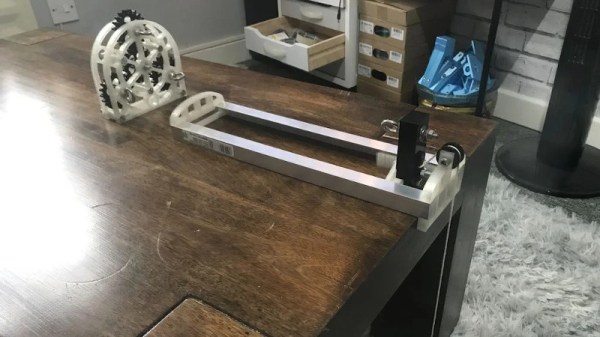
It’s a simple device, but one that makes the task much easier. A series of gears are printed, which assemble on to a frame to form the winding mechanism that weaves the rope. There’s also a slide, a rope separator, and a weight carriage to ensure proper tension is kept on the string during the weaving process. The mechanism is driven by a power drill, though this could be easily replaced with a hand crank if full manual operation was desired.

It’s a project which shows if you have a 3D printer, you can make a lot of other useful tools for your workshop too. We see similar approaches taken when it comes time to wind coils, too. Video after the break.

Continue reading “A Rope Maker You Can 3D Print At Home”

3D Printable Nameplates From Your Web Browser

It’s an unwritten rule that all proper pieces of shop equipment need a nameplate. Otherwise, how are you going to know what name to use when you curse it under your breath? In the old days these would have been made out of something fancy such as brass, but for the modern hacker that doesn’t stand on tradition, you can now easily outfit all your gear with custom 3D printed nameplates using this online tool.

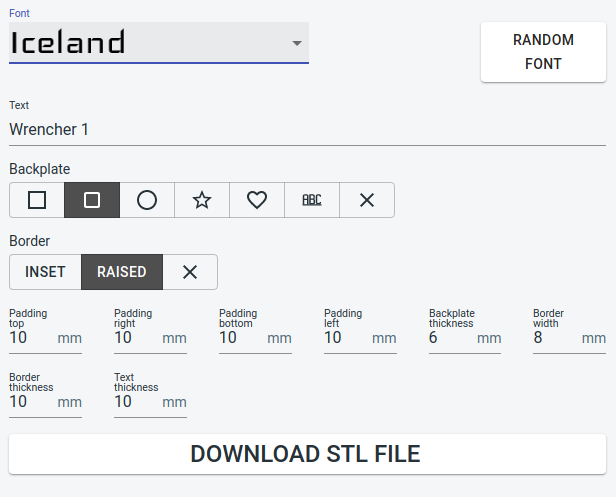
Granted, it wouldn’t be very difficult to throw one of these together in whatever CAD package you happen to have access to. But with the tool [Tobias Weber] has developed, you don’t have to. Simply pick the font, the shape of the border, and fill in a few variables to fine tune things such as padding and base thickness.

Finally, enter your text and marvel at the real-time 3D preview that’s rendered thanks to the magic of modern web technologies. In seconds, you’ll have an STL file that’s ready for the warm liquid goo phase.

The huge collection of fonts are a particularly nice touch, ranging from delicate scripts to military style stencils. Depending on your CAD software, getting arbitrary fonts imported and extruded into a three dimensional shape can be tricky for new players. If we do have one complaint though, it’s that there doesn’t seem to be a clear indicator of how big the nameplate is going to be when exported. First time around, it spit out an STL that would have been 300 mm long if we hadn’t scaled it down in the slicer.

This project is very reminiscent of another web-based tool we featured recently. That one allowed you to make 3D printed QR codes which would whatever entomb in plastic whatever data your cold hacker heart desired.

Continue reading “3D Printable Nameplates From Your Web Browser”

3D Print Your 3D Scanner

[QLRO] wanted a 3D scanner, but didn’t like any of the existing designs. Some were too complex. Some were simple but required you to do things by hand. That led to him designing his own that he calls AAScan. You can see the thing operating in the video below.

In general, you can move the camera around the object or you can move the object around while the camera stays fixed. This design chooses the latter. You’ll need a stepper motor with a driver board and an Arduino to make the turntable rotate. You also need a computer running Python and Meshroom. The phone also has to run Python and [QLRO] used QPython on an Android device.

Continue reading “3D Print Your 3D Scanner”

Everything You Wanted To Know About 3D Printing Support But Were Afraid To Ask

At the dawn of 3D printing, support structures were something to avoid. ABS is a hard substance to clear off, and the slicers did a comparatively poor job of making structures that were easy to remove. Today, supports are not a big deal and most of the slicers and materials allow for high-quality prints with supports. We were printing something with supports the other day and noticed that Cura has a support floor and roof function. Curious, we did a quick search and found this very comprehensive post about the current state of support.

With 25 topics in the table of contents, this isn’t a 3-minute read. Of course, you might wish to skip over some of the first parts if you get why you need support and understand the basic ideas. We became more interested when we reached the geometry section.

Continue reading “Everything You Wanted To Know About 3D Printing Support But Were Afraid To Ask”

$200 Resin Printer Reviewed

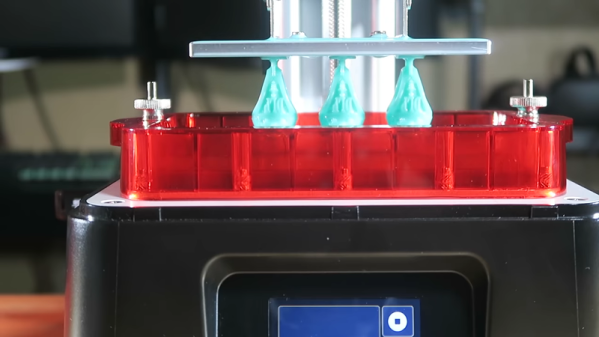
[3DPrintFarm] got an early version of the Phrozen Sonic Mini resin printer. If you look at the video below, he was very impressed with its build quality and results. The price is reported to be $200, although we have seen it on some web sites for a bit more. The build quality does look good, although you have to admit, the motion mechanism on a resin printer is pretty simple, since you just need to move up and down.

The printer uses a monochrome LCD which allows it to cure layers very fast (apparently, monochrome panels pass more ultraviolet light through). The panel also has a higher-rated lifetime than color LCDs

Continue reading “$200 Resin Printer Reviewed”

Welcome To McDonald’s; Would You Like 3D Printing Resin With That?

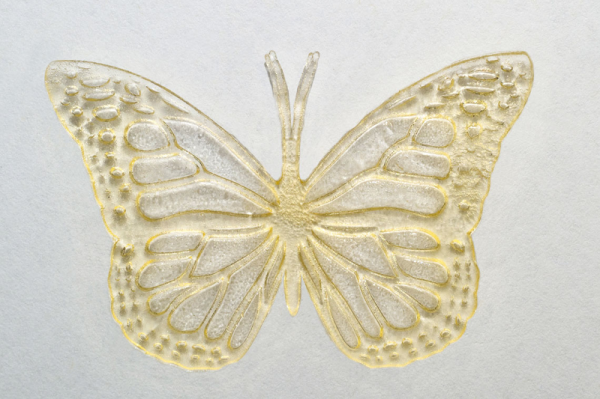
University of Toronto researchers have succeeded in converting used cooking oil — from McDonald’s, no less — into high-resolution 3D printing resin. Your first response might be: “Why?”, but thinking about it there are several advantages. For one thing, waste oil is a real problem for the food industry, and thus it can be acquired rather cheaply. An even bigger benefit is that the plastic that originates from this oil is biodegradable. Their 3d-printed butterfly, of course, is made from the recycled resin.

We aren’t chemists, but apparently 3D resin has a lot in common with cooking oil already. The team used a one-step chemical process to convert one liter of McDonald’s greasiest into a little more than 400 milliliters of resin.

Continue reading “Welcome To McDonald’s; Would You Like 3D Printing Resin With That?”