IceSL Is A Cool Slicer

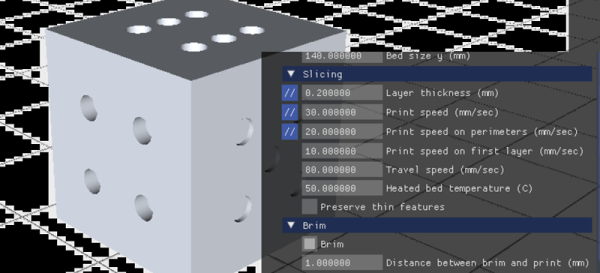
The mechanical and electronic parts of a 3D printer are critical for success, but so is the slicing software. Slic3r and Cura are arguably the most popular, and how they command your printer has a lot to do with the results you can get. There are lots of other slicers out there both free and paid, but it is hard to really dig into each one of them to see if they are really better than whatever you are using today. If you are interested in the performance of IceSL — a free slicer for Windows and Linux — [DIY3DTECH] has a video review that can help you decide if you want to try it. You can see the video below.

IceSL has several modules and can actually do OpenSCAD-like modeling in Lua so you could — in theory — do everything in this one tool. The review, though, focuses only on the slicing aspect. In addition to the desktop client versions, you can use some features online (although on our Linux machine it didn’t work with the latest Chrome beta even with no add ons; Firefox worked great, though).

Continue reading “IceSL Is A Cool Slicer” →

Hackaday Prize Entry: Open Bike Shoe

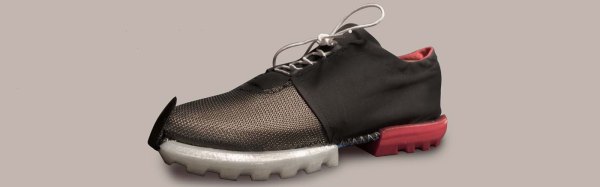
Shoes are some of the most complex pieces of equipment you can buy. There’s multiple materials ranging from foam to weird polyesters in a simple sneaker, and if you dig into shoes for biking, you’ll find some carbon fiber. All these layers are glued together, stitched, and assembled into a functional piece of exercise equipment, with multiple SKUs for each size. It’s really amazing.

Accordingly, [marcs] created N+ Open Bike Shoe Platform, the purpose of which is to create open source,  customizable, and repairable shoe platform based on 3D printing, though with other techniques like rubber molding and sewing fabric uppers are included as well.

The project breaks down its signature shoe into all its various parts: heel, toe tread, insole, upper, and so on. With each part individually customizable, the shoe can be tailored to suit each individual, all while part of a cradle-to-grave lifecycle that allows shoe parts to be replaced, repaired, or recycled.

Sacrificial Bridge Avoids 3D Printed Supports

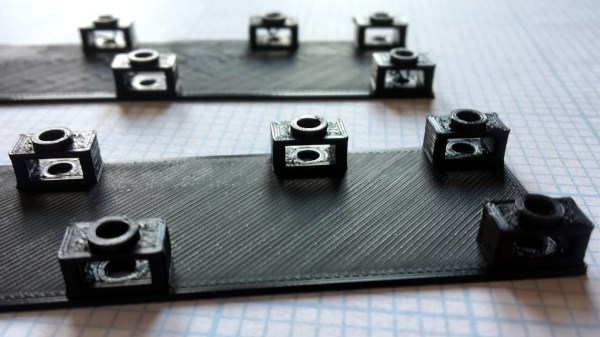
[Tommy] shares a simple 3D printing design tip that will be self-evident to some, but a bit of a revelation to others: the concept of a sacrificial bridge to avoid awkward support structures. In the picture shown, the black 3D print has small bridges and each bridge has a hole. The purpose of these bits is to hold a hex nut captive in the area under the bridge; a bolt goes in through the round hole in the top.

Readers familiar with 3D printing will see right away that printing the bridges might be a problem. When a printer gets to the first layer of the bridge, it will be trying to lay filament in empty space. By itself this is not usually a problem as long as a bridge is short, flat, and featureless. Unfortunately this bridge has a hole in it, and that hole means the printer will be trying to draw circles in mid-air, rather than simply stretching filament point-to-point across a gap. One solution would be to add a small amount of support structure, but that just moves the problem. Removing small supports from enclosed spaces can be a real hassle.

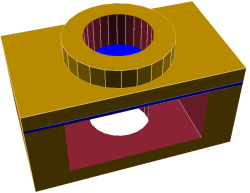
To solve this [Tommy] added what he calls a “sacrificial bridge”, shown as blue in the CAD image. He essentially gives the hole a flat bottom, so that the printer first lays down a thin but solid bridge as a foundation. Then, the portion with the round hole is printed on top of that. With this small design change, the print becomes much more reliable with no support structure required.

There is a bit of post-work involved since each hole needs to be drilled out to punch through the thin sacrificial bridge underneath, but it definitely beats digging out little bits of support structure instead.

3D Prints And Food

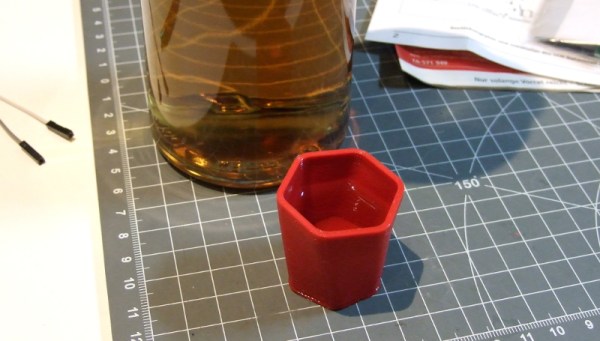
We recently ran a post about a cute little 3D printed elephant that could dispense booze. The design didn’t actually have the plastic touching the liquid — there was a silicone tube carrying the shots. However, it did spark a conversation at the secret Hackaday bunker about how safe it is to use 3D printed objects for food. In particular, when I say 3D printing, I’m talking fused deposition modeling. Yes, there are other technologies, but most of us are printing using filament laid out in layers with a hot nozzle.

There’s a common idea that ABS is bad in general, but that PET and PLA are no problem because there are food-safe versions of those plastics available. However, the plastic is only a small part of the total food safety picture. Let me be clear: I am not a medical professional and although my computers have run a few plastics plants in years past, I am not really an expert on polymer chemistry, either. However, I don’t use 3D printed materials to hold or handle food and while you might not drop dead if you do, you might want to reconsider.

Continue reading “3D Prints And Food” →

3D Printed Tyres Let You Drive On Water

[Jesus] apparently walked on water, without any tools at all. But when you’ve got a 3D printer handy, it makes sense to use it. [Simon] decided to use his to 3D print some tyres for his R/C car – with awesome results.

[Simon] started this project with a goal of driving on water. Initial experiments were promising – the first design of paddle tyres gave great traction in the sand and were capable of climbing some impressive slopes. However, once aimed at the water, the car quickly sank below the surface.

Returning to the drawing board armed with the advice of commenters, [Simon] made some changes. The paddle tyres were reprinted with larger paddles, and a more powerful R/C car selected as the test bed. On the second attempt, the car deftly skipped along the surface and was remarkably controllable as well! [Simon] has provided the files so you can make your own at home.

It’s a great example of a practical use for a 3D printer. Parts can readily be made for all manner of RC purposes, such as making your own servo adapters.

Dumbo Never Forgets To Fill Your Glass

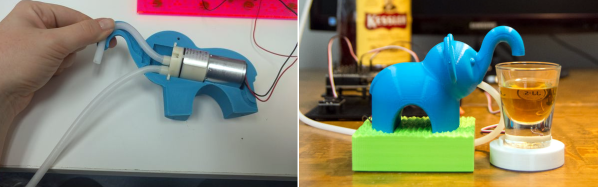
What do you get if you have a 3D printer, some booze (or any beverage), a pump, and an Arduino? If you are [RobotGeek] you wind up with an elephant that will pour you a shot on demand. The project was inspired by the ShotBot, but we have to admit the elephant sells it.

Conceptually, the device is pretty simple. A pump and a light sensor do all the real work. When you cover the sensor with a shot glass, the pump dispenses liquid. What we found of interest, though, was the process of starting with an elephant model and then modifying it for the purpose at hand. In addition to making it larger, they also cut off the trunk and replaced it with a spout. The steps show Fusion 360, but you could apply the same concepts using your choice of CAD programs.

Continue reading “Dumbo Never Forgets To Fill Your Glass” →

3D Printing Aluminum With Nanoparticles

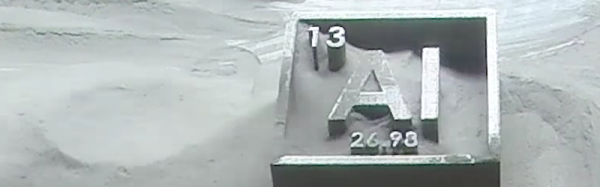
We love our 3D printers. But sometimes we really wish we could print in metal. While metal printing is still out of reach for most of us, HRL Labs announced a powdered aluminum printing process that they claim is a breakthrough because it allows printing (and welding) of high-strength aluminum alloys that previously were unprintable and unweldable.

The key is treating the metal with special zirconium-based nanoparticles. The nanoparticles act as nucleation sites that allow the aluminum to form the correct microstructure. The full paper on the process appears in Nature.

Continue reading “3D Printing Aluminum With Nanoparticles” →