Music Tank Puts The Boom In Boombox

music_tank

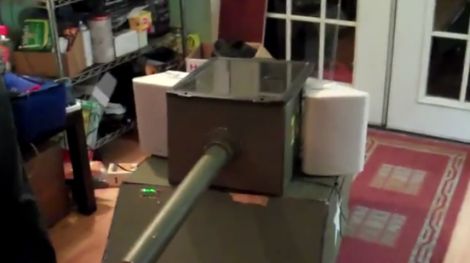
When you think of Memorial Day weekend, what comes to mind? Well around here, all we can think about is this tank cum boombox that Instructable user [Elian_gonzalez] put together.

This build is actually the third version of his Music Tank, and it comes with all sorts of improvements over previous models. The tank is primarily constructed out of plywood, with cavernous compartments for holding all of its goodies. In its capacious body, the tank sports a 60 Watt stereo system that powers a pair of external speakers mounted on either side of the turret. The turret itself contains an air-powered cannon built from PVC tubing, which we imagine can be used to shoot a multitude of different projectiles.

While the concept itself is pretty cool, the tank happens to be nearly self-sustaining as well. The tank has a pretty deep battery well and uses a 50w home made solar panel to help keep things topped off while in use. [Elian] does not specify a total running time, but we imagine that it can go for hours on a nice, sunny day.

Keep reading to see a long video walkthrough of the Music Tank MK3 in action. Continue reading “Music Tank Puts The Boom In Boombox”

Doorbell Hack Makes Coworkers Less Annoying

doorbell_wav_player

Hackaday reader [Sprite_tm] works in an office building that used to house several businesses, and as a remnant of the previous configuration, a doorbell sits in the hallway just outside his office. Several of his coworkers get a kick out of ringing the doorbell each time they enter the office. While not annoyed at the practice, he was getting tired of the same old “ding-dong” and decided to shake things up a bit.

He wanted to modify the doorbell to play random sounds when triggered, but he was pressed for time as it was March 31st, and he wanted to get it installed for April Fools’ Day. Without any real plan or bill of materials in mind, he pieced things together with whatever he happened to have sitting around.

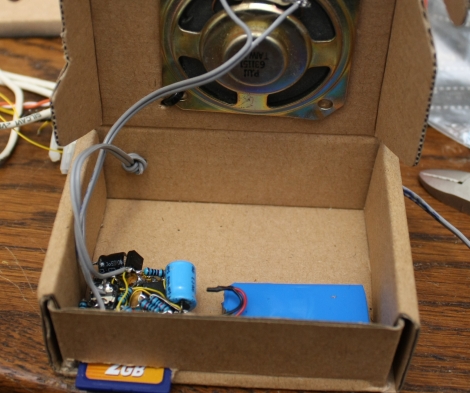
He used a design borrowed from Elm-chan in order to play wav files from an SD card with an ATTiny85, and used an L293 H-Driver as an improvised sound amplifier. After sorting out some power-related problems, and configuring the circuit to be as stingy with its battery as he could, he declared the project complete. He originally aimed to deadbug everything on the metal sleeve of the SD card socket (which is awesome), but considering the size of the speaker and the battery he selected for the project, he ended up stuffing everything into a cardboard box.

We don’t care too much about how he packaged it, we just wanted to know what his co-workers thought of his doorbell augmentation. In the end, they loved it, but we imagine this doesn’t do anything to discourage any of them from hitting the doorbell multiple times a day.

Stick around to see a quick video of his doorbell hack in action.

Continue reading “Doorbell Hack Makes Coworkers Less Annoying”

Micro Audio Player Can Hide Behind A Postage Stamp

The original iPod shuffle was a pretty small device, there’s no doubt about that. However, in the world of miniature audio players, [Chan] is no slouch either.

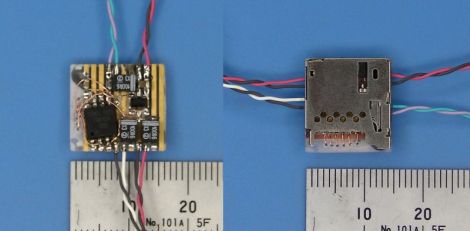
A few years ago, he set out to construct a micro audio player that used little more than a small microcontroller and a microSD memory card. He chose an ATinyX5 series microcontroller to run the show, utilizing its pair of PWM output pins to directly drive the speakers. Since there is no built-in amplifier, the audio volume is not loud, but it does sound reasonable if you use a set of high efficiency desktop speakers. He does mention that the sound can easily be amplified after passing the signal through a filter, so there is hope for those of you who like your music turned up to 11.

The only downside we can see is that the audio player can only process Wave files, but it’s hard to expect more from a DIY audio player smaller than a postage stamp. It would be great to see what sort of micro-handiwork [Chan] could perform if he were to update his design and build a full-functioning MP3 player based upon this project.

Layering Pinball Audio Using Parallel WAV Shields

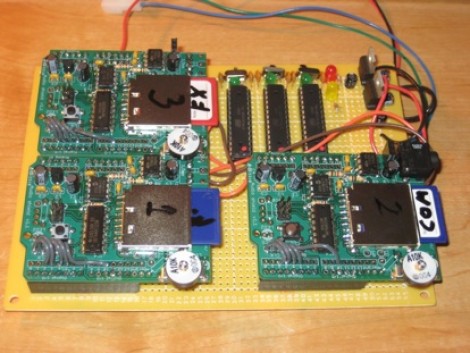
[Ed Zarick] is preparing his pinball project and wants to have authentic sound to go with the game play. The game is modeled after NBA Hangtime and in addition to music he also needs a wide range of sound effects to beef up the experience. To make this all happen at once he developed a set of Arduino WAV shields controlled by an Arduino Mega.

As you can see above, there are three ATmega328 chips which run the Arduino boot loader and each interface with one of the three green WAV shields. That set of chips listens for commands over and i2c protocol, and once they receive instructions they play can play the chosen file without affecting the other shields.

But to have the authentic sounds you first need to acquire the audio samples. [Ed] grabbed a ROM of the original video game and dumped all of the audio samples. From there it was a chore to listen to and catalog the sounds for SD card playback with the pinball version of the game. But it’s well worth the effort as the sound will end up tying the whole experience together.

Continue reading “Layering Pinball Audio Using Parallel WAV Shields”

Recordable SNES Belt Buckle

recordable_snes_controller

[Andrew] recently offered to help out a friend who was looking to get her husband a SNES controller belt buckle. Rather than simply slap one together, he decided that it would be far cooler if the belt buckle played audio as well. He gutted a broken SNES controller, removing most everything inside, leaving just the buttons and a few wires.

To allow for the belt buckle to record sounds, he pulled apart a recordable balloon that would play a 10-second audio clip when shaken. He moved around a few wires, allowing for the audio board to be triggered by a button press rather than motion. Once that was done, he went about fitting it into the SNES controller, drilling speaker and microphone holes in the process. With the electronics components all set, he reassembled the controller shell and mounted it to an old belt buckle he had sitting around.

The final product looks extremely fun, and would make any die hard Nintendo fan’s day.

Modern Freaking: Pull Phone Numbers From YouTube Audio

[Charlie X-Ray] is having some modern fun with the phone system by pulling dialed numbers from the audio track of YouTube videos (translated). The first step was to find a video where a telephone is being dialed and the sounds of the keypresses are audible. You can’t tell those tones apart, but a computer can. That’s because each number pressed generates a combination of two out of seven closely related frequencies. [Charlie] isolated the audio using Audacity, then wrote a python script to generate a spectrogram like the one above. By matching up the two dark nodes you can establish which two frequencies were played and decode the phone number being dialed. So how does this work again… find audio of a phone being dialed, decode the number.. profit?

Canon T1i/500d External Microphone Hack

canon_t1i_external_mic

Like most other DSLR cameras that feature video recording, the Canon T1i has a small built-in microphone with limited sound reproduction capabilities. [Robb] wanted better audio performance while taking video, but found the camera’s inability to use an external microphone to be a frustrating limitation. He decided to take matters into his own hands, and disassembled his camera in order to add an external microphone jack. The process is not overly complicated, as it requires little more than the installation of a switching microphone jack. You will however need to get your hands a bit dirty since it involves opening the camera, a bit of drilling, and some epoxy. Doing such things to your camera clearly voids the warranty, and with a $600 camera at stake, this hack is definitely not for the faint of heart. That said, if you desperately want to get better quality audio from your Canon T1i or 500d DSLR, be sure to check out his tutorial.