Low-power Wireless Home Automation Sensors

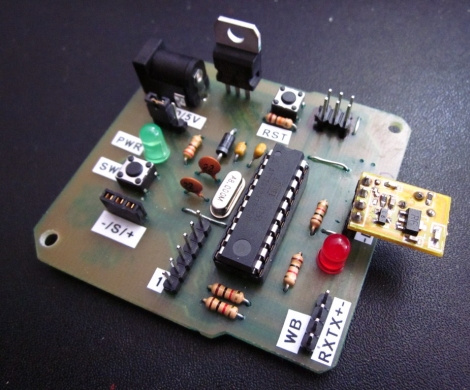
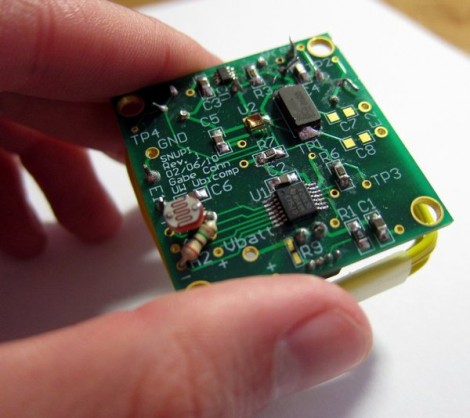
The line between serious research and well-executed hacks has been getting pretty blurry lately. The device above could have been designed in your basement but it actually comes from researchers at the University of Washington. They are working on low-power home automation sensors for monitoring things like humidity, temperature, air quality, and light. The key point in their research has been the use of a home’s electrical system for wireless communication. Operating at 27 MHz has proven quite efficient to the point that one of these modules placed within 10-15 feet of an electrical run can communicate with the rest of the home, powered only by a watch battery projected to last ten years.

That’s kind of exciting, it’s a heck of a lot easier to produce and distribute a set of small boards like this than to run communication wiring throughout the house. Now we just need to pair this with the Air Force’s parasitic power work and there’ll be no need for a battery at all.

[Thanks Sidhant]

Grow Box Controls Heater, Fans, And Water

grow_box_controller

The Cheap Vegetable Gardner wanted more automation than their previous PS2 controller based grow system. This time they set out to design a full featured, compact grow controller that can measure temperature and humidity as well as control a heat lamp, fan, and water pump. An Arduino provides USB connectivity and interfaces the solid state relays and sensors. The assembled project all fits in a box but we are left wondering how much heat the four SSRs generate and will it be a problem?

[Thanks shawn]

Voice Controlled Home Automation

stephanie

[Brian] sent in this writeup on his voice controlled home automation system. Starting with the Microsoft SAPI, a voice recognition system, he programmed some basic home automation. In a move that makes this project decidedly more awesome, he decided to build a physical representation of his automation system. This disembodied head is “Stephanie”. She responds to her name, has an articulated jaw that moves with the syllables in the words, and even ejects her “brain tray” on command. We want one.

There is lots of information on his site about the circuitry involved, as well as source code and a video. You can see the video after the break.

Continue reading “Voice Controlled Home Automation”

Quick Cheap Remote Outlets

ir_plugs1

[jwad650] wanted a remote controlled power strip. These are fairly expensive, with a single outlet running roughly $15. He was able to build a 6 outlet version for about $50.  He is using an SIS-7c to decode signals from a universal remote. Each plug is individually controlled by a 3Amp relay. Be careful making this, there’s lots of nasty shock potential in that mess of wires. We recommend that you confine it in an enclosure as well. [jwad650] plans on adding an enclosure, as well as LED indicators and fuses. You can see a video of it in action after the break. If you want more information about working with relays, check out the working with relays writeup.

Continue reading “Quick Cheap Remote Outlets”

Unique Method Of Home Automation

automation

[leevonk] sent us this quick and dirty home automation set up. Using photo resistors and your computer screen, you can drive as many relays or actuators as you want. [leevonk] is simply using changes in brightness on his computer screen to set off relays. This makes it easy for someone who has no programming knowledge and a tight budget to set up some automation. You could even do remote automation by connecting to your pc via VNC. Be careful taping things to your screen, wouldn’t want to damage it.

Working With Relays

relay

SparkFun’s latest tutorial shows you how to work with relays. A relay is an electrically operated switch. In this case, they’re using it to switch a 120V AC outlet. The article carries the standard warnings about how not to kill yourself with AC (plus some non sequitor linking throughout). As an extra precaution, they chose a GFI outlet. You probably know how a relay works, but it’s worth seeing how they implemented it. They use a transistor to prevent overloading the microcontroller’s GPIO pin. The control pin is pulled to ground to keep the relay off. A diode is placed across the relay coil to manage the power flow when it discharges. An indicator LED is included to show when the relay closes. This is a great foundation for an automation project, or maybe you just want to terrorize your cat.

Mutant Lab Halloween Extravaganza

[youtube=http://www.youtube.com/watch?v=LVnGLCG9Nzg&feature=channel]

Take a tour of the Mutex laboratories, where mutants are made and nothing could possibly ever go wrong. [Steve] directed us to these videos of the Halloween set up he did with his son this year. Neighbor kids got to go on an action packed tour where mutants break free from their cages and have to be neutralized with special ray guns. Wow, why didn’t this guy live near us when we were kids? Check out a behind the scenes walk through with some good technical stuff after the break.

Continue reading “Mutant Lab Halloween Extravaganza”