Window Curtain Moves To Screen Pedestrians

[Niklas Roy] built a motorized window curtain to screen out foot traffic in front of his window. When you hear “motorized curtain” you may think that this will move up and down but it doesn’t. Instead, the small curtain move horizontally to cover passersby as they travel down the sidewalk. This is accomplished using a camera in conjunction with some motion sensing software. In the video after the break you can see that the software also anticipates the movement, and ends up doing a good job of keeping the target covered. That’s thanks to the Processing sketch working in conjunction with a rotary encoder on the hardware setup. Details for both are available on the page linked above.

This harkens to other community involvement hacks we’ve seen like the subway stair piano, or the bottle recycling video game. It’s fun and quirky, which is not too much of a surprise as we saw a glimpse of that when we looked at [Niklas’] public fountain hydropower generator.

Continue reading “Window Curtain Moves To Screen Pedestrians”

Lazarus-64, Not Actually 64 Bit But Still Blows Our Minds

Lazarus-64, breadboard game system; certainly sounds like something from the 1980s. We were surprised to find out not only the name, but also all the ICs used are only those available from the retro age of 30 years back (Save for the AVR controlling everything, of course). Even more amazing is how it has 256 flicker free color support, while not using NTSC chips. Which Goes to show that even if there are common solutions out there for cheap, building or compiling your own is not necessarily a bad thing or a waste of time.

There is a whole lot more to Lazarus, including double buffering and VMS, but sadly it appears progress has stopped on the Lazarus-64 breadboard game system, with the last update being last year. But we can still bask in the amazing glow that currently is.

Beginner Concepts: All About AVR Interrupts

Microcontroller interrupts are one of the big tools in our embedded programming arsenal. They make the chip listen for particular events, and once detected they stop what they’re doing and run a separate set of code called and Interrupt Service Routine. We’ve come across two fairly new tutorials on the subject that you should check out if you’re not yet a master on the topic. One is a ProtoShack tutorial on ATmega168 external interrupts, and the other is a Newbie’s Guide to AVR Interrupts by [Dean Camera] (we’ve been a fan of his tutorials for some time). Both cover a range of topics from what interrupts are, to avoiding the common problems of volatile data types and the compiler optimization caveats.

What can you do with interrupts? External interrupts can be used to wake up a project like this LED menorah from sleep mode. Interrupts can be used to monitor a timer for a certain value or an overflow for use in generating a pulse-width modulation signal. The TI Launchpad uses an interval timer interrupt for button debouncing in projects like this code which was ported from an AVR chip. The source for both is available if you wanted to compare how the two differ.

Interrupts are powerful. Learn them, love them, use them.

Full-featured AVR Time-lapse

This time-lapse photo trigger was built [Lukasz Goralczyk]. It is controlled by an ATmega168 and we were surprised to read that it uses about 12k of code. Curious about what takes up that much space, we were impressed to see all the features demonstrated in the video after the break. The small device, running on two AA batteries, has a well-designed user interface displayed on a 3V character LCD that is navigated with a clickable rotary encoder.

It isn’t the smallest intervalometer we’ve ever seen, but it deserves respect for the features packed into a diminutive form-factor.

Continue reading “Full-featured AVR Time-lapse”

Cheap Cable Reused To Add USB To Your Project

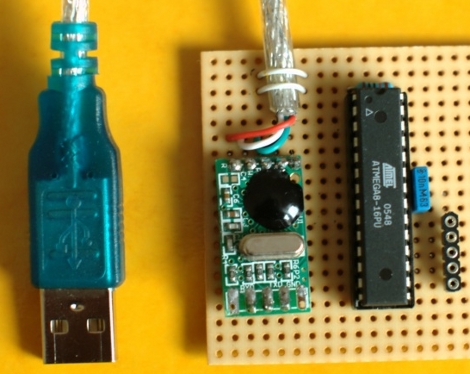
You get what you pay for. [Jkx] wanted to see how a USB to RS232 cable could be sold for just $1.70 and found out that it’s not actually RS232 compliant. The cable communicated as TTL levels, not the 12V expected of RS232 (although it can handle 12V incoming). He didn’t really want to use them for their intended purpose anyway. By betting rid of the DB9 plug and reusing the enclosed circuit board he now has a really cheap way to interface a microcontroller with the Universal Serial Bus. He worked out a couple of short subroutines that take care of receiving and sending data over the connection.

Open Source Version Of The Play Station 3 Jailbreak

Don’t steal. It’s a lesson that children are taught from the youngest age and a core principle in every society. The PSGroove sets out to follow this mantra in several ways. It is an open source implementation of the PSJailbreak hardware we covered a couple of weeks back. It’s difficult to find a definitive source of information on that hardware but many have speculated that the original device contains stolen code. Whether that’s true or not is moot as the PSGroove doesn’t include the backup manager program alleged to violate copyright.

The device is also aimed at running homebrew, and doesn’t natively allow one to play backups. It runs on a variety of AVR hardware, including the Teensy boards. If you have one of them, it’s just a matter of compiling the code and unlocking the potential of your PlayStation 3.

[Thanks Mark via PS3news]

Pressure Mapping Sensor Mat

[imsolidstate] built his own pressure sensitive mat. It utilizes two discs of copper clad board with a piece of foam in between for each of 64 sensors. As the foam gets compressed, the capacitance between the two pieces of copper changes, a measurement that is fairly easy to make with an analog to digital converter. The mat is being used to measure how well a horse saddle fits the animal. Data is read in through a serial port and then mapped using Excel. This prototype proves that the concept works but [imsolidstate] mentions that there’s room to improve the sensitivity and that there could be more noise filtering incorporated into the design.