PCB Take On Stars, Moons, And Ringed Planets Is Gold

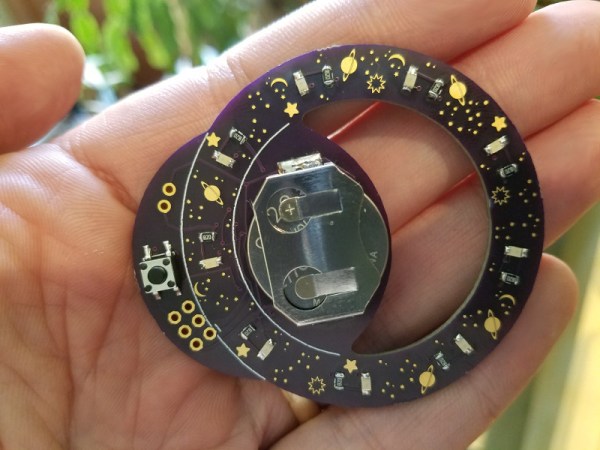
Remember when PCBs were green and square? That’s the easy default, but most will agree that when you’re going to show off your boards instead of hiding them in a case, it’s worth extra effort to make them beautiful. We’re in a renaissance of circuit board design and the amount of effort being poured into great looking boards is incredible. The good news is that this project proves you don’t have to go nuts to achieve great results. This stars, moons, and planets badge looks superb using just two technical tricks: exposed (plated) copper and non-rectangular board outline.
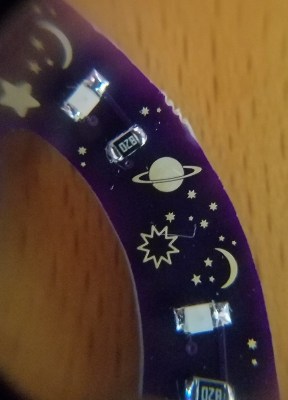
Don’t take that the wrong way, there’s still a lot of creativity that [Steve] over at Big Mess o’ Wires used to make it look this great. The key element here is that copper and solder mask placements have extremely fine pitch. After placing the LEDs and resistors there’s a lot of blank space which was filled with what you might see in the night sky through your telescope.  What caught our eye about this badge is the fidelity of the ringed planet.

The white ink of silk screen is often spotty and jagged at the edges. But this copper with ENIG (gold) plating is crisp through the curves and with razor-sharp tolerance. It’s shown here taken under 10x magnification and still holds up. This is a trick to keep under your belt — if you have ground pours it’s easy to spice up the look of your boards just by adding negative-space art in the solder mask!

[Steve] mentions the board outline is technically not a circle but “a many-sided polygon” due to quirks of Eagle. You could have fooled us! We do like how he carried the circle’s edges through the bulk of the board using silk screen. If you’re looking for tips on board outline and using multiple layers of art in Eagle, [Brian Benchoff] published a fabulous How to do PCB art in Eagle article. Of course, he’s gone deeper than what the board houses offer by grabbing his own pad printing equipment and adding color to white solder mask.

The art was the jumping off point for featuring this badge, but [Steve] is known for his technical dives and this one is no different. He’s done a great job of recounting everything that popped up while designing the circuit, from LED color choice to coin cell internal resistance and PWM to low-power AVR tricks.

Hackaday Links Column Banner

Hackaday Links: April 8, 2018

SiFive raised $50 Million in funding. SiFive is a semiconductor working on two fronts: they want to democratize silicon prototyping, and they’re the people making the HiFive series of microcontrollers and SoCs. The HiFives are built on the RISC-V instruction set, a Big-O Open instruction set for everything from tiny microcontrollers to server CPUs. With RISC-V, you’re not tied to licensing from ARM or their ilk. Recently SiFive introduced an SoC capable of running Linux, and the HiFive 1 is a very fast, very capable microcontroller that’s making inroads with Nvidia and Western Digital. The new round of funding is great news for anyone who wants Open Source hardware, and the silicon prototyping aspect of it is exceptionally interesting. Great news for SiFive.

Guess what’s in just a few weekends? The Vintage Computer Festival Southeast. The VCFSE is Hotlanta’s own vintage computer festival, with a whole host of speakers, exhibits, and consignment to tickle those vintage dopamine receptors. On deck for the speakers is [Michael Tomczyk], one of the people responsible for the VIC-20, and [Scott Adams], no the other [Scott Adams], creator of adventure-style games for personal computers but not that adventure-style game. The exhibits will include Japanese retro computers, simulating an ENIAC and a mechanical keyboard meetup. If you’re around Georgia, this is an event worth attending.

Conference season is just around the corner, and you know what that means. It’s time to start ramping up for #badgelife. What is badgelife? It’s a hardware demoscene of electronic conference badges. This year, the badgelife scene has stumbled upon something everyone can get in on. Add-ons! They’re electronic hats (or shields, or capes) for all the badges. Physically, it’s a 2×2 pin header. Electronically, it’s power, ground and I2C. Want to prototype your own add-on? Good news, there’s a development board.

The Titius-Bode law states the semi-major axes of planets follow a geometric progression. The (simplified, incorrect) demonstration of this law states Mercury orbits at 0.25 AU, Venus at 0.5 AU, Earth at 1 AU, Mars at 2 AU, and continues to the outer planets. The Titius-Bode law is heavily discredited in the planetary science community, and any paper, talk, or manuscript is rejected by scientific editors out of hand. The Titius-Bode law is the planetary science equivalent of flat Earth conspiracy theories and Nazi moon bases; giving any consideration to the idea confirms you’re a moron. This week, some consulting firm posted something that is the Titius-Bode law on their blog. Why? So it could be submitted to Hacker News for that sweet SEO. This submission was upvoted to the top position, and is a wonderful springboard to argue an interesting point on media literacy. I posit the rise of news aggregators (facebook, twitter, digg, reddit, and HN), is the driving force behind ‘fake news’ as lay people become the gatekeepers. Prove me wrong.

The Department of Homeland Security has confirmed there are cell-site simulators (Stingrays, IMSI-catchers, or otherwise known as your own private cell phone base station) around Washington DC. It’s unknown who is operating these simulators, or even where they are. There are two things to read between the lines with this information: Duh, there are rogue Stingrays in DC. Holy crap duh. I bet there are also some around midtown Manhattan. You can buy the stuff to do this on eBay. Personally, I’ve found half a dozen Stingrays or other rogue cell stations this year (guess where?). Second, why is this a news item now? Is this a signal that the DHS will start clamping down on stuff you can buy on eBay? Hop to it, people; cellular hardware is a great way to make a liquid nitrogen generator.

Badgelife: From 1 To 100

Blame it on the falling costs of printed circuit boards, the increased accessibility of hardware design tools, the fact that GCC works on microcontrollers now, whatever the ‘maker movement’ is, or any one of a number of other factors. There’s a hardware demoscene now. Instead of poking bits, writing code, and dividing by zero to create impressive multimedia demonstrations on a computer, there is a small contingent of very creative people who are building their own physical hardware, just for the hell of it. They’re pushing boundaries of what can be done with hardware design, demonstrating manufacturing know-how, and turning a (small) profit while doing it. This is badgelife, the tiny subculture dedicated to creating custom electronic conference badges.

At Hackaday, we’ve been doing a deep dive into the rigors of this demoscene of hardware, and last week we had the pleasure of hosting a meetup with some of the big players of the badgelife community as guests of honor. There were, of course, talks discussing the trials and tribulations of designing, manufacturing, and shipping hundreds of pieces of hardware on a limited budget with not enough time. If you want to know how hard electronic design and manufacturing can be, you want to check out these talks below. Continue reading “Badgelife: From 1 To 100”

What Actually Happens At A Hardware Hacking Con

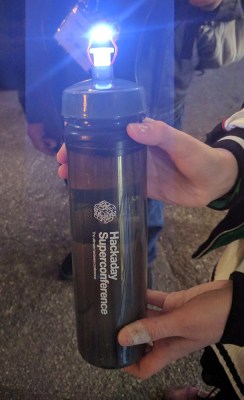
The Hackaday Superconference was last weekend, and it was the greatest hardware con on the planet. What can you build out of a conference badge? If you answered “a resin-based 3D printer” you would have won a prize. If you decided to put your badge in a conference water bottle and make a stun gun you’d receive adoration of all in attendance. Yeah, it got that crazy.

Yes, there’s a Supercon badge in that bottle and it’s now a stun gun.

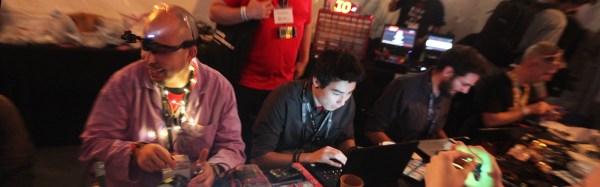
At other tech conferences, you’ll find gaggles of nerds sitting around a table with MacBooks and Thinkpads. The Superconference is different. Here, you’ll find soldering irons, tackle boxes filled with components, and loose WS2812s scattered about the floor. The smell of solder flux wafts through the air. You detect a hint of ozone.

The depth and breadth of hacks that came out of this were simply stunning. We a binocular virtual reality hack, an internet trolling badge, blinky add-on boards, audio add-on boards, a film festival was shot on the badge, and much more which you’ll find below.

We have started a Badge Hacks list and want to see details of all of the hacks. So if you were at Supercon be sure to publish them on Hackaday.io and send a DM to be added to the list.

Starting Up An Extra Day of Hacking

To get all of this creativity rolling we did something a bit different for this year’s Superconference. Instead of opening the doors up on Saturday morning, we set up a badge hacking area and party on Friday afternoon. The drinks flowed like the meniscus on a properly soldered lead, and by 2pm on Friday, everyone was hacking firmware on the incredible camera badge for this year’s con.

We didn’t stop on Friday. The Superconference is a hardware hacking conference, and that meant we brought out the soldering irons, experimented with melting aluminum with gallium, reflowed a few boards, and created a few deadbug LED cubes. This went on all weekend.

Continue reading “What Actually Happens At A Hardware Hacking Con”

The Perils Of Developing The Hackaday Superconference Badge

In case you haven’t heard, the best hardware conference in the world was last weekend. The Hackaday Superconference was three days of hardware hacking, soldering irons, and an epic hardware badge. Throw in two stages for talk, two workshop areas, the amazing hallwaycon and the best, most chill attendees you can imagine, and you have the ultimate hardware conference.

Already we’ve gone over the gory details of what this badge does, and now it’s time to talk about the perils of building large numbers of an electronic conference badge. This is the hardware demoscene, artisanal manufacturing, badgelife, and an exploration of exactly how far you can push a development schedule to get these badges out the door and into the hands of eager badge hackers and con attendees.

The good news is that we succeeded, and did so in time to put a completed badge in the hand of everyone who attended the conference (and we do have a few available if you didn’t make it to the con). Join me after the break to learn what it took to make it all happen and see the time lapse of the final kitting process.

Continue reading “The Perils Of Developing The Hackaday Superconference Badge”

Get Your Hands On A 2017 Hackaday Superconference Badge

We just got the shipment of hot Hackaday Superconference badges in our hands yesterday, and they’re frankly awesome. Due to great manufacturing partners and a fantastic design by [Mike Harrison], we ended up with too few manufacturing defects and too many badges. How’s that for a nice problem to have?

But our gain is your gain! We have enough badges for everyone who’s coming to the con, and we’re selling the rest on Tindie.

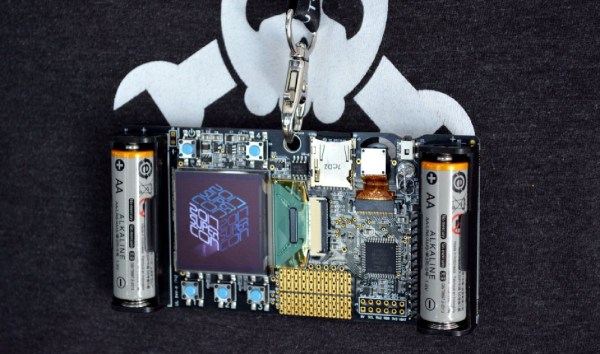
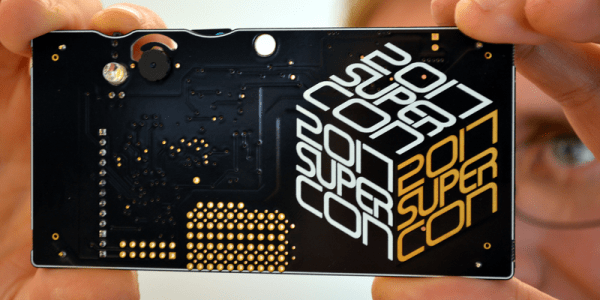
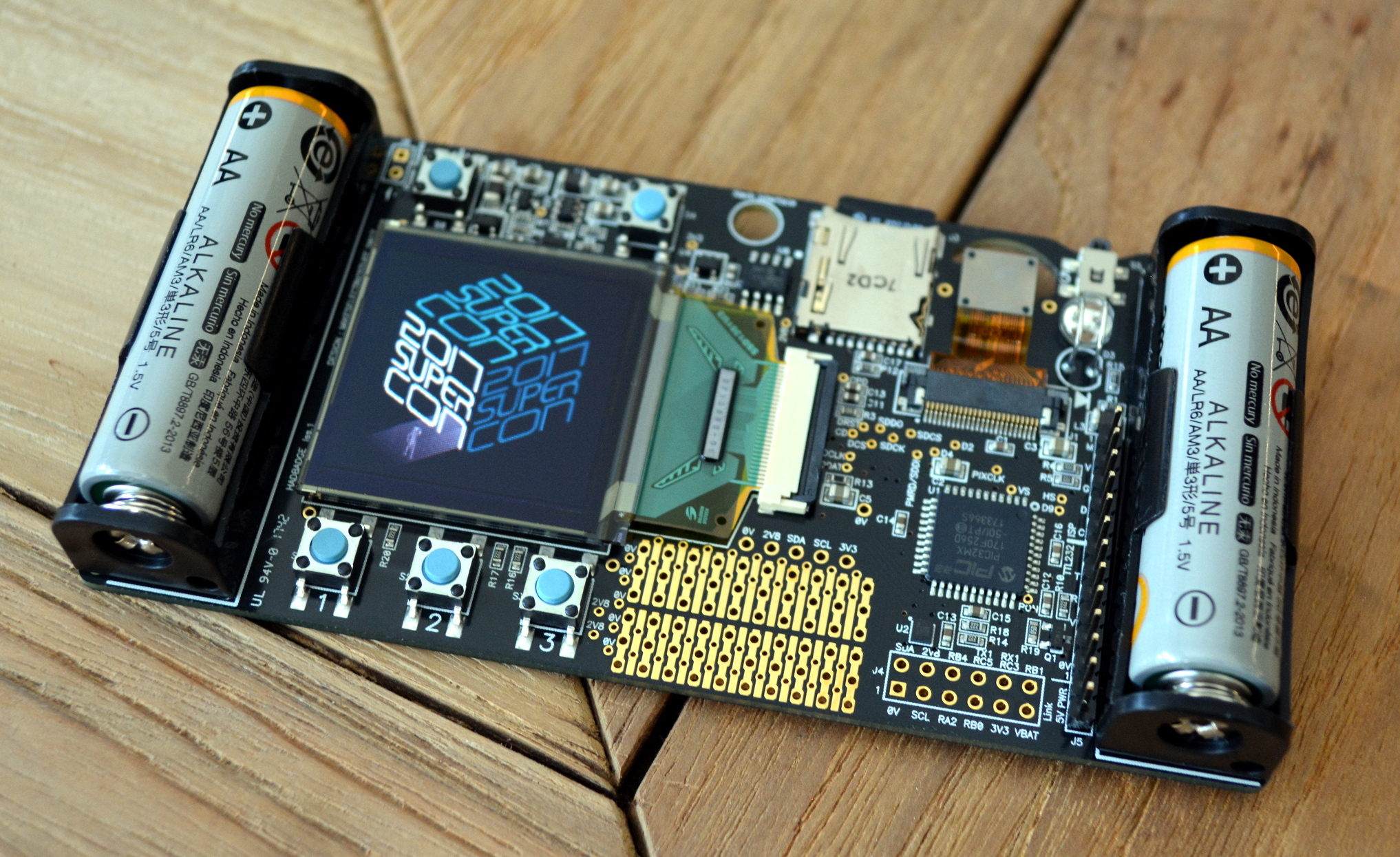
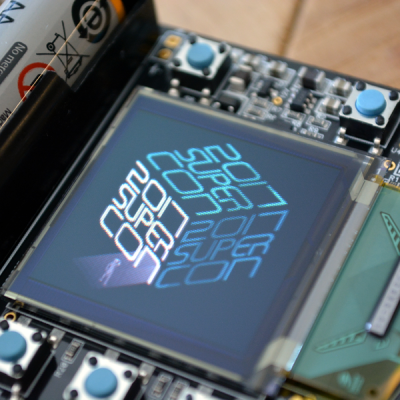
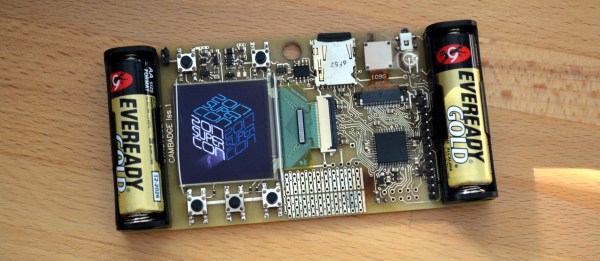
In case you missed it, the badge is a digital video camera, or at least that’s how it’s going to start out its life. It’s got a camera sensor, enough processing power on-board to handle the image data, a screen, and SD card storage. It’s also got a good assortment of buttons, and more importantly, prototyping space and an abundance of pins broken out for you to play with. For the nitty-gritty, see the badge’s Hackaday.io project page. We’ve coded up the obvious applications, added in some challenging puzzles, and now we’re handing them off to you.

Hackaday Badge History

What will you do with them? That remains to be seen. The first time we put on a Supercon, we made the best badge you’ve ever seen — a blank protoboard, and a big pile of parts. Add in an enthusiastic and creative crowd, and out pops magic. Last year, [Voja] produced a badge with finesse and more resources, adding blinkies, IR, and an accelerometer, and we saw hacks making use of each of the features. This year, we’ve pushed it even further. Now it’s your turn.

The Superconference is this weekend, and a few hundred Hackaday hackers will get their hands on this lump of open hardware. Something fantastic is certainly going to happen. If you couldn’t make it but still want to play along, now’s your chance!

Conference badges are a fantastic playground for hardware hackers: they’re a small enough project to get done, but large enough to do something interesting. Some badges, like [Brian Benchoff]’s badge for Tindie, are minimalistic. Others, like this unofficial badge for DEFCON, are quadcopters. In between, there’s room for artistry and aesthetics and just plain cleverness. And don’t forget utility. The 2017 Layer One conference badge (here on Hackaday.io) is easily converted into an OBD II CAN bus sniffer or a video game machine — your pick.

Hackaday loves custom hardware and badges like this are more than just a PCB full of components. They’re a piece of the culture from the event where they made their debut. We’re happy we can share that with some of the hackers who couldn’t make it to Supercon this year.

Supercon Badge Hacking Quick-Start

The hardware badge Mike Harrison designed for this year’s Hackaday Superconference is begging to be hacked. Today, I wanted to help get you up and running quickly.

The Hacker Village atmosphere of Supercon is starting up a day early this year. On Friday, November 10th badge pick-up starts at noon and badge hacking continues throughout the afternoon, followed by a party at Supplyframe HQ that evening. Plan to get to town on Friday and join in the fun. Of course, you need to grab a Supercon ticket if you haven’t already.

Check out the 2017 Superconference Badge project page for full documentation that Mike has put together during his development process.

Continue reading “Supercon Badge Hacking Quick-Start”