An Environmentally Conscious, Solar-Powered Throwie

The basic throwie is a a type of street art/graffiti/vandalism — depending on where you stand — consisting of a coin cell, an led, and a magnet taped together. Seeking to be a slightly more eco-friendly troublemaker, [Alaric Loftus] has kindly put together an Instructable on how to build a solar-powered throwie!

In order to be the best maker of mischief possible, [Alaric Loftus] tried a number of different products to find one that was hackable,  supplied the right voltage, had the right form factor, and cheap enough to literally throw away. Turns out, garden path lights hit that sweet spot. Once [Alaric Loftus] has drilled a hole in the light and opened it up, de-soldering the stock LED, attaching some leads to the contacts and sticking it into the freshly-drilled hole is simply done. Hot-gluing a strong magnet on the bottom completes the throwie.

[Alaric Loftus] also advises that drilling the LED hole slightly smaller and sealing up any cracks with hot glue will strengthen its water resistance — because if it’s worth doing, it’s worth doing it right.

We’ve featured some really cooleven creepy — takes on the throwie concept, but please don’t contribute any further to e-waste buildup.

Blast Your Battery’s Sulphates, Is It Worth It?

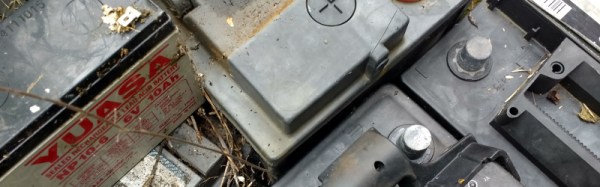
When a friend finds her caravan’s deep-cycle battery manager has expired over the summer, and her holiday home on wheels is without its lighting and water pump, what can you do? Faced with a dead battery with a low terminal voltage in your workshop, check its electrolyte level, hook it up to a constant current supply set at a few hundred mA, and leave it for a few days to slowly bring it up before giving it a proper charge. It probably won’t help her much beyond the outing immediately in hand, but it’s better than nothing.

A lot of us will own a lead-acid battery in our cars without ever giving it much thought. The alternator keeps it topped up, and every few years it needs replacing. Just another consumable, like tyres or brake pads. But there’s a bit more to these cells than that, and a bit of care and reading around the subject can both extend their lives in use and help bring back some of them after they have to all intents and purposes expired.

One problem in particular is sulphation of the lead plates, the build-up of insoluble lead sulphate on them which increases the internal resistance and efficiency of the cell to the point at which it becomes unusable. The sulphate can be removed with a high voltage, but at the expense of a dangerous time with a boiling battery spewing sulphuric acid and lead salts. The solution therefore proposed is to pulse it with higher voltage spikes over and above charging at its healthy voltage, thus providing the extra kick required to shift the sulphation build up without boiling the electrolyte.

If you read around the web, there are numerous miracle cures for lead-acid batteries to be found. Some suggest adding epsom salts, others alum, and there are even people who talk about reversing the charge polarity for a while (but not in a Star Trek sense, sadly). You can even buy commercial products, little tablets that you drop in the top of each cell. The problem is, they all have the air of those YouTube videos promising miracle free energy from magnets about them, long on promise and short on credible demonstrations. Our skeptic radar pings when people bring resonances into discussions like these.

So so these pulse desulphators work? Have you built one, and did it bring back your battery from the dead? Or are they snake oil? We’ve featured one before here, but sadly the web link it points to is now only available via the Wayback Machine.

Possibly The Most Up-Cycled, Hacked E-Bike You’ll See All Week

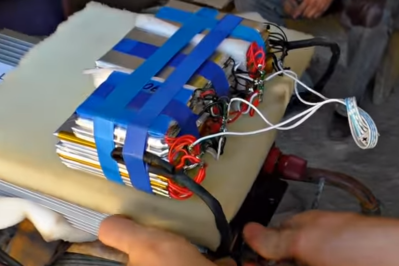
When it comes to bringing an idea to life it’s best to have both a sense of purpose, and an eagerness to apply whatever is on hand in order to get results. YouTube’s favorite Ukrainians [KREOSAN] are chock full of both in their journey to create this incredible DIY e-bike using an angle grinder with a friction interface to the rear wheel, and a horrifying battery pack made of cells salvaged from what the subtitles describe as “defective smartphone charging cases”.

Battery pack made from cells salvaged out of defective equipment. Sometimes, you use what you have on hand.

What’s great to see is the methodical approach taken to creating the bike. [KREOSAN] began with an experiment consisting of putting a shaft on the angle grinder and seeing whether a friction interface between that shaft and the tire could be used to move the rear wheel effectively. After tweaking the size of the shaft, a metal clamp was fashioned to attach the grinder to the bike. The first test run simply involved a long extension cord. From there, they go on to solve small problems encountered along the way and end up with a simple clutch system and speed control.

The end result appears to work very well, but the best part is the pure joy (and sometimes concern) evident in the face of the test driver as he reaches high speeds on a homemade bike with a camera taped to his chest. Video is embedded below.

Continue reading “Possibly The Most Up-Cycled, Hacked E-Bike You’ll See All Week”

MagSafe Power Bank From Scrap

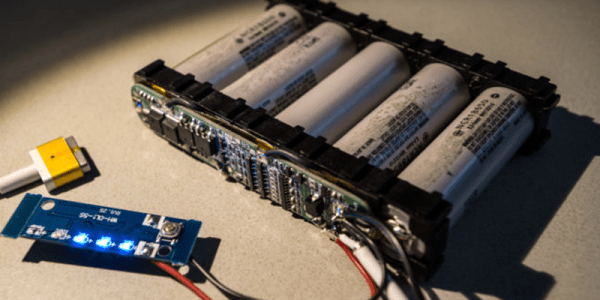
Just a few short years ago, it was possible to find scrapped lithium batteries for free, or at least for very cheap. What most people at the time didn’t realize is that a battery with multiple cells might go bad because only one cell is bad, leaving the others ready for salvaging. Now it’s not a secret anymore, but if you can manage to get your hands on some there’s a lot of options for use. [ijsf] took a step further with this hack, taking a few cells from a Panasonic battery and wrangling them into a MagSafe-capable power bank for a Mac.

The real hack wasn’t scavenging batteries, however, it was getting the MagSafe to signal the computer to use power from the battery bank to run the computer only, and not to use any of that energy for charging the computer’s internal batteries. This is achieved by disabling the center MagSafe pin, which is the computer’s communication line to the power adapter. After that, the battery bank could be programmed to behave properly (a feat in itself for lithium batteries) and the power bank was successfully put into operation.

Not only was this hack a great guide for how to repurpose cells from a “dead” battery, it’s also an unparalleled quick reference for any work that might need a MagSafe connector. Of course, if you’re going to work with these chargers, make sure that you’re using one that isn’t a cheap clone.

Stealing Joules From An Aluminium-Air Battery

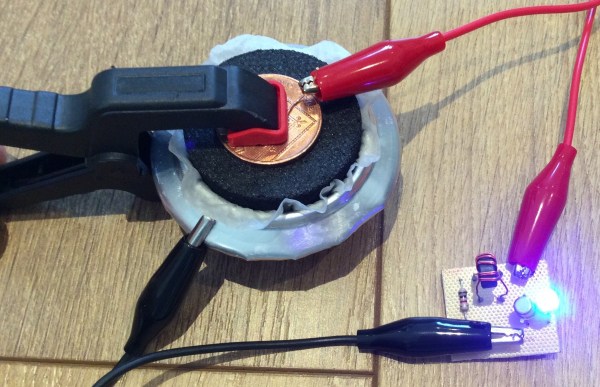
While batteries are cheap and readily obtainable today, sometimes it’s still fun to mess around with their less-common manifestations. Experimenting with a few configurations, Hackaday.io user [will.stevens] has assembled an aluminium-air battery and combined it with a joule thief to light an LED.

To build the air battery, soak an activated charcoal puck — from a water filter, for example — in salt-saturated water while you cut the base off an aluminium can. A circle of tissue paper — also saturated with the salt water — is pressed between the bare charcoal disk and the can, taking care not to rip the paper, and topped off with a penny and a bit of wire. Once clamped together, the reaction is able to power an LED via a simple joule thief.

Continue reading “Stealing Joules From An Aluminium-Air Battery”

Innovating A Backyard Solar Battery System

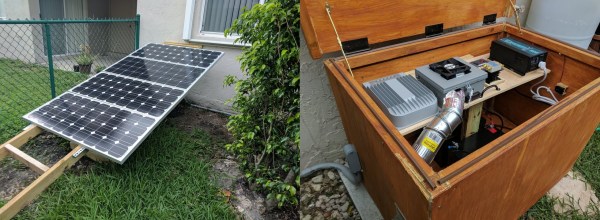
Ever on the lookout for creative applications for tech, [Andres Leon] built a solar powered battery system to keep his Christmas lights shining. It worked, but — pushing for innovation — it is now capable of so much more.

The shorthand of this system is two, 100 amp-hour, deep-cycle AGM batteries charged by four, 100 W solar panels mounted on an adjustable angle wood frame. Once back at the drawing board, however, [Leon] wanted to be able track real-time statistics of power collected, stored and discharged, and the ability to control it remotely. So, he introduced a Raspberry Pi running Raspbian Jessie Lite that publishes all the collected data to Home Assistant to be accessed and enable control of the system from the convenience of his smartphone. A pair of Arduino Deuemilanoves reporting to the Pi control a solid state relay powering a 12 V, 800 W DC-to-AC inverter and monitor a linear current sensor — although the latter still needs some tinkering. A in-depth video tour of the system follows after the break!

Continue reading “Innovating A Backyard Solar Battery System”

Rescuing A Proprietary Battery Pack With A Cell From A Camera

If you have an older handheld battery-powered device, you may be fighting a diminishing battery capacity as its lithium-ion cells reach the end of their life. And if you are like [Foxx D’Gamma], whose device is an Alinco DJ-C7 handheld transceiver, you face the complete lack of availability of replacement battery packs. All is not lost though, because as he explains in the video below the break, he noticed that a digital camera battery uses a very similar-sized cell, and was able to graft the camera battery into the shell of the Alinco pack.

Cracking open the Alinco pack, he was rewarded with the rectangular Li-Ion cell and two PCBs, one for the connector and another for the battery management circuitry. By comparison the camera battery had a much smaller battery management PCB, and it fit neatly into the space vacated by the Alinco cell once those covers had been removed. A fiddly soldering job to attach the connector PCB, and he was rewarded with a working Alinco pack and an unexpected bonus when he found out that the transceiver was a dual band model.

Along the way he’s at pains to point out the safety aspects of handling Li-Ion cells, and to ensure that the polarity of the cell is correct. It’s also worth our reminding readers that these packs must always be accompanied by their battery management circuitry. The result though is pleasing: a redundant piece of equipment made obsolete by a proprietary battery, given a new lease on life.

Continue reading “Rescuing A Proprietary Battery Pack With A Cell From A Camera”