Bluetooth Boombox For That 80s Nostalgia

Sure, anyone can go buy a bluetooth speaker for their portable music needs. But for something a little more unique, at least in this decade, [Daniel] aka [speedfox] went with an 80s-style boombox and outfitted it with a bluetooth module.

The retro boombox was delivered with a few scratches and a broken radio, but the tape decks were still in decent shape so it was ready to be hacked. [speedfox] tied the Bluetooth audio output to the tape reader on one of the boombox’s tape decks, but this revealed a problem: the bass was overwhelming the rest of the sound. [speedfox] fixed this by adding a filter which worked until the power was tied in to the Bluetooth module and produced a lot of RF noise in the audio output. THIS problem was finally resolved with an audio transformer on both sides of the stereo signal. Finally!

After putting all of the new electronics in the case (and safely out of the way of the 120V AC input!) [speedfox] now has a classy stereo that’s ready to rock some Run-D.M.C. or Heavy D. He notes that the audio filter could use a little tweaking, and he’d also like to restore the functionality of the original buttons on the boombox, but it’s a great start with more functionality than he’d get from something off-the-shelf!
Wireless Warning Sign

Bluetooth-Enabled Danger Sign For Lab

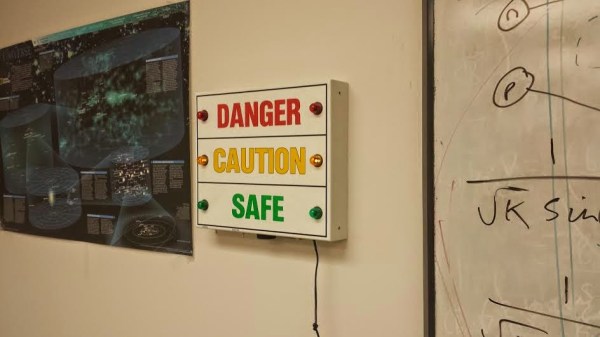
[A Raymond] had some free time at work, and decided to spend it on creating a wireless warning sign. According to his blog profile, he is a PhD student in Applied Physics. His lab utilizes a high-powered laser system. His job is to use said system, but only after it’s brought online by faculty scientists. The status of the laser system is changed by a manual switchbox that controls the warning signs wired around the lab entrances. Unfortunately, if you were in the upstairs office, you only knew this after running downstairs to check. [A Raymond’s] admitted laziness finally got the better of him – he wanted a sign that displayed the laser’s status from the comfort of the office. He had an old sign he could use, but he wanted a way for it to communicate with the switchbox downstairs. After some thought, he decided Bluetooth was the way to go, using a pair of BlueSMiRF Bluetooth modules from Sparkfun and Arduino Uno R3’s.

He constructed a metal box that intercepted the cable from the main switchbox, mounting one BlueSMiRF and Uno into it. Upon learning that the switchbox sends 12V AC signals over three individual status wires, he half-wave rectified the wires and divided their voltages so that the Uno wouldn’t fry. Instead, it determined which status wire that had active voltage. and sent a “g(reen)”, “y(ellow)”, or “r(ed)” signal continuously via Bluetooth. On the receiving end, [A Raymond] gutted the sign and mounted the other BlueSMiRF and Uno into it along with some green, yellow, and red LEDs. The LEDs light up in response to the corresponding Bluetooth signal.

The result is a warning sign that is always up-to-date with the switchbox’s status. We’ve covered projects using Bluetooth before, from plush birds to cameras– [A Raymond’s] wireless sign is in good company. He notes that it’s “missing” a high pitched whining noise when the “Danger” lights are on. If he decides to add an accompanying (annoying) sound, he couldn’t go wrong with something like this. Regardless, we’re sure [A Raymond] is happy that he no longer has to go back and forth between floors before he can use the laser.

Destroy Your Volkswagen Touch Adapter For Bluetooth’s Sake

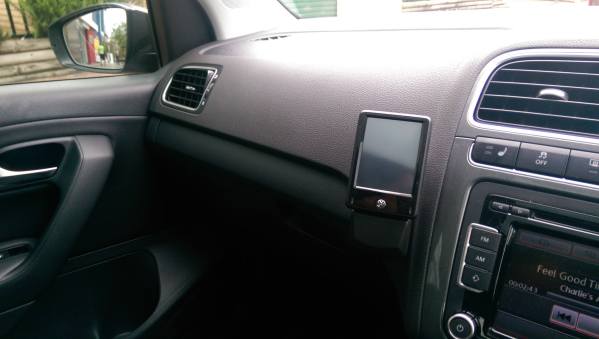
[Mansour]’s Volkswagen Polo has a touch-screen adapter with voice recognition to control a bunch of the car’s features, but he wanted it gone.

Voice control of your car sounds like a great thing, right? Well, the touch adapter blocked other Bluetooth devices from connecting directly to the car, and prevented him from streaming music from his phone while he’s connecting it through the adapter. But if you simply throw the adapter away, the car won’t connect to any Bluetooth devices.

So what options are left? Other than a couple of expensive or complicated options, [Mansour] decided to open up the device and desolder the Bluetooth chip and antenna. Admittedly, it’s not the deepest hack in the world, but we’ve gotta give [Mansour] credit for taking the technology into his own hands.

Disabling unwanted functionality is not uncommon these days. Who hasn’t stuck tape over their laptop’s camera or kept an RFID card in a Faraday wallet? What other devices have you had to “break” in order to make them work for you?

Bluetooth Thingies At Maker Faire

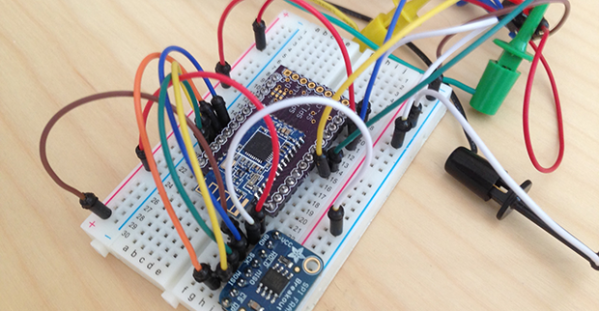
In case you haven’t noticed, one of the more popular themes for new dev boards is Bluetooth. Slap a Bluetooth 4.0 module on a board, and you really have something: just about every phone out there has it, and the Low Energy label is great for battery-powered Internets of Things.

Most of these boards fall a little short. It’s one thing to throw a Bluetooth module on a board, but building the software to interact with this board is another matter entirely. Revealing Hour Creations is bucking that trend with their Tah board. Basically, it’s your standard Arduino compatible board with a btle module. What they’ve done is add the software for iOS and Android that makes building stuff easy.

Putting Bluetooth on a single board is one thing, but how about putting Bluetooth on everything. SAM Labs showed off their system of things at Maker Faire with LEDs, buttons, fans, motors, sensors, and just about every electrical component you can imagine.

All of these little boards come with a Bluetooth module and a battery. The software for the system is a graphical interface that allows you to draw virtual wires between everything. Connect a button to a LED in the software, and the LED will light up when the button is pressed. Move your mouse around the computer, and the button will turn on a motor when it’s pressed.

There are a few APIs that also come packaged into the programming environment – at the booth, you could open a fridge (filled with cool drinks that didn’t cost five dollars, a surprise for the faire) and it would post a tweet.

Inductive charger

Inductive Charger Mod Allows For Non-Stop Wireless Rocking

When you want to jam out to the tunes stored on your mobile devices, Bluetooth speakers are a good option. Battery power means you can take them on the go and the Bluetooth connection means you don’t have to worry about cables or wires dangling around. Unfortunately the batteries never seem to last as long as we want them too. You can always plug the speaker back in to charge up the battery… but when you unhook those cords they always seem to end up falling back behind the furniture.

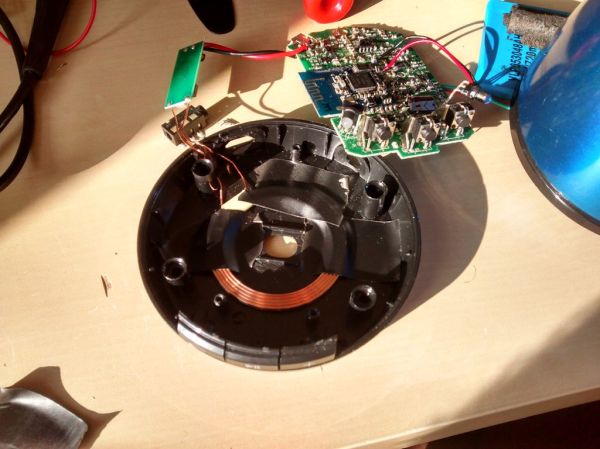
[Pierre] found himself with this problem, but being a hacker at heart meant that he was able to do something about it. He modified his JAM Classic Bluetooth Wireless Speaker to include an inductive charger. It used to be a lot of work to fabricate your own inductive charging system, or to rip it out of another device. But these days you can purchase kits outright.

The JAM speaker was simply put together with screws, so no cracking of the plastic was necessary. Once the case was removed, [Pierre] used a volt meter to locate the 5V input line. It looks like he just tapped into the USB port’s power and ground connections. The coil’s circuit is soldered in place with just the two wires.

All [Pierre] had left to do was to put the speaker back together, taking care to find space for the coil and the new circuit board. The coil was taped to the round base of the speaker. This meant that [Pierre] could simply tape the charging coil to the underside of a glass table top. Now whenever his Bluetooth speaker gets low on battery, he can simply place it on the corner of the table and it will charge itself. No need to mess with cables.


Controlling A Point And Shoot With Bluetooth

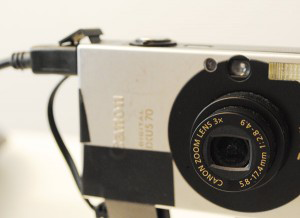
Loading point and shoot digital cameras is old hat around here, but [Alex] and [Andreas] are taking it to the next level. They’ve made a Bluetooth controller for a cheap Canon camera, allowing pictures to be taken with an iPhone or Android device.

The camera in question is a Canon IXUS70, although any camera supported by CHDK will work. We’ve seen a few builds using this firmware to take pictures of the sunrise every day and transmitting images over a radio link, but this build is far more interactive.

The camera is connected to an Arduino and Bluetooth shield with a hacked up USB cable. The ‘duino communicates with a phone using a JQuery app, giving any phone with a Bluetooth module control of the camera’s zoom and shutter.

All the code is available on the github, with a very good video demonstration of the build available below.

Continue reading “Controlling A Point And Shoot With Bluetooth”

Extrinsic Motivation: BASIC For Bluetooth

There’s a lot more to those fancy radio modules you use with your Arduino projects than meets the eye. Many of them are systems on a chip, complete with their own microcontroller and memory that can control your entire blinking LEDs project. Developing for these radio modules is a bit of a challenge, as the IDEs and compilers cost several thousand dollars. [Tim]’s entry for the Hackaday Prize looks at one of these Bluetooth LE modules – Texas Instrument’s CC2540 and CC2541 – and puts an embedded BASIC interpreter right on the chip.

[Tim]’s inspiration for this project came from looking at a few popular devices using the CC254X chip. Many of these included a microcontroller and the added costs, complexity, and power requirements that come along with an additional chip. This radio module could easily run any code an ATMega could, and adding another chip to a product seemed like a terrible waste, and certainly not in the spirit of open hardware and software.

The alternative is writing an interpreter for the CC254X chip. He’s chosen BASIC, but added a little bit of Arduino language syntax to make it even easier to develop on. Having already run through a few successful tests involving SPI, I2C and 1-wire devices, [Tim] has a basic system working, but [Tim] admits it does need a little rework to make it easier to use.

It’s a great project, and personally astonishing that it didn’t make the quarterfinal selection for The Hackaday Prize. [Tim] is still working on his project, though, in a great example of extrinsic motivation; he doesn’t need a trip to space to convince him to build something cool.

You can check out [Tim]’s two minute concept video below.


SpaceWrencherThis project is an official entry to The Hackaday Prize that sadly didn’t make the quarterfinal selection. It’s still a great project, and worthy of a Hackaday post on its own.

Continue reading “Extrinsic Motivation: BASIC For Bluetooth”