Making A 3D Printed DSLR Camera Mount Even Better

We’d love to say that all of our projects worked perfectly on the first try, but the average Hackaday reader is a bit too experienced to buy a fib like that. The reality is, DIY projects rarely get everything right out of the gate. It takes some time to identify issues and work out all the kinks. But of course, that’s half the fun.

For a perfect example of this process, check out the latest update on the 3D printed DSLR camera mount that [isaac879] has been working on. When we last checked in with this project over the summer the mount was already impressive, but with the latest improvements and the addition of a whole new axis of movement, this homebrew camera motion system is an extremely compelling project for anyone who wants to take their project videos to the next level.

The new Hall effect sensor mounts are a very nice touch.

Back in June, the mount [isaac879] showed off was only capable of pan and tilt. But as you can see in the video after the break, he’s since mounted that to a track made of 20×40 aluminum extrusion and added another stepper motor. This allows the pan/tilt mount to move itself back and forth on the track to get those slick panning shots that all the cool kids use in their videos nowadays.

But even if you’re not interested in the slider aspect, the core pan/tilt mount has also received a number of refinements over the last few months. Perhaps the most obvious is the switch over to thinner and lighter stepper motors. Reducing mass is always an improvement with a moving system like this, and in the case of the pan motor, the shorter can prevents a potential collision with the camera itself. Obviously the smaller motors are weaker, but [isaac879] considers that a feature; the mini motors will just start skipping steps if things get bound up instead of potentially damaging your expensive camera.

He’s switched to flange bearings to help hold the frame together, improved wire routing, added a mounting point for the electronics, reprinted the pinion gears in a flexible filament to help absorb some vibrations, and switched over to TMC2208 stepper drivers. The new drivers may actually be one of the biggest usability upgrades, as they allow the entire mount to move faster and more accurately. Critically, [isaac879] also reports the new drivers have solved a troublesome vibration issue he was seeing when the camera was moving slowly.

Obviously you can throw together a simple pan and tilt mount with a couple of servos and some zip ties if you only need to use it once or twice, but a project of this caliber would rightfully become a permanent fixture in your workspace. Perfect if you’re looking to up your project photography game.

Continue reading “Making A 3D Printed DSLR Camera Mount Even Better”

Cheap All-Sky Camera Is Easy As Pi

Combining a Raspberry Pi HQ camera and a waterproof housing, [jippo12] made an all-sky, all-Pi meteorite tracking camera on the cheap, and it takes fantastic photos of the heavens. It’s even got its own YouTube channel. Inside there’s a Raspberry Pi 4 plus an HQ camera to take the pictures. But there’s also a system in place to keep everything warm and working properly. It uses a Raspberry Pi 3+, a temperature sensor, and a relay control HAT to pump pixies through a couple of 10 W resistors, making just enough heat to warm up the dome to keep it from fogging.

A few years ago, we reported that NASA was tracking meteorites (or fireballs, if you prefer) with a distributed network of all-sky cameras — cameras with 360° views of the night sky. Soon after, we found out that the French were doing something quite similar with their FRIPON network. We pondered how cool it would be to have a hacker network of these things, but zut alors! Have you seen the prices of these things?  Nice hack, [jippo12]!

Rather do things the old fashioned way? Dust off that DSLR, fire up that printer, and check out OpenAstroTracker.

Seek And Ye Shall Command

If we count all the screens in our lives, it takes a hot minute. Some of them are touchscreens, some need a mouse or keyboard, but we are accustomed to all the input devices. Not everyone can use the various methods, like cerebral palsy patients who rely on eye-tracking hardware. Traditionally, that only works on the connected computer, so switching from a chair-mounted screen to a tablet on the desk is not an option. To give folks the ability to control different computers effortlessly [Zack Freedman] is developing a head-mounted eye-tracker that is not tied to one computer. In a way, this is like a KVM switch, but way more futuristic. [Tony Stark] would be proud.

An infrared detector on the headset identifies compatible screens in line of sight and synchs up with its associated HID dongle. A headset-mounted color camera tracks the head position in relation to the screen while an IR camera scans the eye to calculate where the user is focusing. All the technology here is proven, but this new recipe could be a game-changer to anyone who has trouble with the traditional keyboard, mouse, and touchscreen. Maybe QR codes could assist the screen identification and orientation like how a Wii remote and sensor bar work together.

DIYing A High End Camera Arm

One of the first purchases for anyone looking to shoot video should be a tripod. Key to getting clean and stable shots, they can nevertheless be limiting in their range of motion. Wanting something a little more high-end, but dissatisfied with the high cost of commercial options, [Alexandre Chappel] decided to build his own camera arm.

The build is based around square alumiunium tubing, with the high-tolerance material acting as the arm’s vertical and horizontal rails. 3D printed brackets and adapters are used to bolt everything together, along with several printed components used as drilling guides to help accurately machine the aluminium tubes. Adjustment is built into the carriages that travel along the rails, to help account for any slop in the 3D printed parts. A counterweight system is then installed to ensure the camera doesn’t hit the floor when not in the locked position.

It’s a tidy build, and one that has given [Alexandre] far more flexibility to shoot than his existing tripods. Additionally, adjusting the camera position is much quicker than before. Of course, when you’re building your own rigs, the sky is the limit. Video after the break.

Continue reading “DIYing A High End Camera Arm”

Pocket TV Now Shows The Inspection Channel 24/7

Those little pocket TVs were quite the cool gadget back in the ’80s and ’90s, but today they’re pretty much useless at least for their intended purpose of watching analog television. (If someone is out there making tiny digital-to-analog converter boxes for these things, please let us know.)

Now that analog pocket TVs are obsolete, they’re finally affordable enough for hacking into a useful tool like an inspection camera. [technichenews] found a nice Casio TV and a suitable analog pinhole camera that also does IR. Since the camera has RCA plugs and the TV’s video input is some long-gone proprietary 3.5mm cable, [technichenews] made a new video-only cable by soldering the yellow RCA wires up to the cable from an old pair of headphones. Power for the camera comes from a universal wall wart set to 12V.

Our favorite part of this project is the way that [technichenews] leveraged what is arguably the most useless part of the TV — the antenna — into the star. Their plan is to use the camera to peer into small engines, so by mounting it on the end of the antenna, it will become a telescoping, ball-jointed, all-seeing eye. You can inspect the build video after the break.

Need a faster, easier way to take a closer look without breaking the bank? We hear those slim earwax-inspection cameras are pretty good.

Continue reading “Pocket TV Now Shows The Inspection Channel 24/7”

Schlieren On A Stick

Schlieren imaging is a technique for viewing the density of transparent fluids using a camera and some clever optical setups. Density of a fluid like air might change based on the composition of the air itself with various gasses, or it may vary as a result of a sound or pressure wave. It might sound like you would need a complicated and/or expensive setup in order to view such things, but with a few common things you can have your own Schlieren setup as [elad] demonstrates.

His setup relies on a cell phone, attached to a selfie stick, with a spherical mirror at the other end. The selfie stick makes adjusting the distance from the camera to the mirror easy, as a specific distance from the camera is required as a function of focal length. For cell phone cameras, it’s best to find this distance through experimentation using a small LED as the point source. Once it’s calibrated and working, a circular field of view is displayed on the phone which allows the viewer to see any change in density in front of the mirror.

The only downside of this build that [elad] notes is that the selfie stick isn’t stiff enough to prevent the image from shaking around a little bit, but all things considered this is an excellent project that shows a neat and useful trick in the photography/instrumentation world that could be useful for a lot of other projects. We’ve only seen Schlieren imaging once before and it used a slightly different method of viewing the changing densities.

Continue reading “Schlieren On A Stick”

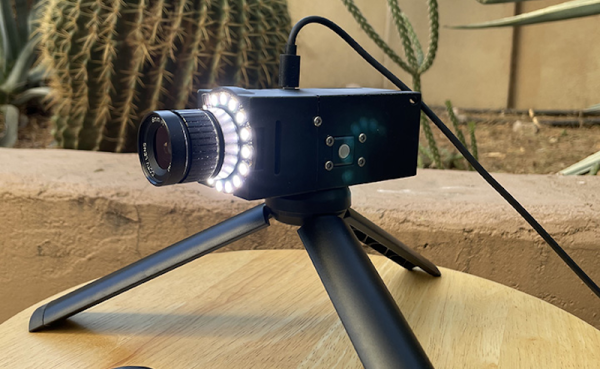
Vizy The AI Camera Aims To Ease Machine Vision

Cameras are getting smarter and more capable than ever, able to run embedded machine vision algorithms and pull off tricks far beyond what something like a serial camera and microcontroller board would be capable of, and the upcoming Vizy aims to be even smarter and easier to use yet. Vizy is the work of Charmed Labs, and this isn’t their first foray into accessible machine vision. Charmed Labs are the same folks behind the Pixy and Pixy 2 cameras. Vizy’s main goal is to make object detection and classification easy, with thoughtful hardware features and a browser-based interface.

Vizy can identify common birds with “Birdfeeder”, one of the several built-in applications that uses local processing only.

The usual way to do machine vision is to get a USB camera and run something like OpenCV on a desktop machine to handle the processing. But Vizy leverages a Raspberry Pi 4 to provide a tightly-integrated unit in a small package with a variety of ready-to-run applications. For example, the “Birdfeeder” application comes ready to take snapshots of and identify common species of bird, while also identifying party-crashers like squirrels.

The demonstration video on their page shows off using the built-in high-current I/O header to control a sprinkler, repelling non-bird intruders with a splash of water while uploading pictures and video clips. The hardware design also looks well thought out; not only is there a safe shutdown and low-power mode for the Raspberry Pi-based hardware, but the lens can be swapped and the camera unit itself even contains an electrically-switched IR filter.

Vizy has a Kickstarter campaign planned, but like many others, Charmed Labs is still adjusting to the changes the COVID-19 pandemic has brought. You can sign up to be notified when Vizy launches; we know we’ll be keen for a closer look once it does. Easier machine vision is always a good thing, because it helps free people to focus on clever ideas like machine vision-based tool alignment.