Xbox 360 Controller Remixed For Optimized FPS Play


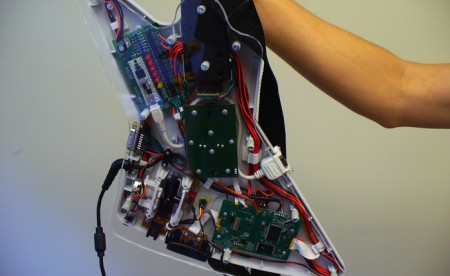
[F00 f00] of Acidmods was not satisfied with his first-person shooter gaming experience, so he modded an Xbox 360 controller so that A, B, X and Y buttons are on the underside of the controller, on the inside edges of the wings where the player’s fingertips usually go. He also moved the right thumbstick up a bit so that it would be level with the left one. He designed it to improve his ability to play first person shooters, but the advantages go beyond one genre of game. The right thumb is free to remain on the right thumbstick, and the colored buttons can be pressed by four fingers instead of just the right thumb. We love this mod for it’s simplicity and effectiveness, and we’re eagerly awaiting the internal photos he promised.

[via BB Gadgets]

Wii Fit Balance Board Controls Robot


More Wii Fit Balance Board hacks keep rolling in from Europe. We’re not sure we agree with [Juan Gonzales]’s assertion that the Wii Fit Balance board is the best way to control robots, but we can’t deny how fun it looks. [Gonzales] managed to control a robot of his own design with the balance board, making it turn when he leans to the sides and moving forward and back when he leans in those directions.

The robot, which he calls SkyBot, is fairly impressive in its own right, built from a PIC microcontroller and featuring various infrared sensors and 6 contact sensors. The robot’s OS can be controlled from Windows, OS X, or Linux, but for this project, they used Debian. The balance board interfaces with a laptop connected to SkyBot; custom software (tar.gz file) to make this work was written in python, and is available on [Gonzales]’s robot wiki, as well as instructions on how to build a SkyBot. It is in Spanish, however, so fire up Google Translate and get to work.

[via Balance Board Blog]

Wireless Arcade Stick


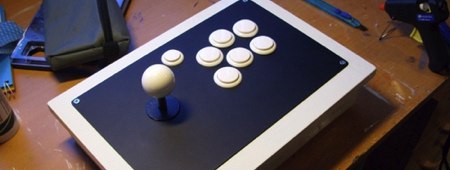
[astralpancakes] wireless arcade stick project looks like a great place to start if you want a simple project. Well constructed arcade sticks can cost $100+, but with all the MAME cabinet builders, the parts have become easy to acquire. The stick has a rigid wooden case with a metal faceplate. All of the component connections are soldered to the pads of a Logitech wireless controller. [astralpancakes] built this specifically to play Street Fighter III: 3rd Strike.

Playstation 2 Controller Analysis


The people at Near Future Laboratory are trying to spoof the behavior of a Playstation 2 controller using just a microcontroller. They wrote some initial code using the controller info found here, but decided the best way to figure out what was going on, was to probe the interface. They’re using a Logicport, which features 34 channels plus two clock channels. They only need six channels because the PS2 implements an SPI protocol plus an ACK line. The post is just a preliminary investigation, but will give you a little insight into how the Logicport works and why you might find it useful.

PSP L2/R2 Button Mod


This is quickly becoming an unintentional “game controller Saturday”. We haven’t been covering the PSP much lately, so this is a treat. AcidMods forum member [Electro] put together a quick guide for adding two missing shoulder buttons to the PSP. The L2 and R2 buttons are used while playing Playstation 1 games and are usually mapped to directions on the joystick. This mod jumps the joystick’s contacts an relocates the buttons to the shoulders. The switches used in the post seem kind of bulky, but you’re free to use anything that fits.

[via Engadget]

X2Wii, NES/SNES/N64 To Wii Adapter


If you poke around [Raphaël]’s site, the creator of today’s featured hack, you’ll find a lot of interesting projects. X2Wii is an ongoing project to adapt controllers from earlier console generations so they work with the Wii’s GameCube ports. He adapted his Multiuse tiny1 which uses an ATmega8. The code is all assembly so the microcontroller can keep up with the protocol. Definitely check out [Raphaël]’s other project pages.

LED Lightbar Controller

[youtube=http://www.youtube.com/watch?v=6ihIaNN9UBY&hl=en]
[Adam Grieg] recently posted this video of his LED lightbar controller at work making a strip of LEDs flash to the beat of his music. The controller does it by picking up the music via an electret microphone, then amplifying it with an LM386 Amp. The ATtiny13 microcontroller keeps track of the noise level and makes the LED array flash whenever it senses a peak.

In addition to the parts listed, [Grieg] used a small SparkFun box as the enclosure for the controller. If you’re considering trying your hand at this project, check out [Grieg]’s schematics and code. It’s relatively cheap to make, so it wouldn’t be that hard to rig up several of these set to flash at different frequencies.

[via SparkFun]