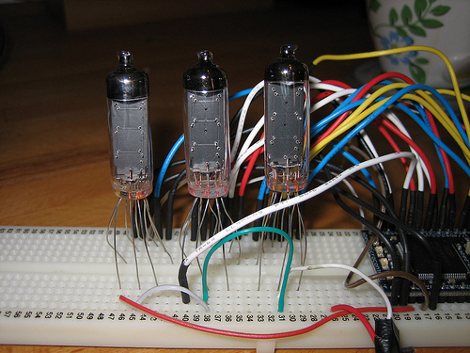
Internet Controlled Scrolling Numitron

How’s this for a first microcontroller project: a ticker that pulls messages from the Internet and scrolls them on a set of numitrons. [David Barton] built this using an mbed microcontroller. Tapping an ethernet library he got this to pull data from his server by connecting directly to the cat5 cables. The display consists of three numitrons which are incandescent 7-segment displays. In the video after the break you can see him sending messages to it from his iPod touch. This is just a PHP form that writes the submitted message to a file for the mbed to read. As [David] points out, there’s obvious Twittering applications here, but we just like the way it looks! Continue reading “Internet Controlled Scrolling Numitron”

Replacement Refrigerator Controller

[Michael] got his hands on a refrigerator that he intended to store beer in but found that it ran constantly. Instead of buying a new thermostat he and his friend [Doug] set out to build an Arduino-based controller for the fridge.

The finished project will switch 240v so they’ve used a transformer to power the logic circuitry and a solid state relay to handle the load switching, with a Dallas 1820 for temperature data. Because the Arduino offers more capabilities than the average thermostat hack they also decided to tap into its potential by adding an Ethernet shield. We see the Arduino as a prototyping device and so do these folks. Once the bugs in their first PCB prototype are worked out the circuit will use the ATmega328 and do away with the Arduino.

[via @littlebirdceo]

Temperature And Electricity Monitoring

[Willem] has been using an Arduino to monitor temperatures and electricity usage. For the temperature monitoring he picked up some 1-wire temperature sensors similar to those we’ve featured in the past. To pick up on electricity usage he’s not using an amp sensors, but because he’s in the UK he does have a flashing LED on his power meter. There’s a known trick to pick up these flashes with a photo cell to calculate energy usage based on meter readings. Finally, the data from the three sensors (indoor temp, outdoor temp, and energy usage) is piped over the Internet via an Ethernet shield so that it can be collected and graphed.

[Willem] has had the system running for a year. If you’re nosy you can look at the temperature graph generated from his collected data.

IPv6 To 1-wire Protocol Translator

[Fli] assembled an AVR based system that can assign IPv6 addresses to 1-wire components. An AVR ATmega644 microcontroller is used in conjunction with an ENC28J60 ethernet controller chip. To get up and running with IPv6 on this meek hardware [Fli] ported the uIPv6 stack from the contiki project over to the AVR framework. Although he encountered some hardware snafus along the way, in the end he managed to get five sensors connected to the device, each with their own IP assigned using the stack’s alias capability.

This is great if you’re looking for a low-cost IPv6 solution. We’re not sure if there’s much demand for that, but it’s useful for that 1-wire home automation setup you’re considering.

Roundup: Simple Hacks

simple-hack-110909

Here’s a collection of simple hacks you can do in between larger projects. After the break we’ll look at converting an iPod from hard drive storage to Compact Flash, build an LED desk lamp using LEGO and USB power for charging, and use an Arduino shield to add network control at the touch of a button.

Continue reading “Roundup: Simple Hacks”

Arduino “python” Integration

vivarium

[Cyberspice] informs us she likes snakes. Hey, who doesn’t? She’ll soon be adopting a lovely ball python and wanted to keep close tabs on the sensitive creature’s environment. To that end she assembled a network-enabled vivarium monitoring system based on Adafruit’s Boarduino (a minimalist Arduino clone), a TMP36 analog temperature sensor, Saelig’s WIZ810MJ Ethernet interface, and a common LCD screen. The Arduino rig periodically issues updates to a web server, which can then generate informative graphs using a set of PHP scripts (what, no Python?).

Okay, so we could probably count on one hand the number of readers in need of fancy reptile monitoring and still have fingers left over. There are countless other applications where networked sensor monitoring of this sort is a frequent necessity, so the article could be a good starting point for your own projects. There’s lots of source code to work with, on both the Arduino and web server sides. And the parts list demonstrates serious frugality: the Boarduino, the generic LCD, and especially the Ethernet interface; even with the breadboard adapter, this unit is about half the cost of the usual Arduino Ethernet shield, leaving more funds available for the snake food budget!

Arduino Email Alert

email

The Arduino makes a great platform for alert systems because it doesn’t need additional parts, other than an LED or motor. [Torchris] made email notifier, and used an Ethernet shield to make it standalone. The Arduino polls your POP server seeing if there are unread emails. POP is an incredibly simple protocol, even simpler than HTTP; this made it easy to communicate with, even with little processing power. He hopes to add a servo or serial display to present the data better, but his current system seems to work well. Video of it in action after the break.

Continue reading “Arduino Email Alert”