The Polyplasmic Archophone

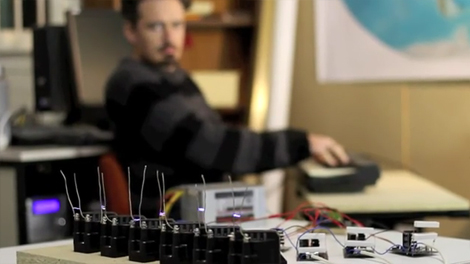
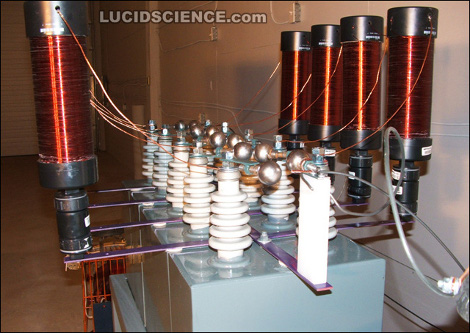
The polyplasmic archophone is a fresh approach to high voltage “arc music“. They are using  an Arduino clone to convert signals for the ignition coils. It is still unfinished, but the effect is decent. In the end it will have 2 tiers of voice coils for a total of 13. They are using different materials for the antenna so they can get different colors of sparks. You can see a video of it after the break and we must say the effect is quite nice. Change the lighting on that video and we could imagine this being the set to a [Joules Verne] movie.

Continue reading “The Polyplasmic Archophone”

Out Now: EL Coat, Coming Soon: EL Hat

[Render] says his coat is simply “enhanced with EL wire”, but we know the truth. He’s secretly an alien that can’t block out all of his glowing green skin with a the black coat. No? Fine,

You can put away the sewing machine, [Render] simply used a needle and fishing line to attach ~50-70 foot of electroluminescent wire to the outside of a coat he picked up at a local clothing shop. Solder and program in an inverter and controller board thanks to SparkFun, and you’re ready to go.

Just double check all your connections, high voltage directly on your person is not fun. Trust us.

Neon Binary Clock

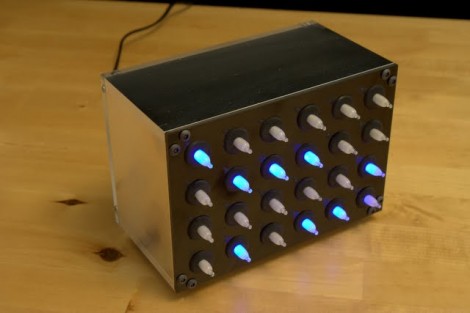
[Josiah] said ‘no’ to LEDs and instead used blue-phosphor neon lamps to build this binary clock. The ATmega328 inside uses three 8-bit shift registers to control the display. Each lamp needs a high-voltage NPN transistor in order to switch on the 150V necessary for proper illumination. A simple circuit was used to pull a 60 Hz clock signal out of the incoming 16VAC power. Unfortunately it was a bit too simple and didn’t provide a clean signal. [Josiah’s] workaround is something of a debounce subroutine in the firmware to prevent multiple interrupts on the falling edge.

The last project we saw from [Josiah] was the Coachella Lamp. That was a show piece of antiquated technology and this is another show piece with a minimalistic style. We also liked seeing the protoboard work on the inside. That’s a pretty jam-packed circuit board and keeping everything in the right place while you build up each trace with blobs of solder is no small feat.

Magically Repair AVR Chips

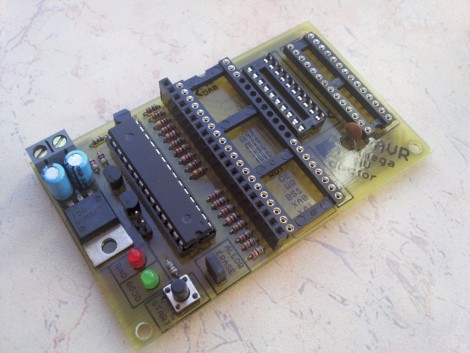
If you’ve ever spent time working with AVR microcontrollers you’ve probably set the fuse bits incorrectly at least once. The ATmega fusebit doctor will automatically repair the fuse bits and get you back in business until your next mishap. The ATmega8 that powers the device has the chip signatures for the ATmega family stored inside so it will automatically detect which chip you’re trying to ‘unbrick’. From there it looks up the correct fuse bits and resurrects the sick microcontroller. This is useful in recovering a chip that has serial programming disabled, used the reset pin as I/O, or just enabled an external clock without the necessary hardware to deliver on that feature.

This magic is taken care of by using High Voltage Parallel Programming. We’ve seen HVPP used in the Arduino rescue shield and it is a valuable feature of the AVR Dragon, our favorite AVR programmer, as well as others. Still, you can hardly beat the ease of plugging a dead chip into this board and pressing one button. Oh, did you brick a member of the ATtiny family? There’s a rescue board for those too.

[Thanks Stewe]

‘tiny’ Power Supply Monitor

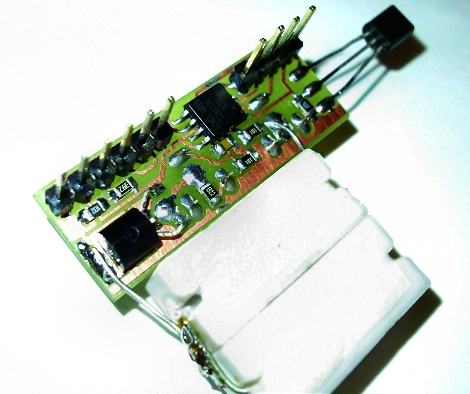
[Manekinen] built a power supply monitor based around an AVR ATtiny13. Voltage and amperage are displayed on a 16×2 LCD character display (we’re not sure what the third number is… samples per second?). This is no small feat considering that the tiny13 is an 8-pin chip. He makes it happen by using the pins for both LCD control and ADC input. To make this happen the HD44780 compliant display is used in 4-bit mode. Check out the video after the break and hit up the non-translated page if you want to download the source code and PCB artwork. A note of warning, he’s using the RESET pin for I/O which means once you burn the fuses you’ll need a programmer that has High Voltage Serial Programming capabilities if you want to reprogram the chip. Continue reading “‘tiny’ Power Supply Monitor”

Ionocraft Aka Lifters

It’s hard to believe that in five years we haven’t covered lifters before. This realization was sparked when [Tyler] tipped us off about a lifter project demonstrated at the Kansas City hackerspace called CCCKC.

Lifters, the casual name for ionocraft, fly without combustion or moving parts. We’re not going to tackle the particulars of what makes flight possible, but high voltage is required to feed the phenomenon that provides the lift. One of the first comments when we asked what to do with old CRT monitors was to use them for lifters. The flyback transformer puts out plenty of voltage if you can tap into it without killing yourself (no, seriously, that’s an issue).

This is the method that the CCCKC folks used. Take a peek at the video after the break. If you’re thirsting for more fun with lifters, stop by the Lifter Project.

Continue reading “Ionocraft Aka Lifters”

ArduiNIX: Nixie Shield For Arduino

ArduiNIX-nixie-shield

Flock of Butterflies has just published their third post in a series about the ArduiNIX, an Arduino shield that drives Nixie tubes.We’ve featured Nixie tube projects such as a single tube clock, free-formed Nixie circuits, and tubes in a bottle. Now the hurdle of handling high voltage tubes while protecting low voltage logic circuitry has been taken care of for you. The shield can be purchased as a kit but the Eagle CAD files are also available, allowing you to etch your own circuit board.

Although this is meant for the Arduino there is nothing to keep you from using it as a driver with any microcontroller. The board listens for 5V logic levels to switch the multiplexed display of up to eight tubes. Get your hands on some Nixies and give this a try yourself.

Related: ArduiNIX Part 1, ArduiNIX Part 2