Did Grandma Remember Her Pills? This Dispenser Tells You!

Everything has to be smart these days, and while smartening things up is a good incentive to tip your own toes into the whole IoT field, many of these undertakings are oftentimes just solutions looking for a problem. Best case, however, you actually make someone’s life easier with it, or help a person in need. For [Guli Morad] and [Dekel Binyamin], it was a bit of both when they built their automated pill dispenser: help people dependent on taking medication, and ease the mind of those worrying whether they actually remembered to.

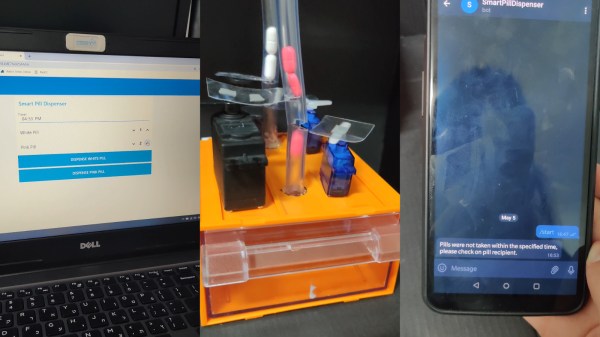
Using an ESP8266 and a rather simple construct comprised of a set of servos with plastic sheets attached, and a plastic tube with strategically placed cuts for each pill type, a predefined amount of each of the pills can be automatically dispensed into a box — either at a given time, or on demand — using a Node-RED web interface. A reed switch mounted on the box then monitors if it was actually opened within a set time, and if not, informs emergency contacts about it through the Telegram app. Sure, a tenacious medication recipient might easily fool the system, but not even adding a precision scale to make sure the pills are actually taken out could counter a pill-reluctant patient of such kind, so it’s safe to assume that this is primarily about preventing simple forgetfulness.

Their proof of concept is currently limited to only two different types of pills, but with enough PWM outputs to control the servos, this should be easily scalable to any amount. And while the built may not be as sophisticated as some pill dispensers we’ve seen entering the Hackaday Prize a few years back, it still gets its main task done. Plus, when it comes to people’s health, a good-enough solution is always better than a perfect idea that remains unimplemented.

Continue reading “Did Grandma Remember Her Pills? This Dispenser Tells You!”

Hackaday Podcast 067: Winking Out Of IoT, Seas Of LEDs, Stuffing PCBs, And Vectrex Is Awesome

Hackaday editors Mike Szczys and Elliot Williams explore the coolest hacks of the past 168 hours. The big news this week: will Wink customers pony up $5 a month to turn their lights on and off? There’s a new open source design for a pick and place machine. You may not have a Vectrex gaming console, but there’s a scratch-built board that can turn you oscilloscope into one. And you just can’t miss this LED sign technology that programs every pixel using projection mapping.

Take a look at the links below if you want to follow along, and as always, tell us what you think about this episode in the comments!

Direct download (60 MB or so.)

Continue reading “Hackaday Podcast 067: Winking Out Of IoT, Seas Of LEDs, Stuffing PCBs, And Vectrex Is Awesome”

How Much Is DIY Worth To You?

It all started with an article about Wink Labs putting a monthly fee on their previously free service. It wasn’t so much the amount they were asking ($5 / month) that raised my hackles, but rather the fact that they would essentially render a device that you ostensibly bought worthless unless you paid up. I’ve ranted about this enough recently, and the quick summary is that IoT companies seem very bad at estimating their true costs, and the consumer ends up suffering for it.

So I started thinking about the price myself. Is $5 per month for a home automation service a lot or a little? On one hand, if you stretch that out to, say, 10 years, you end up with a net present value of something north of $400, plus $70 for the device. That’s a lot, right? Surely, I could DIY myself a solution for less? Or am I falling into the same IoT trap?
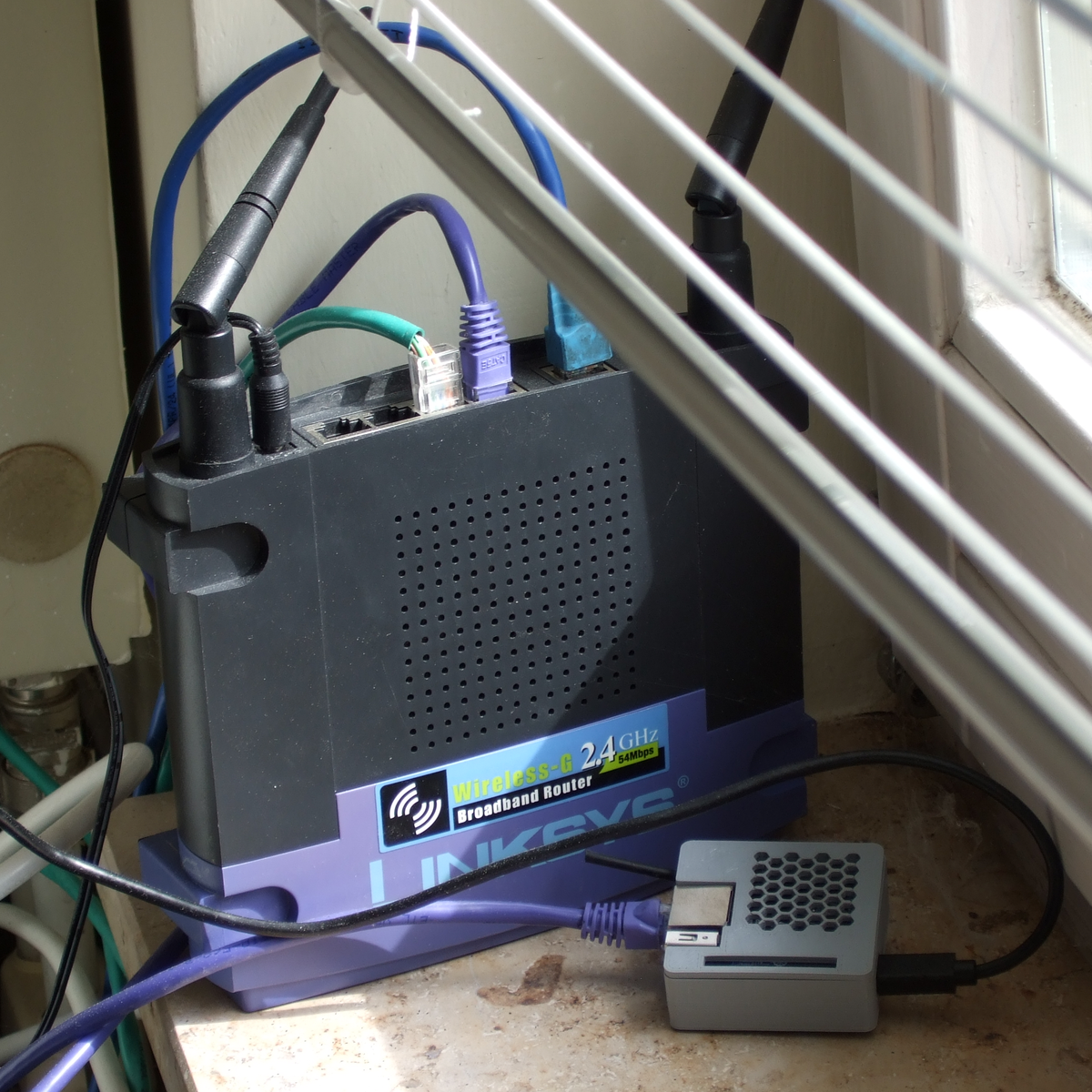
This isn’t hypothetical, because I already have a modest DIY home automation system. We run a bunch of switches, have temperature and humidity loggers in relevant rooms, and the washer and dryer notify us when they’re done. I also use the MQTT infrastructure for all sorts of fun projects, but that’s a bonus. Our hub is a $10 Orange Pi and a long-since depreciated WRT54g router, and it’s run for four years now, and probably will last another six. So that looks like $460 in my pocket.

On the other hand, it’s only really a bargain for me because I already knew what I was doing when I set the system up, and what I didn’t know I wanted to learn. Realistically, I probably spent around 20 hours on the system in total, but most of that has been adding in new devices and tweaking old ones. You’d have to do this sort of thing with any other system too, although my guess is that the professional systems are more streamlined at enrolling new gadgets: I have a whole directory full of Python scripts running as daemons and have to do a lot of hand editing. Still, assuming nothing else drastic happens to the system, I’m probably winning by DIYing here.

But imagine that I had little or no technical clue, and even flashing an image of a pre-configured home automation system to a Raspberry Pi were new. How much time does it take to learn how to do something like that? How much time to learn to administer even such a simple system on your home network? If it took the real me 20 hours, it could be easily twice that much for the hypothetical me. Let’s say 46 hours of time invested. $10 / hour is below minimum wage in many places, and this isn’t minimum wage labor, and that was fairly optimistic.

In the end, the $5 per month is probably pretty fair if the system works. Indeed, when I look around at all of the systems I’ve built, most all of them have taken more time to build than I thought when I was starting. Of course, I’ve enjoyed it most of the time, so maybe it’s not fair to apply my full consulting rates. (Which if I charged my father-in-law for tech support, I’d be rich!) But it’d probably be naive to say that everyone should just DIY themselves a home automation solution when the going gets tough.

So look around you and revel in the hours you’ve spent on your various DIY projects. Who knew that they were worth so much?

This article is part of the Hackaday.com newsletter, delivered every seven days for each of the last 200+ weeks. It also includes our favorite articles from the last seven days that you can see on the web version of the newsletter.

Want this type of article to hit your inbox every Friday morning? You should sign up!

Ask Hackaday: Wink Hubs, Extortion As A Service?

Wink Labs just announced that their home automation hub, the Wink Hub, is “transitioning to a $4.99 monthly subscription, starting on May 13, 2020.” Should you fail to pay the fiver every month, you will lose access to their app, voice control, and automations, which is everything it does as far as we can tell.

This is an especially bitter pill to swallow for Hub users, because the device was just that — a hub. It speaks Bluetooth, Z-Wave, ZigBee, WiFi, Kidde, and a couple other specific device protocols, interfaces with Amazon’s Alexa, has a handy Android master panel app, and had a nice “robot” system that made the automation side of “home automation” simple for normal people. In short, with its low one-time purchase price, compatibility with many devices, nice phone app, and multiple radios, it was a great centerpiece for a home-automation setup.

“Nice home automation system you’ve got there. Would be a shame if anything happened to it.”

Continue reading “Ask Hackaday: Wink Hubs, Extortion As A Service?”

New Contest Puts PSoC Boards In The Hands Of 50 Entries

Today marks the beginning of the PSoC IoT design contest. Show us your idea for an interesting Internet-connected thing and we’ll send you a dev kit to actually build it.

With the help of Cypress, Digi-Key, and AWS IoT we’ll be sending out your choice of  PSoC 6 WiFi-BT Pioneer kit or Prototyping Kit to up to 50 entries just for publishing a great idea of something to build with them. As you guessed from the name, these provide WiFi and Bluetooth connectivity, but they’re also bristling with seven programmable analog blocks the PSoC is known for, and a hundred GPIO. They have prototyping add-ons like a 2.4″ screen for user interface, audio, IMU, capacitive touch, and a heap of other goodies.

You have until May 26th to post a project page on Hackaday.io outlining your idea — don’t forget to use that “Submit project to” button to enter it in the contest. Tells us all about the IoT project you want to build and which PSoC 6 board you plan to use. If your idea is picked, we’ll send you the dev board and you’ll have until August to actually build your idea. Grand Prize will receive a $500 prepaid Visa card, two runners up will each receive a $250 card.

Full details are available on the contest page. We know you’ve always wanted to give your fish a Twitter account, to have a dashboard that shows up-to-the minute stats on how much Boo Berry Cereal you have left, a beacon to give you push alerts when the laundry needs to make its way into the dryer, or perhaps you plan to build a new wave of Internet-connect pagers. Whatever it is, from a silly idea to a truly life-improving build, if it’s begging to spread its data far and wide, it’s a perfect idea for this contest.

A Really Garbage Project

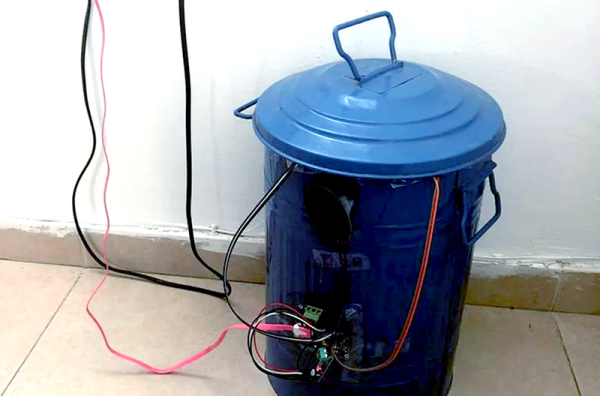
No matter who you are,  you produce garbage of some kind or another. Two students decided they wanted to create a smart garbage can that could alert them when the can is full or even when it is stinky.

We will go on on the record: we didn’t know that an alcohol sensor could tell if your garbage is stinky, so if that works, that’s a new one on us. However, it makes a certain kind of sense because garbage ferments. We thought garbage smelled because of hydrogen sulfide and methane.

Trash cans have a tough life, so if you really want to duplicate this, you’ll probably want to mount things a bit more securely. The software, however, runs everything through a cloud service and from there can use Blynk for a phone app and IFTTT to ship things to a spreadsheet, should you care to track your garbage history statistics.

Continue reading “A Really Garbage Project”

AvoRipe Takes A Firm Grip On The Ultimate First World Food Problem

You don’t have to be an extinct mammal or a Millennial to enjoy the smooth, buttery taste of an avocado. Being psychic on the other hand is definitely an advantage to catch that small, perfect window between raw and rotten of this divaesque fruit. But don’t worry, as modern problems require modern solutions, [Eden Bar-Tov] and [Elad Goldberg] built the AvoRipe, a device to notify you when your next avocado has reached that window.

Taking both the firmness and color of an avocado as indicators of its ripeness into account, the team built a dome holding a TCS3200 color sensor as stand for the avocado itself, and 3D printed a servo-controlled gripper with a force sensor attached to it. Closing the gripper’s arms step by step and reading the force sensor’s value will determine the softness the avocado has reached. Using an ESP8266 as centerpiece, the AvoRipe is turned into a full-blown IoT device, reporting the sensor readings to a smartphone app, and collecting the avocado’s data history on an Adafruit.IO dashboard.

There is unfortunately one big drawback: to calibrate the sensors, a set of nicely, ripe avocados are required, turning the device into somewhat of a chicken and egg situation. Nevertheless, it’s a nice showcase of tying together different platforms available for widescale hobbyist projects. Sure, it doesn’t hurt to know how to do each part from scratch on your own, but on the other hand, why not use the shortcuts that are at our disposal to remove some obstacles — which sometimes might include programming itself.

Continue reading “AvoRipe Takes A Firm Grip On The Ultimate First World Food Problem”