1btn – An Open Source Dash

The availability of cheap radios, omni-present WiFi and powerful web services means the IoT wave is here to stay. Amazon got into the act with its “do only one thing” Dash button. But a more interesting solution would be an IoT “do it all” button.

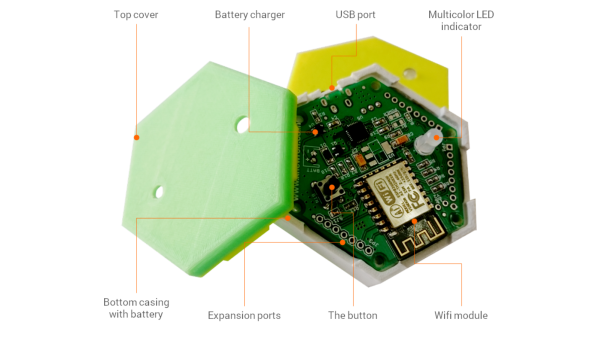
[Anand] has been working on his 1btn Open Source WiFi connected IoT button for a while. It connects to the Internet over WiFi to trigger whatever action you have assigned to it using a simple, online interface. It’s reconfigurable and open source. Which means it can be used in pretty imaginative ways, and if needed, can be re-flashed with your own custom firmware should you decide to really get under its hood.

The 1btn’s ESP8266 module is usually in sleep mode, waking up when the button is pressed, making the connection, performing the task and then going back to sleep once confirmation is received. A Red/Green LED indicates if the action was successful or not. You can set it up to send e-mails, messages, tweets or perform actions via a custom script, API or the IFTTT – maker channel. To make it hacker friendly, all of the ESP8266 GPIO pins are accessible via headers. This makes it convenient to add external sensors, for example. There’s also a (unpopulated) QFN footprint to allow adding an ATmega device (168P/328P) whose GPIO pins are also accessible via headers. This opens up a large number of additional applications for the device such as home automation.

On the software side, the 1btn connects to a web console, where you can set up an account, configure the device, register its MAC ID, assign it an alias and set up its actions. All of the source files for the 1btn – firmware, enclosure, schematic, BOM, PCB layout and example use cases – are posted on his Github repository.

The HackadayPrize2016 is Sponsored by:

Connect All Your IoT Through Your Pi 3

If you’re playing Hackaday Buzzword Bingo, today is your lucky day! Because not only does this article contain “Pi 3” and “IoT”, but we’re just about to type “ESP8266” and “home automation”. Check to see if you haven’t filled a row or something…

Seriously, though. If you’re running a home device network, and like us you’re running it totally insecurely, you might want to firewall that stuff off from the greater Interwebs at least, and probably any computers that you care about as well. The simplest way to do so is to keep your devices on their own WiFi network. That shiny Pi 3 you just bought has WiFi, and doesn’t use so much power that you’d mind leaving it on all the time.

Even if you’re not a Linux networking guru, [Phil Martin]’s tutorial on setting up the Raspberry Pi 3 as a WiFi access point should make it easy for you to use your Pi 3 as the hub of your IoT system’s WiFi. He even shows you how to configure it to forward your IoT network’s packets out to the real world over wired Ethernet, but if you can also use the Pi 3 as your central server, this may not even be necessary. Most of the IoT services that you’d want are available for the Pi.

Those who do want to open up to the world, you can easily set up a very strict firewall on the Pi that won’t interfere with your home’s normal WiFi. Here’s a quick guide to setting up iptables on the Pi, but using even friendlier software like Shorewall should also get the job done.

Still haven’t filled up your bingo card yet? “Arduino!”

Death, Taxes, And Laundry

There’s an old saying that the only two things that are certain are death and taxes. However, unless you live in a nudist colony, there’s probably also laundry. [Darpan Bajaj] and some friends were at a hackathon and decided to put their washing machine on the Internet.

Most of us here at Hackaday — and many Hackaday readers, judging by the comments — are a little suspicious about how much we really need everything attached to the Internet. However, a washing machine is probably not a bad idea: you use it often, you need to know when it is done, and you probably don’t want to just sit and watch it spin. Besides, the intended installation is in a hostel where there are multiple machines and many potential users.

Continue reading “Death, Taxes, And Laundry”

ESP8266 Based Irrigation Controller

If you just want to prevent your garden from slowly turning into a desert, have a look at the available off-the-shelf home automation solutions, pick one, lean back and let moisture monitoring and automated irrigation take over. If you want to get into electronics, learn PCB design and experience the personal victory that comes with all that, do what [Patrick] did, and build your own ESP8266 based irrigation controller. It’s also a lot of fun!

[Patrick] already had a strong software background and maintains his own open source home automation system, so building his own physical hardware to extend its functionality was a logical step. In particular, [Patrick] wanted to add four wirelessly controlled valves to the system.

Continue reading “ESP8266 Based Irrigation Controller”

Weight Tracking, Wise Cracking IoT Bathroom Scale

For those fighting the battle of the bulge, the forced discipline of fitness bands and activity tracking software might not be enough motivation. Some who are slimming down need a little gentle encouragement to help you lose weight and keep it off. If that sounds like you, then by all means avoid building this weight-tracking IoT scale with an attitude.

Then again, if you live in fear of your scale, [Jamie Bailey]’s version is easy to hate, at least when your numbers are going in the wrong direction. Centered around a second-hand Wii Balance Board talking to a Raspberry Pi via Bluetooth, the scale really only captures your weight and sends it up to InitialState for tracking and feedback. Whether the feedback is in the form of jokes at your expense is, of course, is entirely up to you; if you’d rather get gentle nudges and daily affirmations, just edit a few files. Or if your tastes run more toward “Yo momma so fat” jokes, have at it.

Bathroom scales are a good hacking target, whether it’s reverse engineering a digital scale or eavesdropping on a smart scale. This build is snarky good fun, and if nothing else, it’s good for pranking your roommate. Unless your roommate is your husband or wife, of course. That’s just – no.

Hack Corporate Overlords For Single Button Beer Delivery

[Brody Berson] is at it again, but this time he’s hacked the services floating in the aether around him to give him beer on demand. Finally the future we’ve been waiting for.

This hack is not as hacky as his first one, which, at the push of a button, could summon a bad driver straight to his house who would then give him pizza. The first one was done with a modified version of a button used to summon paper towels; because there’s nothing like needing paper towels RIGHT NOW, and then pushing a button to get them a few days later.

Apparently Amazon saw how practically no one was pushing the dish detergent button, but a lot of people were making scary mailboxes and magic pizza apps after ruthlessly scratching the branding off. So they shrugged and decided to sell the buttons as the newly branded (these get more hilarious when you don’t use the acronyms) Amazon, Amazon Web Services Internet of Things Button. Now your button can die along with the internet because Amazon is hosting your Raspberry Pi for a small fee, neat.

Anyway, [Brody] did some research on the best beer delivery services in his area, and went with one called Drizzly because they had a nice API. After integrating this system with Amazon’s, he can now push a button and minutes later, after subtracting some currencies from his account, a bad driver will show up and hand him beer.

Licence-Exempt Network Has High Ambitions

It’s safe to say that the Internet of Things is high on the list of buzzwords du jour. It was last seen rapidly ascending towards the Peak of Inflated Expectations on the Gartner Hype Cycle, and it seems that every startup you encounter these days is trying to place an IoT spin on their offering. Behind all the hype though lie some interesting wireless technologies for cheaply making very small microprocessors talk to each other and to the wider world.

Today we’d like to draw your attention to another wireless technology that might be of interest to Hackaday readers working in this area. UKHASnet is a wireless network developed from within the UK high-altitude ballooning community that uses cheap licence-exempt 868MHz radio modules in Europe and 915MHz in the Americas. The modules they are using have a surprisingly usable power output for licence exempt kit at 100mW, so the system has been designed for extensibility and bridging through nodes mounted on balloons, multirotors, or even seaborne buoys.

All UKHASnet packets are sent as human-readable plaintext ASCII, and the system borrows some of the features of amateur radio’s APRS. All packets are considered unreliable, all nodes repeat the packets they receive with their own node ID appended, and there are gateway nodes that make the packets available to the internet. There is a repeat number built into each packet to stop packets continuing ad infinitum.

Building a node is a simple process, requiring only the radio module, a microcontroller, and a battery. As examples they provide an implementation for the Arduino, and one for the LPC810 microcontroller. Their preferred radio module is the HopeRF RFM69HW, however the system will be capable of running on other modules of the same type.

So far the UKHASnet people have proven the system over a 65km range, created nodes on the sea, attached it to quadcopters, and built a host of other nodes.

This network differs from its commercial counterparts in that it has no proprietary IP or licencing from a standards body. And despite the name, you don’t have to be in the UK to use it. All data is in the clear, and thus it is likely that you won’t see it in mass-market commercial products. But it is exactly these features that are likely to make it attractive to the maker community. Your scribe will probably not be the only person who goes away from this article to suggest that their local hackspace finds the space for a UKHASnet node.

This is the first time we’ve featured UKHASnet here at Hackaday. Plenty of projects using licence-free radio modules have made it onto these pages, though, including this extreme-range remote controller for model aircraft, and this weather station sensor network that could have probably found UKHASnet useful had its creator had it to hand.