Weight Tracking, Wise Cracking IoT Bathroom Scale

For those fighting the battle of the bulge, the forced discipline of fitness bands and activity tracking software might not be enough motivation. Some who are slimming down need a little gentle encouragement to help you lose weight and keep it off. If that sounds like you, then by all means avoid building this weight-tracking IoT scale with an attitude.

Then again, if you live in fear of your scale, [Jamie Bailey]’s version is easy to hate, at least when your numbers are going in the wrong direction. Centered around a second-hand Wii Balance Board talking to a Raspberry Pi via Bluetooth, the scale really only captures your weight and sends it up to InitialState for tracking and feedback. Whether the feedback is in the form of jokes at your expense is, of course, is entirely up to you; if you’d rather get gentle nudges and daily affirmations, just edit a few files. Or if your tastes run more toward “Yo momma so fat” jokes, have at it.

Bathroom scales are a good hacking target, whether it’s reverse engineering a digital scale or eavesdropping on a smart scale. This build is snarky good fun, and if nothing else, it’s good for pranking your roommate. Unless your roommate is your husband or wife, of course. That’s just – no.

Hack Corporate Overlords For Single Button Beer Delivery

[Brody Berson] is at it again, but this time he’s hacked the services floating in the aether around him to give him beer on demand. Finally the future we’ve been waiting for.

This hack is not as hacky as his first one, which, at the push of a button, could summon a bad driver straight to his house who would then give him pizza. The first one was done with a modified version of a button used to summon paper towels; because there’s nothing like needing paper towels RIGHT NOW, and then pushing a button to get them a few days later.

Apparently Amazon saw how practically no one was pushing the dish detergent button, but a lot of people were making scary mailboxes and magic pizza apps after ruthlessly scratching the branding off. So they shrugged and decided to sell the buttons as the newly branded (these get more hilarious when you don’t use the acronyms) Amazon, Amazon Web Services Internet of Things Button. Now your button can die along with the internet because Amazon is hosting your Raspberry Pi for a small fee, neat.

Anyway, [Brody] did some research on the best beer delivery services in his area, and went with one called Drizzly because they had a nice API. After integrating this system with Amazon’s, he can now push a button and minutes later, after subtracting some currencies from his account, a bad driver will show up and hand him beer.

Licence-Exempt Network Has High Ambitions

It’s safe to say that the Internet of Things is high on the list of buzzwords du jour. It was last seen rapidly ascending towards the Peak of Inflated Expectations on the Gartner Hype Cycle, and it seems that every startup you encounter these days is trying to place an IoT spin on their offering. Behind all the hype though lie some interesting wireless technologies for cheaply making very small microprocessors talk to each other and to the wider world.

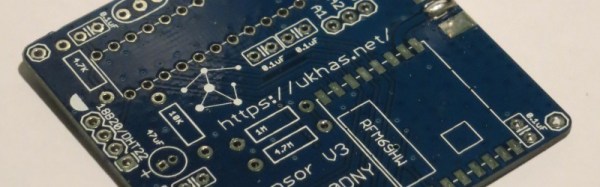
Today we’d like to draw your attention to another wireless technology that might be of interest to Hackaday readers working in this area. UKHASnet is a wireless network developed from within the UK high-altitude ballooning community that uses cheap licence-exempt 868MHz radio modules in Europe and 915MHz in the Americas. The modules they are using have a surprisingly usable power output for licence exempt kit at 100mW, so the system has been designed for extensibility and bridging through nodes mounted on balloons, multirotors, or even seaborne buoys.

All UKHASnet packets are sent as human-readable plaintext ASCII, and the system borrows some of the features of amateur radio’s APRS. All packets are considered unreliable, all nodes repeat the packets they receive with their own node ID appended, and there are gateway nodes that make the packets available to the internet. There is a repeat number built into each packet to stop packets continuing ad infinitum.

Building a node is a simple process, requiring only the radio module, a microcontroller, and a battery. As examples they provide an implementation for the Arduino, and one for the LPC810 microcontroller. Their preferred radio module is the HopeRF RFM69HW, however the system will be capable of running on other modules of the same type.

So far the UKHASnet people have proven the system over a 65km range, created nodes on the sea, attached it to quadcopters, and built a host of other nodes.

This network differs from its commercial counterparts in that it has no proprietary IP or licencing from a standards body. And despite the name, you don’t have to be in the UK to use it. All data is in the clear, and thus it is likely that you won’t see it in mass-market commercial products. But it is exactly these features that are likely to make it attractive to the maker community. Your scribe will probably not be the only person who goes away from this article to suggest that their local hackspace finds the space for a UKHASnet node.

This is the first time we’ve featured UKHASnet here at Hackaday. Plenty of projects using licence-free radio modules have made it onto these pages, though, including this extreme-range remote controller for model aircraft, and this weather station sensor network that could have probably found UKHASnet useful had its creator had it to hand.

Anti-Hack: Free Automated SSL Certificates

You want to put your credit card number into a web site. You know to look for a secure web site. But what does that really prove? And now that so many electronic projects have Web servers (ok, I’ll say it… the Internet of Things), do you need to secure your web server?

There was a time when getting a secure certificate (at least one that was meaningful) cost a pretty penny. However, a new initiative backed by some major players (like Cisco, Google, Mozilla, and many others) wants to give you a free SSL certificate. One reason they can afford to do this is they have automated the verification process so the cost to provide a certificate is very low.

Continue reading “Anti-Hack: Free Automated SSL Certificates”

Start Your Day The Arduino Way With This IoT Shower Controller

No longer content with adding value to the thermostat in the hallway or making your fridge smarter than it should be, IoT vendors are pushing into the inner sanctum of homes, the holy of holies – the bathroom. Sure, you can spend big bucks on an electronically controlled valve to turn your shower into a remote-controlled spa that shares your bathing habits with the cloud, but if you’re on a more modest budget and have the hacker spirit, you might want to check out this DIY automated shower valve with IoT features.

When we last ran into [TVMiller], he was opening gates using Jedi mind tricks, and before that he was shrinking a floating golf green to a manageable size. Such hacks work up a sweat, and while a clean hacker is a happy hacker, all that pesky valve-twisting and temperature-fiddling is so annoying. So with a few parts acquired from the waste stream, like an acrylic box, some salvaged servos, popsicle sticks, and a hell of a lot of caulk, [TVMiller] hacked together a feature-packed controller for his existing shower valves. An Arduino MKR1000 reads the water temperature and controls the servos that allow him to start the shower from his phone. Time and temperature data are sent to the cloud using ThingSpeak. You can see the whole thing in action in the mildly-NSFW video after the break.

Admittedly, this is a pretty janky setup, but it falls under the universal hacker disclaimer of “it’s just a prototype.” Still, we like the idea of retrofitting standard shower valves, and the popsicle-stick parallelograms for increasing leverage is a neat trick. We’ll be watching to see where this goes next.

Continue reading “Start Your Day The Arduino Way With This IoT Shower Controller”

Password Extraction Via Front Doorbell

Not a day goes by without another IoT security hack. If you’re wondering why you don’t want your front doorbell connected to the Internet, this hack should convince you.

The hack is unfathomably stupid. You press the button on the back of the unit that pairs the doorbell with your home WiFi network, and it transmits the password in the clear. Sigh. It’s since been fixed, and we suppose that’s a good thing, but we can’t resist thinking for a moment about an alternative implementation.

Imagine, like all previous non-IoT wireless doorbells, that the doorbell transmitted a not-very coded signal over an open frequency like 433 MHz to a receiver inside your home. Do the same with the video stream. Now the receiver can be connected to the Internet, and can be significantly more secure because it’s behind your locked front door. The attack surface presented to the outside world by the doorbell itself is small, and limited to faking a doorbell press or showing you pictures you don’t want to see. Yawn.

But because the outside doorbell unit could be connected to a network, it was. Now the attack surface extends into your home’s network, and if you’re like most people, the WiFi router was your only real defense.

Now we love the IoT, in principle. There are tons of interesting applications that need the sort of bandwidth or remote availability that the Internet provides. We’re just not convinced yet that a doorbell, or a fridge for that matter, meet the criteria. But it does add a hundred bucks to the price tag, so that’s good, right? What do you think? When does the risk of IoT justify the reward?

Thanks [Dielectric] for the tip!

Open Sesame, From A Galaxy Far, Far Away.

[TVMiller]’s description of his project is epic enough to deserve a literal copy-paste (something our readers often praise us about). In his own words,  “Having discovered several spare Midichlorians in my liquor cabinet, I trained and applied them to opening a large cumbersome gate. The FORCE motion travels through my inner what-nots and is translated by the Pebble Classic accelerometer toggling a command sent to the (Particle) Cloud (City) which returns to the Particle Photon triggering a TIP120 to fire a button on an existing RF transceiver. May the ridiculous hand gestures be with you, always.” Thus was born the Gate Jedi , and you’ll need exactly 47 Midichlorians, and some other trivial parts, to build one.

The Pebble watch hooks up to his android smart phone. A Pebble (android) app sends the accelerometer data to the Particle (previously called Spark) cloud service. From there, the data is pushed to the Photon IoT board which runs a few lines of code. Output from the Photon turns on a TIP120 power transistor, which in turn triggers the existing RF trans receiver that opens the Gate.

This looks way cooler than the Light Sabre hacks. Check out the video of him summoning the Force. And if you’d like to do more, try integrating gesture controls with this Pebble Watch hack that turns it into a home automation controller.

Continue reading “Open Sesame, From A Galaxy Far, Far Away.”