On-the-go Prototyping

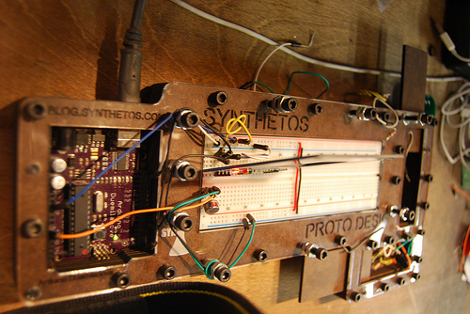
[Riley Porter] has been working on several different custom enclosure designs. Above, you can see his Proto Desk which holds a breadboard, Arduino, and has two recessed boxes with sliding tops for components and patch wires. He’s got a miniature version that gets rid of the breadboard, as well as slick-looking cases for the Bus Pirate, tinyISP, and face plates for word clocks.

Well, if you’ve got a laser cutter you should be using it right? We’ve seen [Riley’s] wares in the past; he wrote the guide for laser cutting solder stencils.

[Thanks Brian]
3D Laser Printer

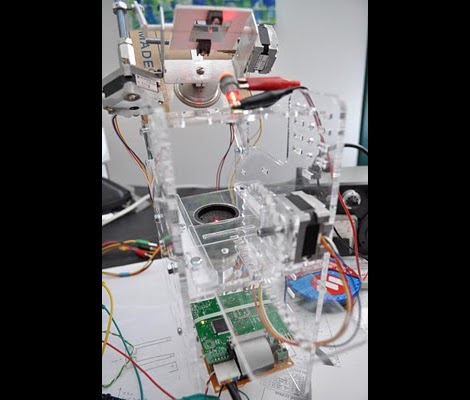
Working with easy replication in mind, [Peter] is building a 3D laser printer. The majority of the machine is made from laser-cut acrylic held together by parts that are inexpensive and available at your local hardware store. In the end this will lay down a layer of powder, use a laser to fuse the powder together in the outline of your choice, then repeat. This is known as selective laser sintering which is sometimes used in commercial rapid prototyping and, like a lot of other cool technologies, came into existence as a result of a DARPA project.

Sorry folks, this is not a fully functioning prototype yet. [Peter] is searching for the right laser for the job and a source for the powder. If you’ve got a solution please lend a hand and let’s see this project through to completion.

Die Bloodsuckers – Pew Pew

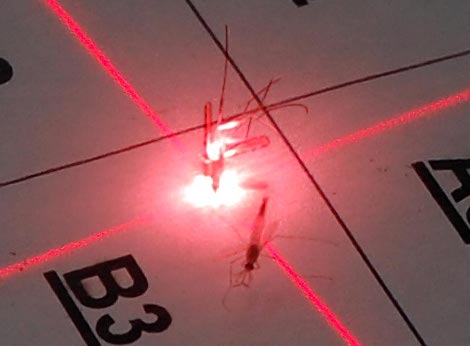
In a bid to combat malaria, Intellectual Ventures is developing a method of killing mosquitoes with lasers. The system is called a Photonic Fence and identifies the beasties by the frequency of their wing flapping (hey, that’s exactly how we know when they’re dive-bombing our heads). Once locked-on, it’s death to the filthy blood-suckers.

This story was latched onto by the gambit of news sources in the middle of 2009. Since then, the development team has added some pretty interesting info on their webpage. Last Feburary several videos of mosquito flight were posted. These were shot at 6000 fps using specially designed photographic rigs (probably much like this one) to make sure the shots were in focus. Now they’re slated to give a talk at the 2010 TED conference. The publication of these talks sometimes lags behind by several months so be patient. Watch the video after the break to get some abstract shots of the hardware being used; they’re not giving up the goods until the conference.

Continue reading “Die Bloodsuckers – Pew Pew”

Raise Your Hand If You Want To Listen To Something Else

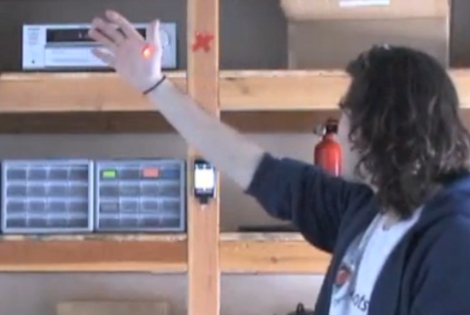
This track is awful, someone skip it! This project does just that with a wave of your hand. A laser beam shines across a room and, when obstructed, it sends a command to an iPod. One wave pauses playback, two waves skips to the next track, and a constant obstruction jumps backward one track.

They’re using a textile-compatible electronics platform called Schemer. This is the first time we’ve run across this product which uses a modular system to connect devices via a 1-wire communications bus.

No matter what hardware you use the concept is what interests us. There’s no shortage of iPod remote projects to draw on as examples. This method seems a bit more fun than banging your head for track changes or slapping wildly at an over-sized remote. We’re just a bit concerned about the power consumption of the laser-pointer, perhaps an IR beam would be a more economical choice?

RGV Laser

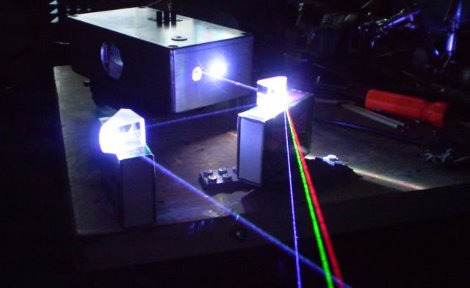
[Carl] sure has come a long way with laser modifications, now introducing his portable RGV Full Colour Laser. Although it feels just like yesterday when he showed us his green spiro and his Lego diffraction grating projector.

But enough of the past, the RGV laser is built using a White Fusion Mixing Kit and his own Full Colour Driver Extension. We couldn’t find any circuit diagrams or code to build your own at the moment, but it appears fairly straight forward and you can always take a look at [c4r0’s] Colour Laser.

Building A Bigger, Better Laser Engraver

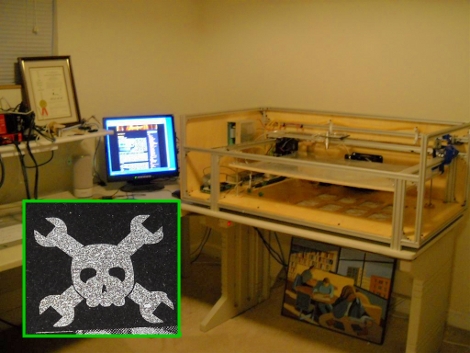
[Bart] built a giant laser etcher from scratch. One of his first test engravings included the Hackaday skull-and-wrenches on a polished granite floor tile (we love it when people do that). He used an XMOS controller and Mach3 CNC software to handle the device. With just two axes to worry about this seem like an easy project. The difficult bit is controlling, cooling, and focusing the laser.  Oh, and if you screw up, you could be blinded, burned or horribly maimed. But if you start from the beginning you’ll see that [Bart] knows what he’s doing.

SpiderBot Prompts Laser Envy

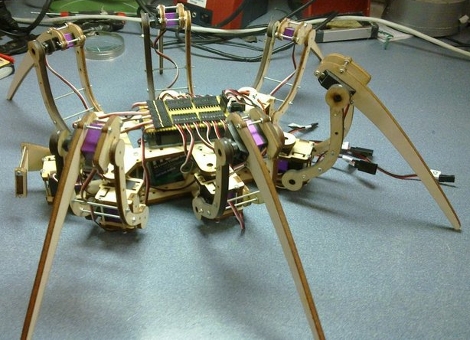
[Daniel’s] horrifying hexapod makes us wish we were sitting next to a laser cutter. The parts are cut from 4.9mm plywood and include laser-sculpted sections to allow the twenty servos to properly seat in their mounting spaces. We would suggest that you build it in secret so as not to ruin the surprise when your house mates come home to find this romping around their room.

Sadly, we couldn’t find video of this in action but go look at this other hexapod if the still shots aren’t good enough. Adding two legs to the party, you behold the video after the break of the 8-legged spider milled from ABS.

Continue reading “SpiderBot Prompts Laser Envy”