Lego Machine Uses Machine Learning To Sort Itself Out

In our opinion, the primary evidence of a properly lived childhood is an enormous box of every conceivable Lego piece, from simple bricks to girders and gears, all with a small town’s worth of minifigs swimming through it. It takes years of birthdays and Christmases to accumulate a Lego collection best measured by the pound, but like anything worth doing, it’s worth overdoing.

But what to do with such a collection? Digging through it to find Just the Right Piece™ can be frustrating, and bringing order to the chaos with manual sorting is just so impractical. How about putting some of those bricks to work with a machine-vision Lego sorter built from Lego?

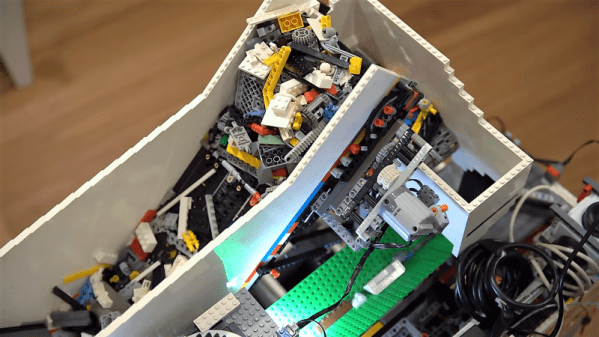
[Daniel West]’s approach is hardly new – we’ve even featured brick-built Lego sorters before – but we’re impressed by its architecture. First, the mechanical system is amazing. It uses a series of conveyors to transport bricks from a hopper, winnowing the stream down as it goes. The final step is a vibratory feeder that places one piece on a conveyor at a time. Those pass under a camera attached to a Raspberry Pi, where OpenCV does background subtraction from the video stream, applies bounding boxes to the parts, and runs the images through a convolutional neural network (CNN) that’s been trained on a database of every Lego part. Servo-controlled gates then direct the parts into one of 18 bins. See it in action in the video below.

We must admit that we’re not sure what the sorting criteria are, as some bins seem nearly as chaotic as the input mix. Still, we appreciate the fine engineering, and award extra style points for all the Lego goodness.

Continue reading “Lego Machine Uses Machine Learning To Sort Itself Out”
Simulate City Blocks With Circuit Blocks In A LEGO Box

Have you ever looked around your city’s layout and thought you could do better? Maybe you’ve always wanted to see how she’d run on nuclear or wind power, or just play around with civic amenities and see how your choices affect the citizens.

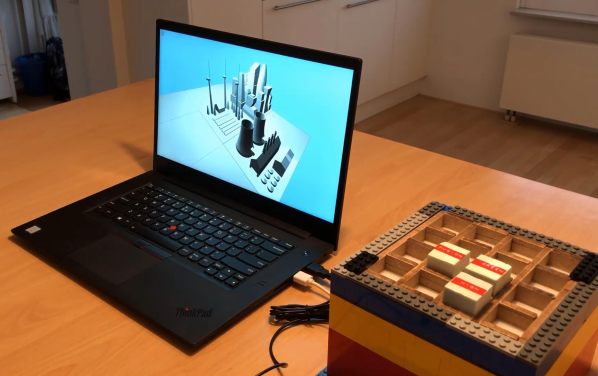
[Robbe Nagel] made this physical-digital simulator for a Creative Programming class within an industrial design program. We don’t have all the details, but as [Robbe] explains in the video after the break, each block has a resistor on the bottom, and each cubbyhole has a pair of contacts ready to mate with it. An Arduino nestled safely in the LEGO bunker below reads the different resistance values to determine what block was placed where.

[Robbe] wrote a program that evaluates various layouts and provides statistics for things like population, overall health, education level, pollution, etc. As you can see after the break, these values change as soon as blocks are added or removed. Part of what makes this simulator so cool is that it could be used for serious purposes, or it could be totally gamified.

It’s no secret that we like LEGO, especially as an enclosure material. Dress it up or dress it down, just don’t leave any pieces on the floor.

Continue reading “Simulate City Blocks With Circuit Blocks In A LEGO Box”

LEGO And Minecraft Team Up For Custom Gaming PC Case

There are probably few parents who haven’t watched their kids sitting on the floor, afloat on a sea of LEGO pieces and busily creating, and thought, “If only they could make a living at that.” But time goes on and kids grow up, and parents soon sing the same refrain as the kids sit transfixed by the virtual equivalent of LEGO: Minecraft.

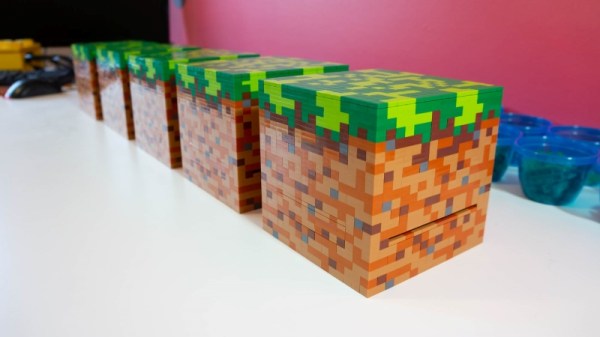
Finding a way to monetize either LEGO or Minecraft is a bit difficult for the young enthusiast; combining both obsessions into a paying proposition would be a dream come true. [Mike Schropp] did it, and this Minecraft-themed LEGO computer case was the result. Intel wanted a LEGO case for their new NUC mini-PC motherboard, and as a sponsor of the Minefaire event, the case needed to be Minecraft themed.

[Mike] chose the block that any Enderman would choose: the basic grass block. Each of the ten cases he made for the show had about 1000 of the smallest LEGO pieces available, to recreate the texture of the grass block in all its faux 8-bit glory. The 4″ x 4″ (10cm x 10cm) 8th Gen NUC board was a great fit for the case, which included slots for ventilation and SD card access, plus pop-out covers to access the board’s ports. It’s not exactly a screamer, but playing Minecraft on a grass block made from LEGO bricks is probably worth the performance hit.

We’ve seen [Mike]’s work a time or two here, most recently with a full-scale LEGO rack-mount server. Our hats off to him for another fun and creative build, and for proving that you’re never too old to LEGO. Or Minecraft.

Custom Lego Server Case Looks As Though It Came Straight From A Data Center

The picture above appears to show two unremarkable 2U rack servers, of the kind that are probably hosting the page you’re reading right now. Nothing special there – until you look carefully and realize that the rack server case on the left is made entirely from Lego. And what’s more, the server even works.

When it comes to building Lego computers, [Mike Schropp] is the guy to call. We’ve previously featured his Lego gaming computer, a striking case wrapped around what was a quite capable machine by 2016 standards, as well as an earlier case that reminds us a little of a NeXT. His reputation for Lego-clad computers led server maker Silicon Mechanics to commission a case for a trade show, and [Mike] jumped at the challenge.

Making a home-grade machine is one thing, but supporting all the heavy drives, power supplies, and fans needed to make the machine work is something else. He used a combination of traditional Lego pieces along with a fair sampling of parts from the Lego Technics line to pull off the build, which looks nearly perfect. Sadly, the Lego unit sizes make the case slightly taller than 2U, but that’s a small quibble when everything else matches so well, even the colors. And the fact that the server works, obviously important for a trade show demo, is pretty amazing too. The power supplies are even hot-swappable!

Congratulations to [Mike] on yet another outstanding Lego creation.

Lego House: Right Next To Denmark’s Legoland, But Way Cooler

If there is one thing that most Hackaday readers will know about Denmark, it is that it’s the home of the Lego brick. The toy first appeared at the end of the 1940s from the factory of Ole Kirk Christiansen‘s Lego company in Billund, central Denmark, and has remained inseparable from both the town and the country ever since.

When spending a week in Denmark for the BornHack hacker camp it made absolute sense to take a day out to drive up to Billund and visit the famous Legoland theme park. All those childhood dreams of seeing the fabled attraction would be satisfied, making the visit a day to remember.

Your first view of the Lego House, in the centre of Billund.

The Danes at Bornhack however had other ideas. By all means go to Legoland they said, but also take in Lego House. As a Brit I’d never heard of it, so was quickly educated. It seems that while Legoland is a kid’s theme park, Lego House is a far more Lego-brick-focused experience, and in the view of the Danish hackers, much better.

Continue reading “Lego House: Right Next To Denmark’s Legoland, But Way Cooler”

Lego-Powered Sub Built In A Water Jug

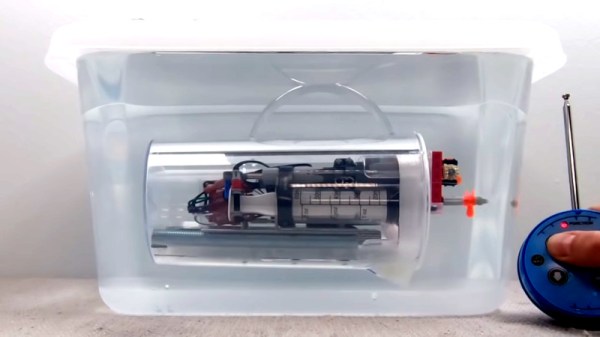
Submarines are universally considered cool, but bring several challenges to the RC modeller that aren’t there with land and air builds. Water ingress can ruin your project, and there’s always the possibility of it sinking to the bottom, never to return. That didn’t phase [Brick Experiment Channel], however, and thus a Lego sub was born. (Video embedded below the break.)

The sub uses a water jug as a hull. The video steps through the process of sealing the hull itself, before dealing with sealing the rotating propeller shafts. A large syringe is used as a ballast tank, with Lego motors used to actuate the tank and provide propulsion and steering. An existing RC submarine is cannabilized for parts, providing the necessary radio control hardware.

In testing, the sub performs admirably, with a few final tweaks necessary to improve the performance of the propellers. It’s not winning any races anytime soon, but it’s a functional underwater explorer that we’d love to take down the lake ourselves sometime.

We’ve seen Lego subs built before, even including missiles.

Continue reading “Lego-Powered Sub Built In A Water Jug”

Custom Bases Make LEGO Spacecraft Even Cooler

If you’re reading Hackaday, we’re willing to bet that you either own the LEGO Saturn V and Lunar Module models, or at the very least know somebody who does. Even if you thought you’d finally outgrown playing with little plastic bricks (a critical mistake, but one we’ll ignore for now), these two kits just have an undeniable appeal to them. You might never get a chance to work for NASA, but you can at least point to the Saturn V rocket hanging on your wall and say you built it yourself.

[Ben Brooks] thought these fantastic models deserved equally impressive stands, so he built “exhaust plumes” that both craft could proudly perch on. With the addition of some RGB LEDs and a Particle Photon to drive them, he added incredible lighting effects that really bring the display to life. There are also sound effects provided by an Adafruit Audio FX board, and for the Lander, an LCD display that mimics the Apollo Guidance Computer DSKY that astronauts used to safely navigate to the Moon and back.

In his write-up on Hackaday.io, [Ben] makes it clear that he was inspired by previous projects that added an illuminated column of smoke under the LEGO Saturn V, but we think his additions are more than worthy of praise. Playing real audio from the Apollo missions that’s synchronized to the light show honestly makes for a better display than we’ve seen in some museums, and he even rigged up a wireless link so that his neighbor’s kids can trigger a “launch” that they can watch from their window.

For the Lunar Module, he 3D printed an enclosure for the Photon and Adafruit quad alphanumeric display that stands in for the DSKY. There’s even lighted indicators for the 1201/1202 program alarms that popped up as Neil Armstrong and Buzz Aldrin descended to the lunar surface 50 years ago.

While many of us aren’t old enough to have our own first hand memories of the Moon landing, projects like this prove that the incredible accomplishments of the Apollo program never fail to inspire. Who knows? Those kids that are watching [Ben]’s Saturn V from next door might one day get to make the trip themselves.

Continue reading “Custom Bases Make LEGO Spacecraft Even Cooler”