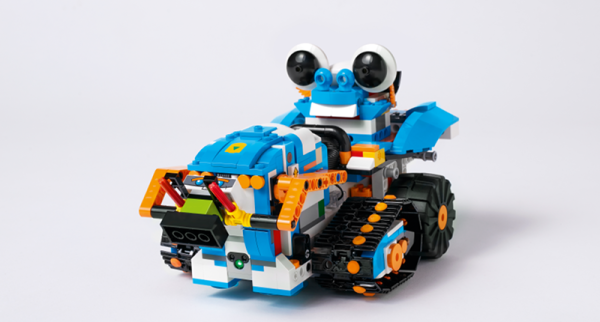
Kids often have their first exposure to robots in school using Lego Mindstorm kits. Now Lego is rolling out Boost — a robotic kit targeting all Lego builders from 7 years old and up. The kit is scheduled to be on the market later this year (it appeared at the recent CES) and will sell for about $160.
[The Brothers Brick] had a chance to try the kit out at CES (see the video below) and you might find their review interesting. The kit provides parts and instructions to build five different models: a cat, a robot, a guitar, a 3D printer, and a tracked vehicle. You can check out the official page, too.
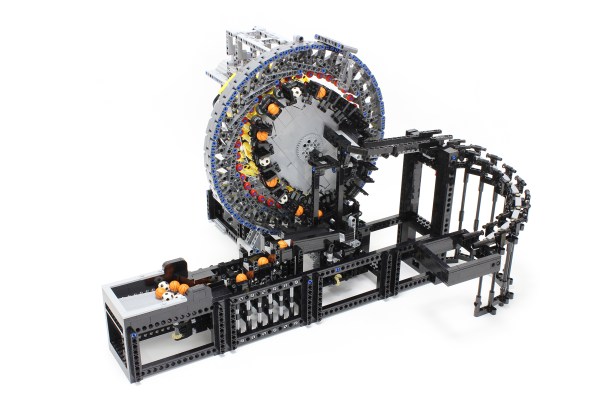
We are continually amazed by the things people do with LEGO and Technics, especially those that require incredible engineering skill. There’s an entire community based around building Great Ball Contraptions, which are LEGO Rube Goldberg machines that move tiny basketballs and soccer balls from one place to another. Except for a few rules about the input and output, the GBC horizons are boundless.
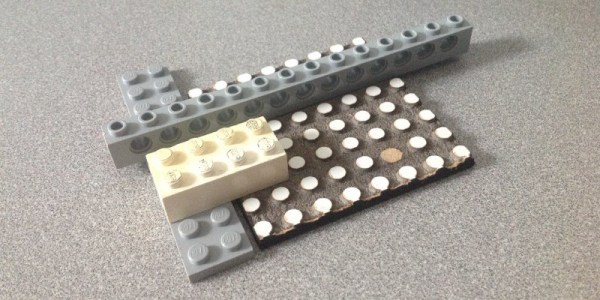
It’s hard not to be a fan of LEGO. The humble plastic bricks from Denmark enabled many a young engineer to bring their architectural and mechanical fantasies to life. But one limitation was that you were stuck using the bricks LEGO designed. Thankfully, [John Sokol] has come up with a way to laser cut his own LEGO-compatible bricks, and provided the tools so you can do the same.
After hacking an OpenSCAD script to generate just the top pins of the block, [John] exported an SVG into Inkscape so that he could scale the pins properly before exporting a final PNG for the lasercutter. Using RDWorks, [John] was able to find an engraving setting that worked well with dry-erase whiteboard MDF — an unusual material for a brick, but functional nonetheless. The key here is that the engraving setting takes away just enough material to create a raised pin on the part, without cutting all the way through the MDF or burning the surface.
Despite some damage when removing the work piece from the laser cutter, the part mates up well with the official LEGO brand parts. We’d be interested to see how the MDF cut parts hold up over time compared to real LEGO bricks made in ABS, which seem to last forever.
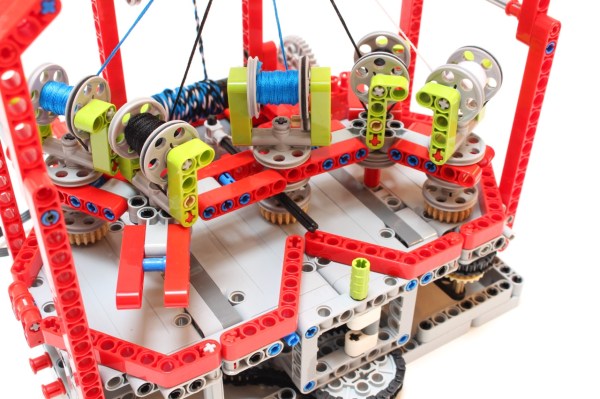
We love a good LEGO build as much as anyone, but Technics takes it to the next level in terms of creating working mechanisms. And nobody takes Technics as far as [Nico71], as evidenced by his super-fast Technics rope braiding machine.
The last time we saw one of [Nico71]’s builds, it was also a LEGO Technics rope-making machine. At the time, we called it a “rope-braiding machine” and were taken to task in the comments since the strands were merely twisted to make the final product. [Nico71] must have taken that to heart, because the current build results in true braided cordage. That trick is accomplished by flying shuttles that are not attached to either of the two counter-rotating three-spoked wheels. The shuttles are transferred between the two wheels by a sweeper arm, each making a full revolution with one wheel before being transferred to the other. Each shuttle’s thread makes an intertwining figure-eight around the threads from the two fixed bobbins, and the result is a five-strand braided cord. The whole machine is mesmerizing to watch, and the mechanism is silky smooth even at high speeds. It seems like a much simpler design than the previous effort, too.
You’ve got to hand it to builders like [Nico71] that come up with fascinating machines while working within the constraints of the Technics world. And those that leverage the Technics platform in their builds can come up with pretty neat stuff, like this paper tape reader for a music machine.
There are many kits available to today’s hobbyists who wish to try their hand at producing simple computer-controlled robots. Small concoctions of servos and laser-cut acrylic, to which boards such as the Arduino, Raspberry Pi, or Beaglebone can easily be fitted.
In the 1980s though this was a market that was yet to be adequately served. The sheer size of the many 8-bit machines of the day meant they could not be incorporated in your robot, and interfacing to them was a bit more challenging than the easy-to-use GPIOs of their modern counterparts. Then the mechanical hardware of a small robot was something that had not been easily and cheaply packaged for the constructor, making building a physical robotic platform a significant task in itself.
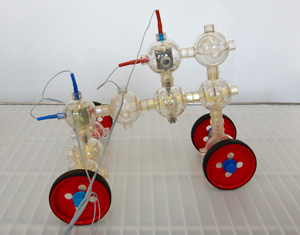
[Charlie] is a robot based on the Capsela construction system, a toy consisting of interlocking plastic spheres containing different functions of shafts, gears, and motors. There was a Robotic Workshop kit for Capsella that featured a Commodore 64 interface, and it is through this means that [Charlie]’s three motors are controlled. It includes a ROM that extends Commodore BASIC with extra commands, which allow the robot to be easily controlled.
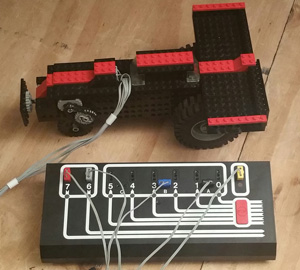
Artie the robot, with Dacta box in foreground
Meanwhile [Artie] is a Lego robot, using the Dacta TC Logo, a kit sold for the educational market and available at the time with interfaces for the PC and the Apple II. They had a Dacta control box but not the Apple II card to go with it, so had to make do with a functional replica built on a prototyping card. As the name suggests, this was programmed using Logo, and came with the appropriate interpreter software.
Both robots are reported to have been a success in terms of working in the first place, then demonstrating the 1980s technology and providing entertainment and engagement with the faire’s visitors.
We have covered numerous Lego robots over the years, as a search of our site will confirm. But this is only the second time we’ve featured a Capsela project, the first being this Arduino rover from 2011. [Mike] mused why we don’t see Capsela more often, and the same sentiment is true today. Do you have a Capsela set gathering dust somewhere that could make a robotic project?
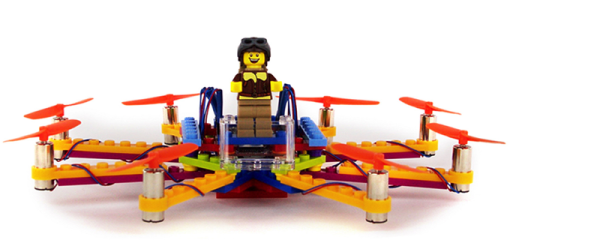
Building your own drone is a common enough pursuit among Hackaday readers. There are quite a few LEGO enthusiasts around, too. A company named Flybrix wants to marry those two pursuits and is offering a kit that allows you to build your drone out of LEGO bricks.
The company isn’t affiliated with LEGO. The kits look like they have some pretty common motors and control hardware. There are a few custom pieces, but the real key appears to be a LEGO compatible mount for the motors. You can see a video about the kit, below.
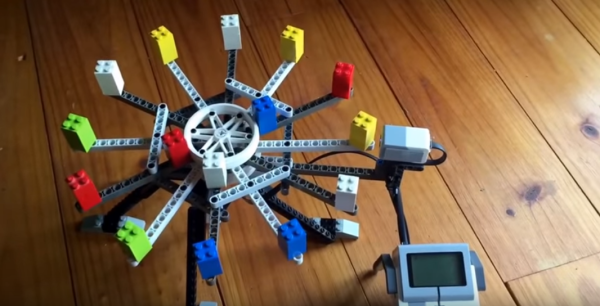
It combines elements from LEGO Mindstorms with regular blocks in order to make music with color. A different music sample is assigned to each of five colors: red, blue, green, yellow, and white. The blocks are attached to spokes coming off of a wheel made with NXT an EV3. As the wheel turns, the blocks pass in front of a fixed color sensor that reads the color and plays the corresponding sample. The samples are different lengths, so changing the speed of the wheel makes for some interesting musical effects.
As you’ll see in the short video after the break, [Rare Beasts] starts the wheel moving slowly to demonstrate the system. Since the whole thing is made of LEGO, the blocks are totally modular. Removing a few of them here and there inserts rests into the music, which makes the result that much more complex.