In the early 1990s, NASA experienced a sea change in the way it approached space exploration. Gone were the days when all their programs would be massive projects with audacious goals. The bulk of NASA’s projects would fall under the Discovery Project and hew to the mantra “faster, better, cheaper,” with narrowly focused goals and smaller budgets, with as much reuse of equipment as possible.
The idea for what would become the Mars InSight mission first appeared in 2010 and was designed to explore Mars in ways no prior mission had. Where Viking had scratched the surface in the 1970s looking for chemical signs of life and the rovers of the Explorer program had wandered about exploring surface geology, InSight was tasked with looking much, much deeper into the Red Planet.
Sadly, InSight’s primary means of looking at what lies beneath the regolith of Mars is currently stuck a few centimeters below the surface. NASA and JPL engineers are working on a fix, and while it’s far from certain that that they’ll succeed, things have started to look up for InSight lately. Here’s a quick look at what the problem is, and a potential solution that might get the mission back on track.
It’s been fifty years since man first landed on the Moon, but despite all the incredible advancements in technology since Armstrong made that iconic first small step, we’ve yet to reach any farther into deep space than we did during the Apollo program. The giant leap that many assumed would naturally follow the Moon landing, such as a manned flyby of Venus, never came. We’ve been stuck in low Earth orbit (LEO) ever since, with a return to deep space perpetually promised to be just a few years away.
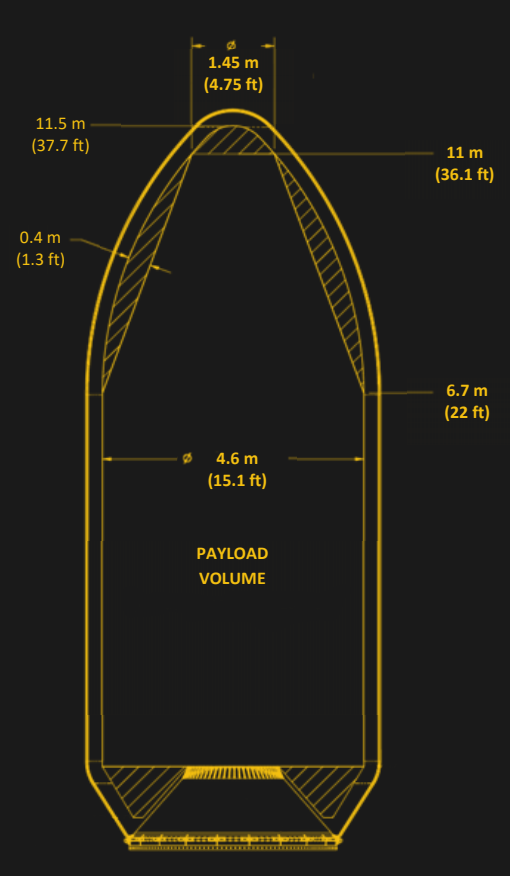
Falcon Heavy Payload Fairing
But why? The short answer is, of course, that space travel is monstrously expensive. It’s also dangerous and complex, but those issues pale in comparison to the mind-boggling bill that would be incurred by any nation that dares to send humans more than a few hundred kilometers above the surface of the Earth. If we’re going to have any chance of getting off this rock, the cost of putting a kilogram into orbit needs to get dramatically cheaper.
Luckily, we’re finally starting to see some positive development on that front. Commercial launch providers are currently slashing the cost of putting a payload into space. In its heyday, the Space Shuttle could carry 27,500 kg (60,600 lb) to LEO, at a cost of approximately $500 million per launch. Today, SpaceX’s Falcon Heavy can put 63,800 kg (140,700 lb) into the same orbit for less than $100 million. It’s still not pocket change, but you wouldn’t be completely out of line to call it revolutionary, either.
Unfortunately there’s a catch. The rockets being produced by SpaceX and other commercial companies are relatively small. The Falcon Heavy might be able to lift more than twice the mass as the Space Shuttle, but it has considerably less internal volume. That wouldn’t be a problem if we were trying to hurl lead blocks into space, but any spacecraft designed for human occupants will by necessity be fairly large and contain a considerable amount of empty space. As an example, the largest module of the International Space Station would be too long to physically fit inside the Falcon Heavy fairing, and yet it had a mass of only 15,900 kg (35,100 lb) at liftoff.
To maximize the capabilities of volume constrained boosters, there needs to be a paradigm shift in how we approach the design and construction of crewed spacecraft. Especially ones intended for long-duration missions. As it so happens, exciting research is being conducted to do exactly that. Rather than sending an assembled spacecraft into orbit, the hope is that we can eventually just send the raw materials and print it in space.
We humans are good at a lot of things, but making holes in the ground has to be among our greatest achievements. We’ve gone from grubbing roots with a stick to feeding billions with immense plows pulled by powerful tractors, and from carving simple roads across the land to drilling tunnels under the English Channel. Everywhere we go, we move dirt and rock out of the way, remodeling the planet to suit our needs.
Other worlds are subject to our propensity for digging holes too, and in the 50-odd years that we’ve been visiting or sending robots as our proxies, we’ve made our marks on quite a few celestial bodies. So far, all our digging has been in the name of science, either to explore the physical and chemical properties of these far-flung worlds in situ, or to actually package up a little bit of the heavens for analysis back home. One day we’ll no doubt be digging for different reasons, but until then, here’s a look at the holes we’ve dug and how we dug them.
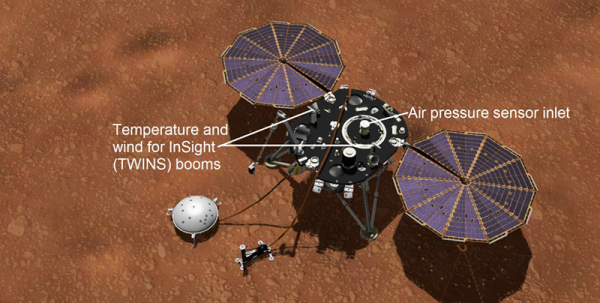
NASA’s latest Mars lander has a very precise weather package, and you can check the daily conditions on Elysium Planitia online. The data however has apparently led to a bit of a mystery. According to Ars Technica, every day at 7AM and 7PM local time, there’s an unexplained atmospheric pressure spike.
The TWINS (Temperature and Wind for InSight) package provided by Spain’s Centro de Astrobiología shows the little spikes regularly since the lander hit the ground in November. They seem to correspond to local sunrise and sunset. Keep in mind, the pressure on Mars is very low — about 1% of Earth’s atmosphere — and scientists have already ruled out instrument problems.
It’s been a long, long time since we heard from Opportunity, the remarkable Mars rover that has shattered all expectations on endurance and productivity but has been silent since a planet-wide dust storm blotted out the Sun and left it starved for power. Right now, it’s perched on the edge of a crater on Mars, waiting for enough sunlight to charge its batteries so it can call home. All we can do is sit, and wait.
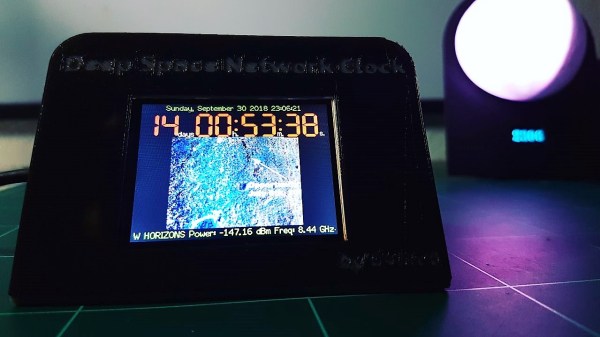
To pass the time until Opportunity stirs again, [G4lile0] built this Deep Space Network clock. Built around an ESP32 and a TFT display, the clock monitors the Deep Space Network (DSN) website to see if mission control is using any of the huge antennas at its disposal to listen for signals from the marooned rover. If the DSN is listening, it displays a special animation exhorting the rover to phone home; otherwise, it shows which of the many far-flung probes the network is communicating with, along with a slideshow of Mars mission photos to keep the spirits up. When the day finally comes that Opportunity checks in, an alarm will sound so [G4lile0] can pop the champagne and celebrate with the rest of us.
We realize that the odds that Opportunity will survive this ordeal are decreasing by the Sol. It’s an uphill battle; after all, the machine was 55 times its original 90-day design life when it went dark, so it’s an uphill battle. Then again, it has beaten the odds before, so there’s still hope.
Mars ain’t the kind of place to raise a kid. In fact, it’s cold as hell. There’s no one there to raise them if you did, or is there? Is there life on Mars? That’s the question NASA has been trying to answer for the last forty years, and with the new Mars rover, we might get closer to an answer. For this week’s Hack Chat, we’re going to be talking with the people responsible for some interesting instruments flying on the Mars 2020 rover.
Our guest for this week’s Hack Chat will be [Matteo Borri], an Italian engineer who’s been living in the US for the better part of a decade now. He’s had various projects ranging from robotics — including a BattleBot — AI, and aerospace. [Matteo] is also one of the engineers behind the Vampire Charger, a winner in the Power Harvesting Module Challenge in this year’s Hackaday Prize.
Right now, [Matteo] is working on an interesting project that’s going to fly on the next Mars rover. He’s developed a chlorophyll spectroscope for NASA and the Mars Society. This week, [Matteo] is going to share the details of how this device works and how it was developed.
During this Hack Chat, we’re going to be discussing various technology that’s going into the search for life on Mars and elsewhere in the galaxy such as:
Chlorophyll detection
Mars Rovers
Various other hardware hacks
You are, of course, encouraged to add your own questions to the discussion. You can do that by leaving a comment on the Hacking with Fire event page and we’ll put that in the queue for the Hack Chat discussion.
Everyone knows that space is an incredibly inhospitable place, but the surface of Mars isn’t a whole lot better. It’s a dim, cold, and dry world, with a wisp of an atmosphere that provides less than 1% of Earth’s barometric pressure. As the planet’s core no longer provides it with a magnetosphere, cosmic rays and intense solar flares bathe the surface in radiation. Human life on the surface without adequate environmental shielding is impossible, and as NASA’s fleet of rovers can attest, robotic visitors to the planet aren’t completely immune to the planet’s challenges.
Opportunity Mission Patch
As a planet-wide dust storm finally begins to settle, NASA is desperately trying to find out if the Red Planet has claimed yet another victim. The agency hasn’t heard from the Opportunity rover, which landed on Mars in 2004, since before the storm started on June 10th; and with each passing day the chances of reestablishing contact are diminished. While they haven’t completely given up hope, there’s no question this is the greatest threat the go-kart sized rover has faced in the nearly 15 years it has spent on the surface.
Opportunity was designed with several autonomous fail-safe systems that should have activated during the storm, protecting the rover as much as possible. But even with these systems in place, its twin Spirit succumbed to similar conditions in 2010. Will Opportunity make it through this latest challenge? Or has this global weather event brought the long-running mission to a dramatic close?