Hackaday Links Column Banner

Hackaday Links: October 18, 2020

Remember subliminal advertising? The idea was that a movie theater operator would splice a single frame showing a bucket of hot buttered popcorn into a movie, which moviegoers would see and process on a subconcious level and rush to the concession stand to buy the tub o’ petrochemical-glazed starch they suddenly craved. It may or may not work on humans, but it appears to work on cars with advanced driver assistance, which can be spoofed by “phantom street signs” flashed on electronic billboards. Security researchers at Ben Gurion University stuck an image of a stop sign into a McDonald’s ad displayed on a large LCD screen by the side of the road. That was enough to convince a Tesla Model X to put on the brakes as it passed by the sign. The phantom images were on the screen anywhere from an eighth of a second to a quarter second, so these aren’t exactly subliminal messages, but it’s still an interesting attack that bears looking into. And while we’re skeptical about the whole subliminal advertising thing in the first place, for some reason we really want a bacon cheeseburger right now.

Score one for the good guys in the battle against patent trolls. Mycroft AI, makers of open-source voice assistants, proudly announced their latest victory against what they claim are patent trolls. This appears to be one of those deals where a bunch of investors get together and buy random patents, and then claim that a company that actually built something infringes on their intellectual property. Mycroft got a letter from one such entity and decided to fight it; they’ve won two battles so far against the alleged trolls and it looks pretty good going forward. They’re not pulling their punches, either, since Mycroft is planning to go after the other parties for legal expenses and punitive damages under the State of Missouri’s patent troll legislation. Here’s hoping this sends a message to IP squatters that it may not be worth the effort and that their time and money are better spent actually creating useful things.

Good news from Mars — The Mole is finally completely buried! We’ve been following the saga of the HP³, or “Heat Flow and Physical Properties Package” aboard NASA’s Mars InSight lander for quite a while. The self-drilling “Mole”, which is essentially the guts of an impact screwdriver inside a streamlined case, has been having trouble dealing with the Martian regolith, which is simultaneously too soft to offer the friction needed to keep the penetrator in its hole, but also too hard to pierce in places where there is a “duricrust” of chemically amalgamated material below the surface. It took a lot of delicate maneuvers with the lander’s robotic arm to get the Mole back on track, and it’s clearly not out of the woods yet — it needs to get down to three meters depth or so to do the full program of science it was designed for.

If watching Martian soil experiments proceed doesn’t scratch your itch for space science, why not try running your own radio astronomy experiments? Sure, you could build your own radio telescope to do that, but you don’t even have to go that far — just log into PICTOR, the free-to-use radio telescope. It’s a 3.2-m parabolic dish antenna located near Athens, Greece that’s geared toward hydrogen line measurements of the galaxy. You can set up an observation run and have the results mailed back to you for later analysis.

Here’s a fun, quick hack for anyone who hates the constant drone of white noise coming from fans. Build Comics apparently numbers themselves among that crowd, and decided to rig up a switch to turn on their fume extractor only when the soldering iron is removed from its holder. This hack was executed on a classic old Weller soldering station, but could easily be adapted to Hakko or other irons

And finally, if you’ve never listened to a Nobel laureate give a lecture, here’s your chance. Andrea Ghez, co-winner of the 2020 Nobel Prize in physics for her work on supermassive black holes, will be giving the annual Maria Goeppert Mayer lecture at the University of Chicago. She’ll be talking about exactly what she won the Nobel for: “The Monster at the Heart of Our Galaxy”, the supermassive black hole Sagittarius A*. We suspect the talk was booked before the Nobel announcement, so in normal times the room would likely be packed. But one advantage to the age of social distancing is that everything is online, so you can tune into a livestream of the lecture on October 22.

ExoMy Is A Miniature European Mars Rover With A Friendly Face

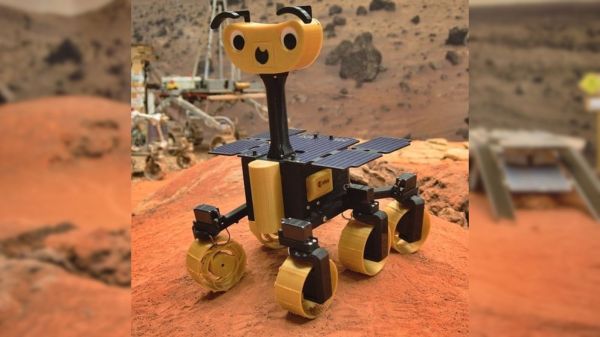
Over the past few weeks, a new season of Mars fever kicked off with launches of three interplanetary missions. And since there’s a sizable overlap between fans of spaceflight and those of electronics and 3D printing, the European Space Agency released the ExoMy rover for those who want to experience a little bit of Mars from home.

ExoMy’s smiling face and cartoonish proportions are an adaptation of ESA’s Rosalind Franklin (formerly the ExoMars) rover which, if 2020 hadn’t turned out to be 2020, would have been on its way to Mars as well. While Rosalind Franklin must wait for the next Mars launch window, we can launch ExoMy missions to our homes now. Like the real ESA rover, ExoMy has a triple bogie suspension design distinctly different from the rocker-bogie design used by NASA JPL’s rover family. Steering all six wheels rather than just four, ExoMy has maneuvering chops visible in a short Instagram video clip (also embedded after the break).

ExoMy’s quoted price of admission is in the range of 250-500€. Perusing instructions posted on GitHub, we see an electronics nervous system built around a Raspberry Pi. Its published software stack is configured for human remote control, but as it is already running ROS (Robot Operating System), it should be an easy on-ramp for ExoMars builders with the ambition of adding autonomy.

ExoMy joins the ranks of open source rover designs available to hackers with 3D printing, electronics, and software skills. We recently covered a much larger rover project modeled after Curiosity. Two years ago NASA JPL released an open source rover of their own targeting educators, inspiring this writer’s own Sawppy rover project, which is in turn just one of many projects tagged “Rover” on Hackaday.io. Hackers love rovers!


An Up-Close Look At The First Martian Helicopter

The news was recently abuzz with stories of how the Mars 2020 mission, which launched from Cape Canaveral at the end of July, had done something that no other spacecraft had done before: it had successfully charged the batteries aboard a tiny helicopter that is hitching a ride in the belly of the Mars 2020 rover, Perseverance.

Although the helicopter, aptly named Ingenuity, is only a technology demonstrator, and flight operations will occupy but a small fraction of the time Mars 2020 is devoting to its science missions, it has still understandably captured the popular imagination. This will be humanity’s first attempt at controlled, powered flight on another planet, after all, and that alone is enough to spur intense interest in what amounts to a side-project for NASA. So here’s a closer look at Ingenuity, and what it takes to build a helicopter that will explore another world.

Continue reading “An Up-Close Look At The First Martian Helicopter” →

What Is The Tianwen-1 Probe Saying?

A few days ago, the Chinese National Space Administration launched their Tianwen-1 mission to Mars from their launch site in the province of Hainan. It should arrive at the Red Planet in April 2021, when it will face the daunting task of launching a surface probe from its orbiting component, which will release a rover once it has reached the surface. Like all such missions it’s in constant contact with its controllers on the ground, and as with any radio transmissions floating through the aether its telemetry has been received by the radio hacker community and analaysed by [r00t].

Straight away there’s something interesting in the modulation scheme, instead of a carrier with modulation applied to it there is a main unmodulated centre carrier, and the data appears instead on a series of subcarriers. Is this a feature of its being a space probe, the unmodulated carrier making it easier to find and track in deep space?

They quickly find the telemetry carrier, and decode its frames. It carries a series of data sets, including positional and instrumentation data. From the positional data they can tell when the craft has made any course changes, and from the sensor data such as the solar sensor its movement can be deduced and graphed. It makes for a fascinating insight into the mission, and we’re grateful for the analysis.

Mars is a notoriously difficult target for space probes, somewhere that multiple missions have for various reasons failed to reach. We hope the Tianwen-1 mission is ultimately successful and that in time the Chinese space people will in due course be showing us some of the fruits of their labours. They’re not alone in launching this month, so we’ve got a plethora of Mars-related stories to look forward to next year.

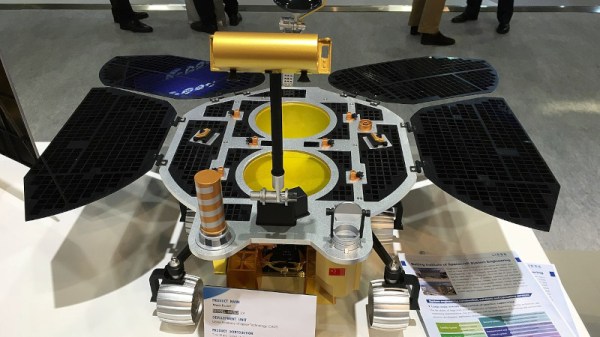
Header image: Tianwen-1 rover mockup. Pablo de León‎ / CC BY-SA 3.0

Window In The Skies: Why Everyone Is Going To Mars This Month

Mars may not be the kind of place to raise your kids, but chances are that one day [Elton John]’s famous lyrics will be wrong about there being no one there to raise them. For now, however, we have probes, orbiters, and landers. Mars missions are going strong this year, with three nations about to launch their rockets towards the Red Planet: the United States sending their Perseverance rover, China’s Tianwen-1 mission, and the United Arab Emirates sending their Hope orbiter.

As all of this is planned to happen still within the month of July, it almost gives the impression of a new era of wild space races where everyone tries to be first. Sure, some egos will certainly be boosted here, but the reason for this increased run within such a short time frame has a simple explanation: Mars will be right around the corner later this year — relatively speaking — providing an ideal opportunity to travel there right now.

In fact, this year is as good as it gets for quite a while. The next time the circumstances will be (almost) as favorable as this year is going to be in 2033, so it’s understandable that space agencies are eager to not miss out on this chance. Not that Mars missions couldn’t be accomplished in the next 13 years — after all, several endeavors are already in the wings for 2022, including the delayed Rosalind Franklin rover launch. It’s just that the circumstances won’t be as ideal.

But what exactly does that mean, and why is that? What makes July 2020 so special? And what’s everyone doing up there anyway? Well, let’s find out!

Continue reading “Window In The Skies: Why Everyone Is Going To Mars This Month” →

Hackaday Links Column Banner

Hackaday Links: June 14, 2020

You say you want to go to Mars, but the vanishingly thin atmosphere, the toxic and corrosive soil, the bitter cold, the deadly radiation that sleets down constantly, and the long, perilous journey that you probably won’t return from has turned you off a little. Fear not, because there’s still a way for you to get at least part of you to Mars: your intelligence. Curiosity, the Mars rover that’s on the eighth year of its 90-day mission, is completely remote-controlled, and NASA would like to add some self-driving capabilities to it. Which is why they’re asking for human help in classifying thousands of images of the Martian surface. By annotating images and pointing out what looks like soil and what looks like rock, you’ll be training an algorithm that one day might be sent up to the rover. If you’ve got the time, give it a shot — it seems a better use of time than training our eventual AI overlords.

We got a tip this week that ASTM, the international standards organization, has made its collection of standards for testing PPE available to the public. With titles like “Standard Test Method for Resistance of Medical Face Masks to Penetration by Synthetic Blood (Horizontal Projection of Fixed Volume at a Known Velocity)”, it seems like the standards body wants to make sure that that homebrew PPE gets tested properly before being put into service. The timing of this release is fortuitous since this week’s Hack Chat features Hiram Gay and Lex Kravitz, colleagues from the Washington University School of Medicine who will talk about what they did to test a respirator made from a full-face snorkel mask.

There’s little doubt that Lego played a huge part in the development of many engineers, and many of us never really put them away for good. We still pull them out occasionally, for fun or even for work, especially the Technic parts, which make a great prototyping system. But what if you need a Technic piece that you don’t have, or one that never existed in the first place? Easy — design and print your own custom Technic pieces. Lego Part Designer is a web app that breaks Technic parts down into five possible blocks, and lets you combine them as you see fit. We doubt that most FDM printers can deal with the fine tolerances needed for that satisfying Lego fit, but good enough might be all you need to get a design working.

Chances are pretty good that you’ve participated in more than a few video conferencing sessions lately, and if you’re anything like us you’ve found the experience somewhat lacking. The standard UI, with everyone in the conference organized in orderly rows and columns, reminds us of either a police line-up or the opening of The Brady Bunch, neither of which is particularly appealing. The paradigm could use a little rethinking, which is what Laptops in Space aims to do. By putting each participant’s video feed in a virtual laptop and letting them float in space, you’re supposed to have a more organic meeting experience. There’s a tweet with a short clip, or you can try it yourself. We’re not sure how we feel about it yet, but we’re glad someone is at least trying something new in this space.

And finally, if you’re in need of a primer on charlieplexing, or perhaps just need to brush up on the topic, [pileofstuff] has just released a video that might be just what you need. He explains the tri-state logic LED multiplexing method in detail, and even goes into some alternate uses, like using optocouplers to drive higher loads. We like his style — informal, but with a good level of detail that serves as a jumping-off point for further exploration.

Hackaday Links Column Banner

Hackaday Links: March 15, 2020

Just a few weeks ago in the Links article, we ran a story about Tanner Electronics, the Dallas-area surplus store that was a mainstay of the hacker and maker scene in the area. At the time, Tanner’s owners were actively looking for a new, downsized space to move into, and they were optimistic that they’d be able to find something. But it appears not to be, as we got word this week from James Tanner that the store would be shutting its doors after 40 years in business. We’re sad to see anyone who’s supported the hardware hacking scene be unable to make a go of it, especially after four decades of service. But as we pointed out in “The Death of Surplus”, the center of gravity of electronics manufacturing has shifted dramatically in that time, and that’s changed the surplus market forever. We wish the Tanner’s the best of luck, and ask those in the area to stop by and perhaps help them sell off some of their inventory before they close the doors on May 31.

Feel like getting your inner Gollum on video but don’t know where to begin? Open source motion capture might be the place to start, and Chordata will soon be here to help. We saw Chordata as an entry in the 2018 Hackaday Prize; they’ve come a long way since then and are just about to open up their Kickstarter. Check out the video for an overview of what Chordata can do.

Another big name in the open-source movement has been forced out of the organization he co-founded. Eric S. Raymond, author of The Cathedral and the Bazaar and co-founder and former president of the Open Source Initiative has been removed from mailing lists and banned from communicating with the group. Raymond, known simply as ESR, reports that this was in response to “being too rhetorically forceful” in his dissent from proposed changes to OSD, the core documents that OSI uses to determine if software is truly open source. Nobody seems to be saying much about the behavior that started the fracas.

COVID-19, the respiratory disease caused by the newly emerged SARS-CoV-2 virus, has been spreading across the globe, causing panic and claiming lives. It’s not without its second-order effects either, of course, as everything from global supply chains to conferences and meetings have been disrupted. And now, coronavirus can be blamed for delaying the ESA/Russian joint ExoMars mission. The mission is to include a Russian-built surface platform for meteorological and biochemical surveys, plus the ESA’s Rosalind Franklin rover. Program scientists are no longer able to travel and meet with their counterparts to sort out issues, severely crimping productivity and forcing the delay. Social distancing and working from home can only take you so far, especially when you’re trying to get to Mars. We wonder if NASA’s Perseverance will suffer a similar fate.

Speaking of social distancing, if you’ve already decided to lock the doors and hunker down to wait out COVID-19, you’ll need something to keep you from going stir crazy. One suggestion: learn a new skill, like PCB design. TeachMePCB is offering a free rigid PCB design course starting March 28. If you’re a newbie, or even if you’ve had some ad hoc design experience, this could be a great way to productively while away some time. And if that doesn’t work for you, check out Bartosz Ciechanowski’s Gears page. It’s an interactive lesson on why gears look like they do, and the math behind power transmission. Ever wonder why gear teeth have an involute shape? Bartosz will fix you up.

Stay safe out there, everyone. And wash those hands!