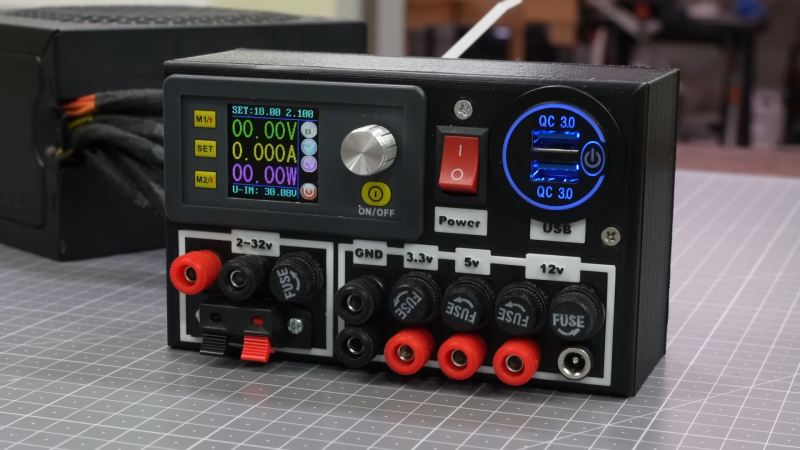
Bench power supplies can sometimes be frustratingly expensive and also kind of limited. If you’re enterprising and creative, though, you can create your own bench supply with tons of features, and it doesn’t have to break the bank either. Do what [Maker Y] did—grab an ATX supply and get building!
ATX power supplies work as a great basis for a bench power supply. They have 12 volt, 3.3 volt, and 5 volt rails, and they can supply a ton of current for whatever you might need. [Maker Y] decided to break out these rails on banana plugs for ease of access, and fused them for safety, too. But the build doesn’t stop there. [Maker Y] also added a buck-boost converter to provide a variable voltage output from 1 to 30 volts for added flexibility. As a nice final touch, the rig also features a pair of USB A ports compatible with Quick Charge 3.0, for keeping smart devices charged while working in the lab.
[Caelestis Workshop] also designed a fully enclosed version if you prefer that style. Check it out on Instructables.
No matter which way you go, it’s a pretty simple build, with a bunch of off-the-shelf parts tossed together in a 3D printed housing. Ultimately, though, it’s got more functionality than a lot of cheap off-the-shelf bench supplies. You can build it just about anywhere on Earth where you can get cheap eBay parts via post. Continue reading “Turning An ATX PSU Into A Variable Bench Supply”


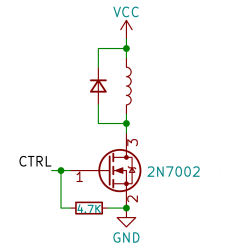 Perhaps, that’s the single most popular use for an NPN transistor – driving coils, like relays or solenoids. We are quite used to driving relays with BJTs, typically an NPN – but it doesn’t have to be a BJT, FETs often will do the job just as fine! Here’s an N-FET, used in the exact same configuration as a typical BJT is, except instead of a base current limiting resistor, we have a gate-source resistor – you can’t quite solder the BJT out and solder the FET in after you have designed the board, but it’s a pretty seamless replacement otherwise. The freewheel (back EMF protection) diode is still needed for when you switch the relay and the coil produces wacky voltages in protest, but hey, can’t have every single aspect be superior.