The above is a specially designed game controller made by [Giorgos] solely for the RTS game Men Of War (now that’s dedication to a game). [Giorgos] started off with a rough breadboard and 11 buttons. Slowly overtime he included a joystick, countdown timers, and the wonderfully lit case. Under the hood is a couple of PIC microcontrollers multiplexing the switches, LEDs, timers, and also interfacing with the computer via how is it not dead yet PS/2 port. The build log is a very detailed read and well worth it, even if you’re not planning on making a custom controller. [Ben Heck] better watch out, there is a new controller making enthusiast on the loose.
pc91 Articles
Build A Cutting Laser From An Old PC
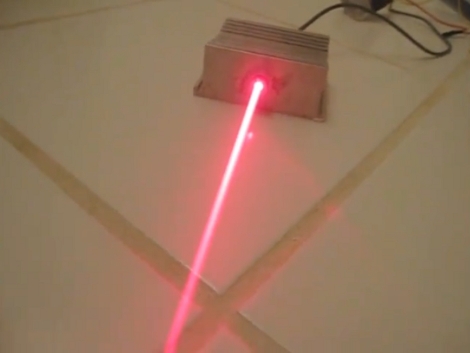
[Drake Anthony] makes building a cutting laser from a PC look easy, and it seems like it actually is. Almost everything you need can be found in a dead desktop unit. The diode is pulled from a DVD writer (16x or faster), with the power supply unit, and heat sinks from the processor and GPU being used as well. You’ll also need a focusing lens (just a few dollars), some thermal glue, an LM317, a resistor, and a pair of protective goggles matching the laser diode’s wavelength.
He fits the diode into the lens, then glues the assembly into a hole drilled through the processor heat sink. A driver is built using the LM317 variable regulator, resistor, power supply, and the GPU heat sink to keep things cool. Check out the video after the break to see the laser cutting tape, burning plastic, and lighting matches. Continue reading “Build A Cutting Laser From An Old PC”
Auxiliary Scoreboard Reads Status Directly From Memory

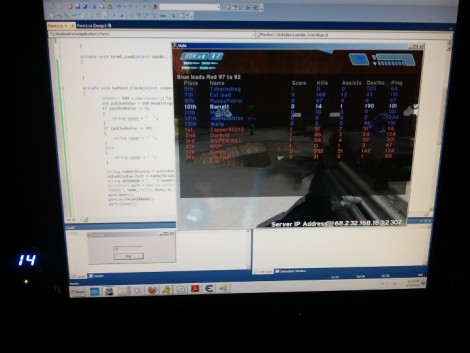
[StaticChanger] built a scoreboard to display his kill statistics from Halo for the PC. Yes, we’ve seen kill counters before, but we like the way that he gathers the data. This project is reading the score directly from an address in memory.
Using a program called Cheat Engine, the memory used by a program can be sniffed. After a few passes, the program will help you find a static memory address for your desired data. Once you have that it’s just a matter of using a pointer to that address in your desired programming language. In this case, a C# program polls the value and instructs an Arduino to display the value on a couple of 7-segment displays. Voila, the number appears next to your screen as you see in the image above.
Cray-inspired PC Case

35 years following its introduction, and despite fewer than 100 systems deployed, the Cray-1 remains one of the most recognizable computers in history; it is a timeless icon of pure supercomputer badassery. Custom case builder [Daryl Brach] pays homage to this classic with his third-scale model housing two modern PC motherboards.
In an interesting reversal, the base of the model — the upholstered bench that housed cooling and power distribution for the original Cray — holds the PC motherboards and storage, while the upper section is currently just for show but may house a water cooling rig in the future. The paint scheme is inspired by the Cray-1 on display at the Smithsonian, though Daryl’s model does make a few modern concessions such as LED lighting. Hinged panels in the base flip open to access the systems’ optical drives (perhaps to watch Tron on DVD).
The Cray-1 ran at 80 MHz and could house up to eight megabytes of memory…just about unfathomable performance in its day. It’s not clear what processors [Daryl] chose to outfit his system with, but regardless, even an entry-level modern PC doesn’t just run circles around its progenitor, it runs ray-traced glass spheres around it. Technology marches on, but good design never goes out of style.
Monster Chess

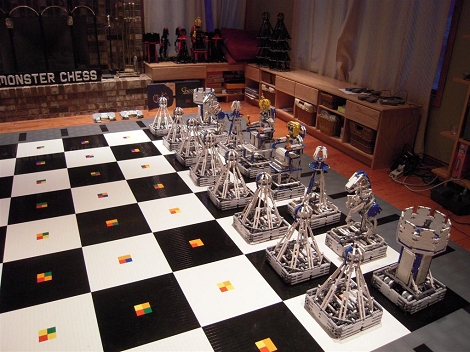
Over 100,000 Lego pieces, 4 people a year to create, and a 12 foot by 12 foot chess board make this the largest most awesome Lego hack we’ve ever seen. Take that Lego Printer.
For a mere $30,000 you too can have such a setup. Not a lot of information is out yet, but we do know all the pieces are remote controlled via a PC with LabVIEW and a total of 38 NXT controllers are used. Oh, and of course you can see it live at the 2010 Brickworld. Check out a video of a replayed game after the jump.
[via Geekologie]
CNC Brought To You By Zip Ties

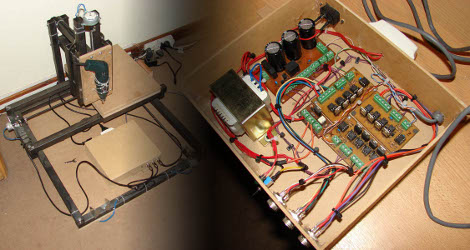
[lucassiglo21] let us know about his finished 3 axis CNC (Translation via Google). While home CNCs are nothing new, we really liked this masterpiece. The CNC is entirely custom, from the electronic control boards (connected to a PC via parallel port) to the physical mill (with an end result of 30x30x15cm workable area). Our favorite part is the use of screw/band clamp zip ties to hold the Dremel – a true showing of hacker geekyness. For those who haven’t seen a CNC drill a circle before (and honestly, who hasn’t?), check a video after the break.
Make A Mac On The Cheap

We’re not usually the type for PC case mods, but when we received the tip for the Macbook Mod of hiding a Macbook inside of two Linksys routers, we decided to make an exception on three accounts. [Tyler’s] original intent was acquiring a Mac, the total price for a full functioning system was a little over $200, and Macs aren’t PCs.
[Thanks Bluewraith]
But what if you want the mac experience and not the nitty gritty hassle of fixing logic boards, searching for long lost components, and modding a case? Then buy a Mac you might like [Useless Ninjas’] super cheap modification of an MSI Wind into Leopard running brute for only $240.
[Thanks Flyordie2]