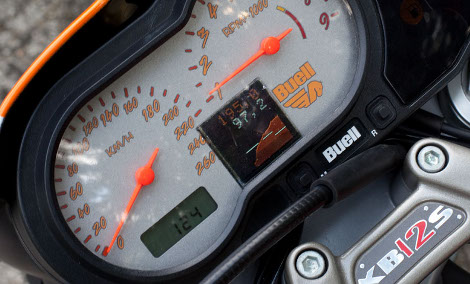
In-dash Motorcycle Display

[Muth] added an auxiliary display to his motorcycle instrument panel. He started out prototyping with a PIC 16F877A which he used to access information through the ECM diagnostic connection. Once he had that working he found this tiny display which fits perfectly between the speedometer and tachometer. There’s a short demo after the break where you can see a past-30-minute history of the Adaptive Fuel Value and the engine temperature as well as a secondary information screen.

This is another nice addition to our collection of vehicle displays, scooter controllers, gear indicators, and motorcycle computers.
Continue reading “In-dash Motorcycle Display”

Adventures In Consumer Electronics Control (CEC)

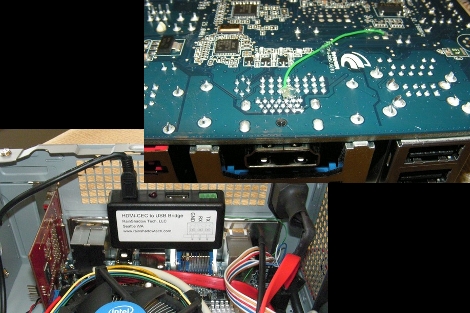
[Valkyrie-MT] was frustrated by the inability to control TrueHD audio volume from his computer. That’s because digital audio passes through the cable to the receiver where the volume adjustments are done. This meant that his RF computer remote was no good because the receiver uses an IR remote. He set out to find a way to get around this and ended up working with the Consumer Electronics Control (CEC) protocol.

The CEC protocol is a 1-wire serial bus built into the HDMI standard. The solution he settled up required one solder connection on the motherboard as well as the internal USB translator module seen above. That translator box, called the RainShadow, is a PIC 18F87J50 controlled board that translates incoming commands from the USB connection and sends them out as CEC hex codes. A bit of code writing and [Valkyrie-MT] is in business. You can see in the video after the break that it’s not just controlling audio, he can now control the entire entertainment center including turning on the TV and setting it to the appropriate input.

Continue reading “Adventures In Consumer Electronics Control (CEC)”

More Car Audio Input Hacking

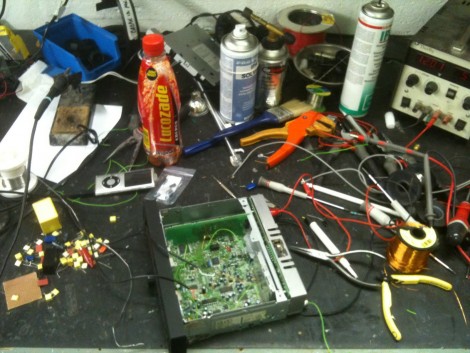
[Dave] pulled the head unit out of his dashboard to add an iPod input. He took a much more invasive route than the other hack we saw a few days ago. He actually patched into the audio lines going from the Dolby reader head chip to the amplifier.

The first step was to trick the deck into thinking it had a cassette inserted. He scoped an enable pin on one of the chips to discover the timing and emulated that signal using a PIC microprocessor. From there he popped off the chip that reads the tape data, patching directly into the audio out traces. This presented some noise issues when charging the iPod but [Dave] fixed that with some decoupling capacitors.

Miniscule Intervalometer

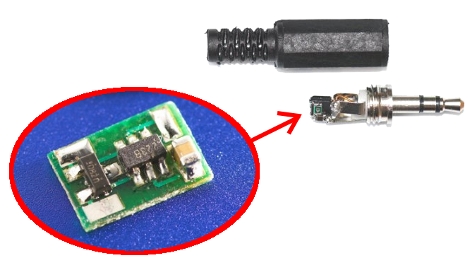
Calling this intervalomemter small would be a glaring understatement. It’s tiny enough to fit inside the plastic cover for a 2.5mm jack for use with a Canon DSLR camera. We should point out that the image we put together is a bit misleading. The picture of the jack is version 1 of this circuit and uses an 8-pin SOIC chip. The board in the oval is version 2, with a PIC 10f222 SOT23-6 package making it even smaller than the original version.

This is used for time-lapse photography. When plugged in the chip draws power from the camera. Get this: it learns the timing interval by listening for the first two images. Once you’ve snapped the first two pictures the PIC will continue to take images based on that initial delay. Amazing.

[Thanks AW via DIY Photography]

RGB VU Meter

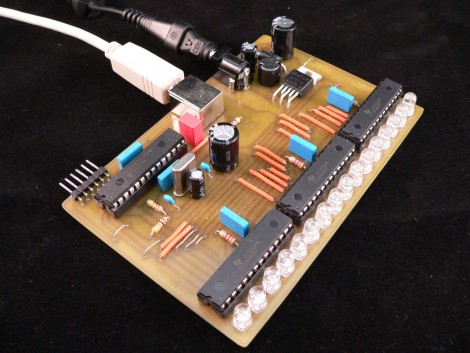
[Simon Inns] turned out this VU meter with a 16 RGB LEDs. He’s using three 16-bit TLC5940NTG LED drivers for the project. They’re not cheap chips but they do a great job. If you were looking to save on parts [Simon] found there’s more than enough brightness and any loss due to multiplexing would not be a problem. The device connects to a computer via USB thanks to the PIC 18F2550 which he’s used in his past VU meter projects. One of the design choices he made was to use a switching power supply. The LM2576 (datasheet) has no problem sourcing 3A at 5V and in addition to two electrolytic capacitors which are commonly used with linear regulators, you just need to add a diode and an inductor.

The meter offers several different configurations which are set on the PC side of things. These include the colors that are used and if the entire bars is used as one meter or split into sections to display both audio channels. Check it out after the break.

Continue reading “RGB VU Meter”

Extremely Organized Prototyping

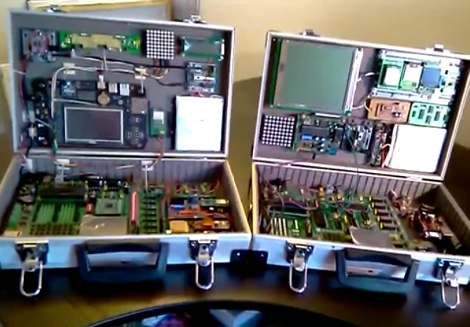
We’ve got a couple of very high-tech shoe boxes in which we store our prototyping accessories. You’ll find a collection of LCD modules, chips on breakout boards, switches soldered to homemade boards for easy breadboarding, and much more. That is assuming you can find anything in that mess of components.

[Shahriar] took a different approach. He’s mounted all of his prototyping gear inside of a briefcase. This large collection of high-end boards include PIC prototyping, various LCD screens, and a large portion of SparkFun’s stocked boards. It’s much more advanced than the Arduino to-go platform, and you can see a full walk through of the system after the break.

Continue reading “Extremely Organized Prototyping”

PIC Based Picture Frame

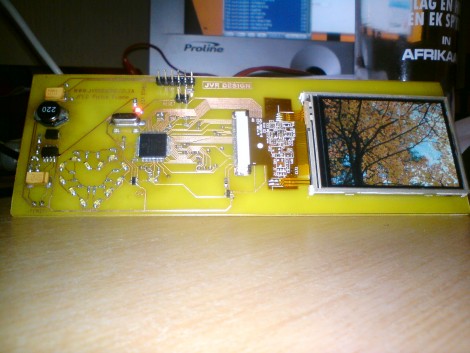
Take a PIC 24HJ256GP206 processor and add a dash of knock-off touchscreen and a pinch of SD card compatibility for a DIY digital picture frame. [Daniel] wrote his own driver for the HX8347 controlled LCD that can achieve 15 FPS at 320×240 resolution with 16-bit color. As this was a gift for his wife, [Daniel] included a heart-shaped ring of LEDs that fade in and out like an electronic pulse. He notes that the JPEG decoder runs rather slow but that’s mostly because of the bottleneck caused when accessing data from the SD card. We’ve got more pictures and a link to the source code after the break.

Continue reading “PIC Based Picture Frame”